Showing posts with label 1930. Show all posts

Thursday, February 25, 2021

05. Box Car Blues (1930)

Release date: December 1930

Series: Looney Tunes 

Director: Hugh Harman and Rudolf Ising

Starring: Bernard Brown (Bosko), Ken Darby (Pig)

The last short of 1930! Unlike previous Bosko cartoons, this one doesn’t have music as a priority. It’s more of a climax cartoon. Bosko and a pig are camping out in a boxcar, but the train goes downhill and the boxcar detaches from the train, sending Bosko and the pig uncontrollably hurtling down the railroad.

The short opens with a train chugging along on the railroad. I really love the animation here! Your typical rubber hose animation, but the stretchiness like in the drawing above is very charming and fun to watch in motion.

We’re now introduced to Bosko and a pig who are camping out in a boxcar, dancing and singing together. Not much to say, some catchy banjo picking and some jaunty dance moves.

Suddenly, Bosko and the pig are sent flying down to the end of the boxcar, flattening against the wall. the train is struggling to go up a very long hill. There are a few gags where the train scales various inclines and slides down them, with some lovely rubbery animation. 

A personal favorite gag of mine is when the tree is climbing a mountain and pulls down its pants, which the mountain angrily pulls them back up. It’s silly and out there, but a good little creative touch to break up any monotony.

The train makes it up the mountain once more, but one of the boxcars detaches and barrels down the opposite side of the mountain. it just so happens that that boxcar is the one inhabited by Bosko and the pig. 

There’s a sequence where Bosko sticks his head out from the top of the car, and his head is decapitated by a railroad crossing sign (first decapitating a mouse in Hold Anything and now this... brutal!). Nevertheless it’s a fun sequence, and it’s amusing to hear the sound of his head bouncing around to the beat of the music.

We then get this cool shot of Bosko heading down the hill and into a tunnel.
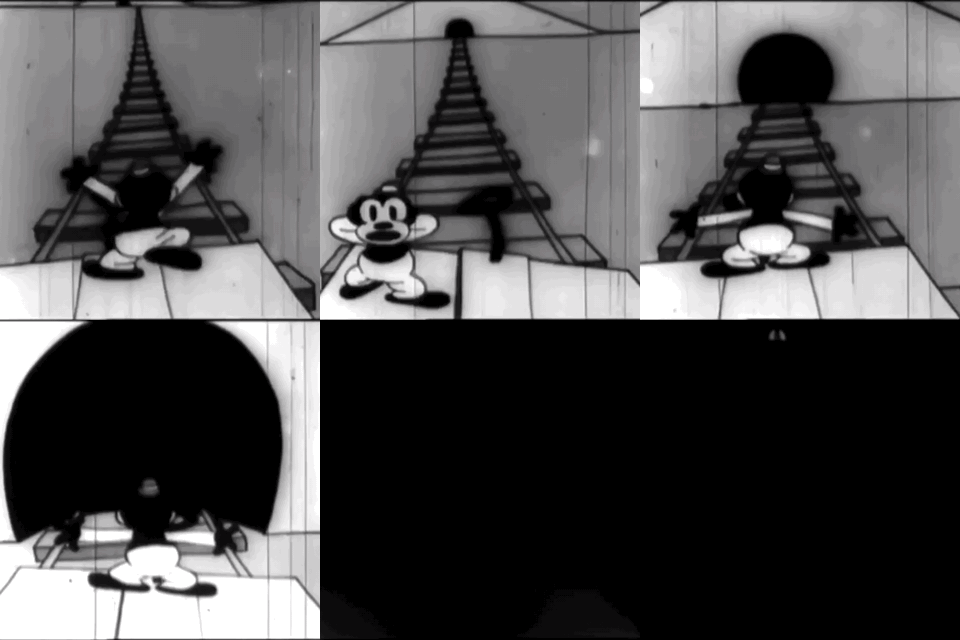
As always, gifs do it little justice, but it’s pretty dizzying to watch. It makes it a lot more interesting than just showing a side view of him entering a tunnel.

Bosko exits the tunnel unharmed, when two halves of the boxcar split open, with Bosko’s legs holding them together as they weave in and out, in and out. More fun animation to watch, especially when he stretches his neck out and turns it like a winch, bringing the two halves together again.

Another tunnel enters, and Bosko tumbles and slides down on top of it from the outside, landing on a cow at the end of the tunnel with the boxcar behind them. One more tunnel separates Bosko from the cow, and he lands back on top of the boxcar, which is headed straight for the cow.

More of the same chase sequence follows, with the cow mooing in distress and Bosko getting hurt, such as being dragged through trees and electricity poles. The whole chase sequence is rather lengthy and becomes a bit repetitive, which I think lessons the impact of the climax. Still has a lot of fun and stretchy animation though.

Finally, the sequence ends when the boxcar crashes into a tree, squishing the cow into an accordion shape who walks away unharmed but haughtily. 

We’re reminded of the pig’s existence, who, for some reason, was inexplicably absent during the entirety of the climax, as he and Bosko huddle under an umbrella, shielding themselves from falling debris. The debris stop, and the pig puts away the umbrella, before getting hit on the head with the banjo seen at the beginning of the short.

The pig begins to cry, but Bosko comforts him and starts to pick on the banjo, and the two of them head down the tracks on a remaining wagon, and they dissipate into the darkness of a tunnel as the short ends.

This cartoon is different from the previous Bosko cartoons, in that the focus isn’t really on music, but on climax. Of course the musical timing is all there, but there’s none of the inanimate objects/animals coming to life and being used as instruments. Personally, this cartoon isn’t my favorite—not bad by any means, but the climax takes up a good chunk of the cartoon, and with it being so stretched out it loses its impact and just feels repetitive. With that said, though, there’s a lot of fun, malleable animation, and I appreciate that they were being experimental by going for something other than a music based cartoon.

And that’s a wrap for 1930! I think out of the year, The Booze Hangs High is probably my favorite, with a lot of clever and unexpected gags. I don’t have any that I hate, but I did find this one to be rather boring since it’s approximately half of it is just Bosko getting hurt and the same gags being reused. Though, again, a nice change of pace from the previous musical cartoons! It makes me curious as to where the Bosko cartoons will go next!


04. The Booze Hangs High (1930)

Release date: December 1930 

Series: Looney Tunes 

Director: Hugh Harman and Rudolf Ising 

Starring: Bernard Brown (Bosko), J. Delos Jewkes (Pig, Horse)

Like so many of the Bosko cartoons, this short is a showcase of music in a barnyard setting (as opposed to the jungle or a construction site). The first half of the cartoon consists of Bosko dancing with animals and playing them like various instruments, while the second half includes a bunch of pigs getting drunk and singing obnoxiously.

The cartoon opens with Bosko dancing with a cow. The dancing is cut short as the cow’s pants (fur? Skin?) fall down, revealing a frilly blouse. Bosko laughs and the cow, obviously offended, stalks away.

Bosko now turns his attention to a horse, which he tunes and plays like a fiddle. It’s a very fun and charming scene with happy animation—a nice change of pace in the midst of The Great Depression.

Our attention is now turned elsewhere to a family of ducks dancing and hopping along. One of the ducklings stops and begins to look anxious, and whispers something to his mother. The mother unbuttons an invisible butt flap so the little duckling can defecate offscreen (no cartoon is complete without some bathroom humor) before marching back to his mother, clearly accomplished.

I know this was before the Hays Office, but wow! It’s a bit jarring to think of. Though it did it’s job effectively in bringing some laughs because I’m definitely amused by it. What’s a cartoon without some butt flaps? 

After some more musical antics we pan to a bunch of hungry pigs. Bosko pours the feed into the trough, and the pigs eat away. One of the pigs dives into the trough and proudly pulls out a bottle of liquor. The little pigs unscrew it and take turns taking swigs of alcohol and get drunk.

The father pig investigates the situation and takes a few drinks himself before bursting into a rousing, lyric-less rendition of “One Little Drink”. The deep bass of the pig’s voice singing nonsensically is hilarious and makes for a very corny and absurd yet charming scene. The pig tosses the bottle away...

Which lands on Bosko’s head, the impact causing HIM to become intoxicated, too. Together, Bosko and the pigs sing “Sweet Adeline”— the father pig even throws up a corn cob at one point before discreetly attempting to stow it back inside him, a very unexpected and strange gag, but amusing for that reason.

The cartoon irises out as they all dance together one last time.

This was actually a very enjoyable cartoon, probably my favorite so far! Intoxication would be commonly used as a source of humor in many cartoons, so it’s a pretty common theme. But it’s even more amusing to remember that this cartoon IS from 1930–still during prohibition. I really enjoyed the little touch of the pig glancing between his children and Bosko in the gif above, I love that they included that. It’s your typical “entertain the audience by synchronizing music and animation” and seems primitive and trite by today’s standards, but still holds up as a fun cartoon.


03. Hold Anything (1930)

Release date: October 1930 

Series: Looney Tunes 

Director: Hugh Harman and Rudolf Ising 

Starring: Bernard Brown (Bosko, Saw), Rochelle Hudson (Honey) 

The 3rd installment of Looney Tunes is loosely based off the film Hold Everything (which is now a lost film) and prominently features the song “Don't Hold Everything” as the centerpiece for the short, with Bosko and Honey dancing and making music to the song.

The cartoon opens with Bosko on a construction site, whistling and playing the riveter and other various construction tools as instruments.

He has a band of mice helping him lay some bricks (who all look like a certain obscure, unnoteworthy, hard to come by mascot I know—which makes sense, since Harman and Ising had previously worked at Disney). The mice all march away to the beat of the music as more dancing occurs.

One of the gags includes (rather morbidly) Bosko decapitating one of the mice and playing with it, sliding the mouse around on the saw until the two halves pop back together. I wonder what Walt would think of that.

More of the same dancing and music happens, when Bosko asks one of the mice to raise the construction beam. The mouse ties the rope around a goat and uses it as a pulley system. As Bosko ascends, he notices Honey typing away on a typewriter (again, to the beat of the music.) 

Bosko dances and whistles for her, prompting her to type out “Gee, you’re swell!” and show him the message.

Bosko plucks the suspension strings like a harp and uses the music notes that come out to bridge his way over to Honey, where he takes over on the typewriter and begins to play it like a piano.

Back at the bottom, the goat holding the beam in the air gets tired of the work and slips out from the rope. As all goats do, it sees a pair of construction whistles and decides to eat them. The steam from the whistles inflated the goat like a balloon, which Bosko uses to float back to the beam (which is still being supported somehow.) 

Bosko plays the goat like a pipe organ. As the goat starts to float away, Bosko, in an attempt to maintain a grip, grabs onto one of the goat’s udders. The goat sprays him with milk and Bosko falls to the ground, splits into a bunch of miniature versions of himself before coming back together for a happy end.

Not too much stands out to me with this cartoon, it’s your average cheery and charming musical short with some gags to accompany it. The musical score is pretty catchy, though! Again, falling into the decent category. Not bad, but not exactly riveting. I do like that these cartoons are so cheery and happy, though. It’s pretty hard to feel down watching them.


02. Congo Jazz (1930)

Release date: September 13th, 1930 

Series: Looney Tunes 

Director: Hugh Harman and Rudolf Ising 

Starring: Bernard Brown (Bosko) 

Congo Jazz stars Bosko as a hunter in the jungle, who gets himself out of various tricky situations with predators by enticing them with music. It’s the first cartoon where he speaks with a high, squeaky, Mickey Mouse-esque voice, which would serve as the basis for the voices of other upcoming "stars" (I use that term loosely) such as Buddy and Beans. Composer Bernard Brown is to thank--with Bosko's minstrel dialect now absent, Brown was chosen to supplement his voice instead.

Like any good cartoon, the short starts out with Bosko screaming off-screen. We fade into him tiptoeing through the jungle (quite reminiscent of Elmer Fudd) and randomly screaming every few steps in time with the music (NOT quite reminiscent of Elmer Fudd).

We see that Bosko is being followed by a hungry tiger, much to his oblivion. Soon enough, Bosko takes notice, because the tiger licks him. Terrified, Bosko attempts to shoot the tiger, but to no avail. A chase sequence ensues with some creative, rubber hose, stretchy gags, including this great frame:

Desperate to save his skin, Bosko brings out a clarinet (Well. An ambiguous pipe instrument) from his pocket and begins playing it to calm the tiger down. It works, and what started as a chase sequence now ends in a game of patty cake.

Bosko and the tiger depart, and Bosko notices two monkeys playing leap frog. Lured in by their cuteness, Bosko picks one of the monkeys up and begins to pet it.

The monkey isn’t too pleased with this development, and takes it out on Bosko by spitting in his face.

The logical thing to do, of course, is pull down the monkey’s fur and spank him... Until the monkey’s mother approaches.

(I know this is before the Hays Office, but I can’t help but giggle like a 5 year old at this. An unabashed display of ass.) 

The gorilla is clearly pissed at Bosko, so Bosko feebly offers the gorilla some gum, and once again they bond over the power of music.

The rest of the cartoon is basically the same: all of the critters join in to make a communal band, filled with musical and visual gags like these:

 I know I use this as a descriptor often, but Congo Jazz is a very fun cartoon! It’s your stereotypical “animals and plants come to life and play music” scenario, but the cartoon is very cheery. There’s not much that stands out exceptionally for me, like Bosko, the Talk-Ink Kid and Sinkin’ in the Bathtub it’s decent. Not bad, but not Oscar worthy either. This is a very cheerful and happy cartoon, though, which you can never go wrong with that.


01. Sinkin' in the Bathtub (1930)

Release date: April 19th, 1930 

Series: Looney Tunes

Director: Hugh Harman and Rudolf Ising 

Starring: Carman Maxwell (Bosko), Rochelle Hudson (Honey) 

The first official Looney Tunes short! The title (and entire short) is an ode to the 1929 song “Singin’ in the Bathtub”, which would be used by Carl Stalling in quite a few Looney Tunes shorts. In it, Bosko gets ready for a date with his girlfriend, Honey, but various obstacles (such as a goat eating flowers, a cow blocking the road, a dying car uphill and thusly an out of control car going downhill) deter them from their date.

The cartoon opens with Bosko whistling “Singin’ in the Bathtub” and playing the water coming out of the showerhead like a harp. Not much is to be said, in typical 30s fashion the bathtub comes to life and joins in on the festivities.

(I feel obligated to include this picture, just because I love it so much. The happiest bathtub you’ll ever see in your lifetime.)

Freshened up, Bosko gets into his car. We see him playing harmonica for awhile, before stopping to pick some tulips, indicating that he’s getting ready for a date.

We see Bosko’s girlfriend, Honey, who is also singin’ in the bathtub. She spots Bosko, excuses herself to put on some clothes, and croons down to him from the window. Bosko holds a bunch of tulips behind his back, but a goat comes in just in time to eat the bouquet.

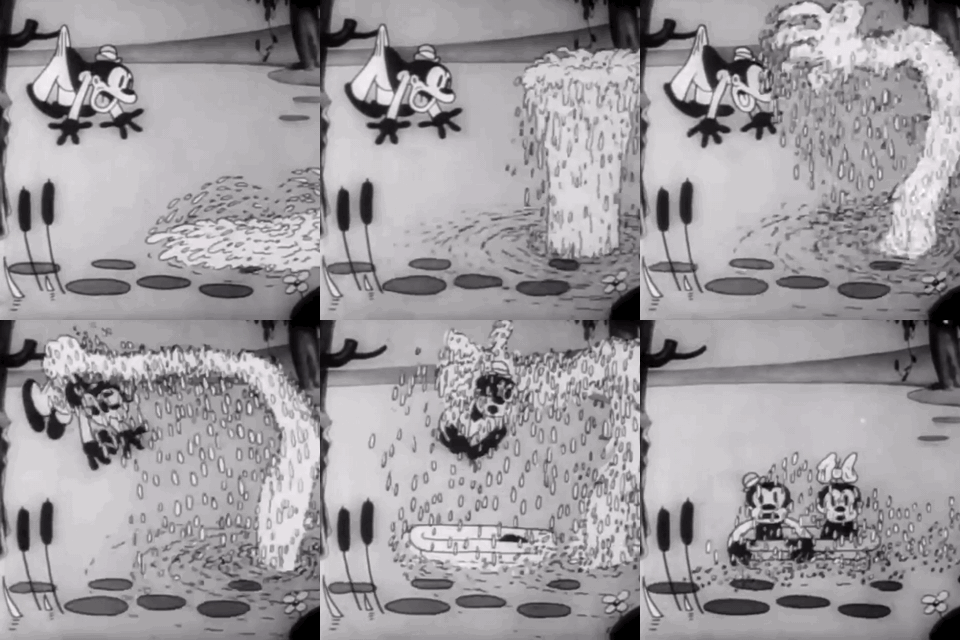
Bosko, visibly upset, begins to cry, but Honey assures him that she still loves him, and to celebrate, Bosko rips off the horn of his car and turns it into a saxophone. Honey finds it annoying (though it sounds fine to me) and pours bubbles and water into the makeshift saxophone and frolics on the bubbles emitted from it.


The happy couple then get into the car and go along their merry way, until a cow blocks their path. Bosko pushes the cow flat onto the ground and crosses over it like a bridge.

More gags ensue, such as this one above, which I LOVE. I often forget how fun and inventive the 30s cartoons are! Low budget, yes, but the fact that this is so fun and amusing to me now... I can only imagine seeing it for the first time nearly 90 years ago! 

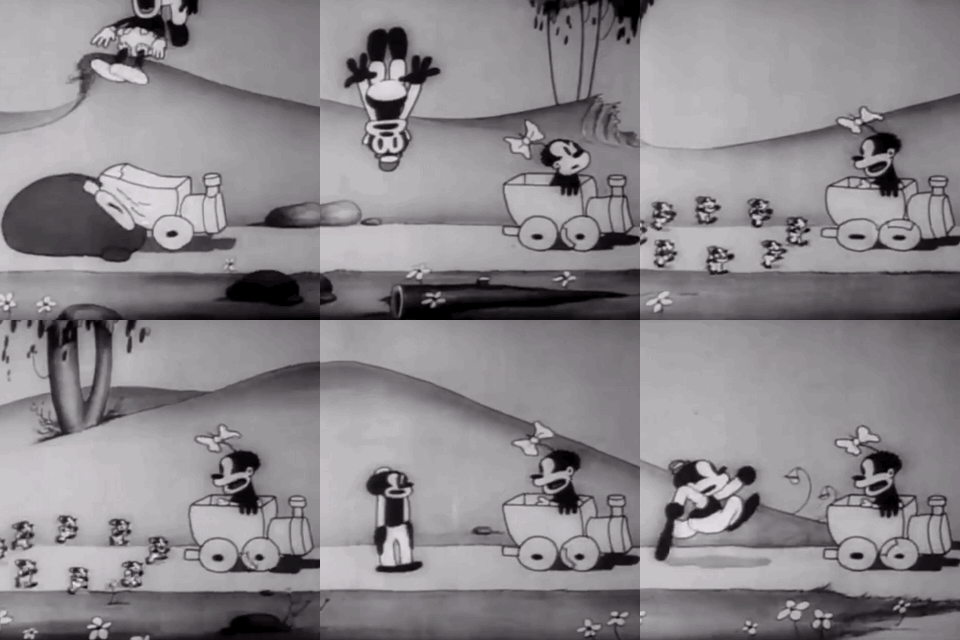
Essentially more disasters strike: the car’s engine dies and Bosko pushes it uphill (with Honey in the car), but the hill peaks and Honey barrels down in the car, which is now out of control. There’s a gag where Honey drives through the house (with Bosko running in front, trying not to get run over) and the car then turns into a bathtub. A cliff approaches and Bosko, Honey, and the bathtub jump and land in a lake.

The unlucky couple is unscathed, and they go back to singing (in the bathtub mind you!) and there’s an iris out as they embrace.

Overall, an interesting cartoon for Looney Tunes’ first! It’s certainly fun and very musical and catchy. Friz Freleng’s (who did some animation, as you can tell by the credit on the title card) knack for musical timing is evident, particularly when Honey is dancing on the bubbles. There are a lot of creative gags (like Bosko crashing to the ground and multiplying into a bunch of mini Boskos) and the entire cartoon has a very musical feel to it. Bosko still talks in a stereotypical voice, and Honey’s voice is... intriguing, to say the least, though they don’t have much to say—Honey has more lines than Bosko does.

Ultimately, a very catchy and fun cartoon that is undoubtedly primitive, but remains entertaining and odd, which adds to its charm. And it’s the first ever Looney Tunes short, so it’s certainly historical.


390. Case of the Missing Hare (1942)

Release Date: December 12th, 1942 Series: Merrie Melodies Director: Chuck Jones Story: Tedd Pierce Animation: Ken Harris Musical Direction:...