Showing posts with label Buddy. Show all posts

Sunday, May 16, 2021

111. Buddy the Gee Man (1935)

Release date: August 24th, 1935

Series: Looney Tunes

Director: Jack King

Starring: Billy Bletcher (Jail Warden, Prisoners), Jackie Morrow (Buddy), Abe Dinovitch (Machine Gun Mike)

23 cartoons. 5 dogs. 3 and a half designs. 3 girlfriend designs. 3 years. 2 voice actors. Buddy’s legacy comes to a close with Buddy the Gee Man, and what an unmemorable ride it’s been. I don’t hate him as much as I thought I would have, but I don’t nearly like him as much as I would have liked to. Some cartoons he’s more insufferable than others (though Jackie Morrow is cute and does a good voice performance for him, I find something about the voice very unfitting and annoying. Maybe I just hate hearing Buddy say stuff like “blow your nosey” or speaking in rhyme.) Buddy bids us farewell as he works as an undercover detective, investigating happenings at the local sing song prison.

A shot of a door labeled department of justice. A man possesses a letter, which we see is addressed to buddy — “Federal Agent Buddy, 000 1/2 Cornbread Ave., Kansas City, MO” (we know where he lives, boys, let’s get ‘im!). The man deposits the letter into the mail chute, and sure enough Buddy opens it up. He’s being sent to conduct a “secret investigation” on the warden at the local Sing Song prison, investigating the warden’s treatment towards the prisoners. Buddy inconspicuously dons the perfect disguise—a mustache. Genius! No one will ever know! 

Buddy dons his trademark captain’s hat as he prepares to embark on his journey. He pulls out a horseshoe in his pocket (which has a nail through one of the pegs, already a lucky sign) and tosses it for luck. Luck is promising as the horseshoe shatters a mirror behind him. Didn’t your mother ever tell you not to throw horseshoes in the house? Flummoxed, Buddy scratches his head and shrugs.

What’s an adventure without a faithful dog companion? Buddy enlists in his dog Gee-Man for help, who’s conveniently donning a sherlock hat and pipe. Buddy whispers in his ear, the dog perking up instantly.

A crowd congregates in town as a sea of voices clash against each other. Buddy and his dog use a matryoshka of people lined together as stairs to hop straight into the crowd (reused from Buddy the Gob). Elsewhere, a pig asks a hurried frog “What’s all the excitement?” the frog answers “They’re taking Machine Gun Mike to sing song prison!” The voice acting is so bad it’s good. Mel’s absence is sorely missed. 2 more years! 

We then get a shot of Machine Gun Mike, who’s getting hauled away by the police. Aggravated by the attention, he yells at the crowd in an attempt to scare them off. Buddy and his dog hitch a ride on the back of the police car, the car exploding a plume of exhaust on a man peeking out from a manhole.

At the prison, a guard is asleep in his lookout tower. He snaps awake once a motorcade of motorcycles escort the convict. Buddy and his dog make it safely into the jail.

Buddy’s dog sniffs the ground while buddy creeps around, the dynamic duo halting at a door. The door is emblazoned “OTTO B. KINDER — WARDEN”. Curious, Buddy pokes his head inside the office. The warden paces around his office, scowling. Seems his name is prophetic.

Some nice music making merriment as a gaggle of prisoners sing “Lulu’s Back in Town” in harmony, because why not? The jail warden is infuriated, slamming his fist down on his desk. Instead he sends a tray of papers flying onto his head. He then marches over to the prisoners, shouting at them to be quiet. A lovely Billy Bletcher bellow. Buddy and his faithful companion observe, Buddy scribbling down some notes.

Elsewhere, one of the prisoners gossips with Machine Gun Mike, holding out a letter and sneering “Get a load of this.” A love letter. Machine Gun Mike grunts “Not bad.” A prison guard marches towards the cells, carrying a harpoon gun. At the tip of the harpoon point is a letter, which he gingerly bestowed upon machine gun mike. Mike snatches it up. It reads:

“In omitting top name, send that person ten cents (10¢) as a charity donation—is this worth a dime?”

 the other jailbird laughs, while Mike crumples the letter up and throws it to the ground. Overhearing the obnoxious laugh of the prisoner, the warden stalks back to the cells and orders the prisoner to be quiet—Billy Bletcher shutting up Billy Bletcher. Buddy dutifully jots down more notes. The warden hates singing AND laughing.

In the courtyard, a prisoner slacks off and dinkily taps a rock he’s supposed to be breaking. The warden chews him out, handing him a bigger mallet and demanding he get to work. Dutifully, the prisoner swings the mallet behind his head, anticipating a great swing. The mallet smacks the warden in the head and his head sinks into his jacket, a lovely visual as his head pops out of his stomach area, yelling “What’s the idea?” Buddy and his pal take more notes, gee-man writing the notes with his tail instead.

Machine Gun Mike plans a not so subtle escape. He stuffs his ball and chain into a cannon, hoping the fire of the cannon will propel him out of the prison. He anticipates the ride... nothing. Instead, the CANNON flies backwards. The warden busts Mike and snarls “Get to work!” 

Satisfied with his observations, Buddy heads to the typewriter to transcribe his report. It reads: 

24 Pennsylvania Ave.

Washington, D.C.

Dear Chief: 

Inspection completed. Recommend change in warden. Have some new ideas how prison should be run.

Buddy.

Time marches on, and a newspaper headline zooms into view, declaring Buddy as the new warden of the jail. “BUDDY MADE WARDEN! Local boy makes good.” 

Sure enough, buddy greets a receptive crowd of prisoners, asking “Is everybody happy?” in the style of Ted Lewis. The prisoners cheer in unison. Quite a turnaround in atmosphere! A shot of the happy go lucky jail—including a few prisoners whacking the old warden on the head with some mallets. Corny as that is, I can’t help but love it. Buddy even serves ICE CREAM to the prisoners. I suppose that’s what happens when you put a boy in charge of a prison unit, a very funny concept.

The happy prisoners sing while carrying their ice cream, one prisoner receives a shoe shine as Buddy offers him a cigar. Elsewhere, a man carrying a letter inquired for Machine Gun Mike. He asks two happy prisoners—the sound of a machine gun answers the postman’s question as the prisoners answer “Machine Gun Mike.” 

A great, incongruous setup as the machine gun sound is actually revealed to be a jackhammer. Machine Gun Mike blows a cloud of cigar smoke in the face of the hapless mailman, snatching his letter. The letter pardons machine gun mike from his parole, signed by Hans Cuff. I love my puns, but they definitely feel a bit TOO coy. Funnily enough, Mike lights the letter with his cigar and continues with his jackhammering.

One last shot of the sleeping jail guard in the lookout tower. He awakens as a crowd barrels through the gates. They all want a slice of Buddy’s prison heaven. Free ice cream, cigars, shoe shines... who wouldn’t want to be there? Buddy pops up over the gate and displays a sign that says “NO VACANCIES”. We iris out one last time on our hero, who takes off his hat and waves it to the crowd.

Another “second watch saved my opinion” short. First time I watched this, I found it incoherent and difficult to understand. I think I was so distracted thinking about how this was Buddy’s last appearance that I didn’t focus much on the details. It wasn’t bad, though! I think there are definitely worse shorts Buddy could have ended his career on. The prisoners were very entertaining and had much more personality than Buddy did—the warden and Machine Gun Mike were especially entertaining. Nothing too funny, and the puns felt a bit overboard at times, but the animation was decent—I did like the gag of the warden popping his head out of his shirt buttons to yell at one of the prisoners. An above average cartoon that may be worth a watch, just for how absurdly silly it is.

And now, onto Buddy. What to say about him? He was definitely as mediocre as I had expected, maybe even more so. It was interesting to see how Buddy progressed, especially thinking of how far we’ve come since Buddy’s Day Out and Buddy’s Beer Garden. I liked Buddy’s final design the best—at first I had really liked Tom Palmer’s design in Buddy’s Day Out, but I think his final design is more suitable, especially for the adventurer persona he adopted later on. Jack Carr’s voice for Buddy fit him better than Jackie Morrow’s. Nothing against Jackie, who was a literal child while voicing him. I love that! But I think Jack Carr’s voice was a good balance between youthful adult and child, like his appearance. Buddy definitely came off as more of a child in his last handful of shorts, and was thusly more annoying. I never particularly liked Buddy, and sometimes he annoyed me much more than other times, but... his cartoons all blend together. I can’t really discern a particular favorite, and the fact that he only has 23 cartoons amazes me. It felt like 230! However, if anything, he’s intriguing for historical purposes. I can say I’ve seen every buddy cartoon so you don’t have to! Beans will take over for his 9 cartoons of fame, Tex Avery will come into play, and our favorite stuttering porcine will climb up the rungs and really make a splash as 1936 goes on.

That’s all, Buddy! 

Link!

Friday, May 14, 2021

109. Buddy Steps Out (1935)

Release date: July 20th, 1935

Series: Looney Tunes

Director: Jack King

Starring: Tommy Bond (Buddy), Berneice Hansell (Cookie, Campbell's Soup Kids)

It’s been awhile since Cookie’s been in a Buddy short—or it sure feels like it. This would be her last appearance, and Buddy’s second to last. I also find the animation credit for Chuck Jones as “Chas. Jones” funny, that’s a new one to me. Buddy and Cookie go out on a date, and the objects in Cookie’s house come to life, including a framed portrait of Buddy.

Cookie ends her career the way she began: dolling herself up for a date with Buddy. She coos at a bird in her birdcage to come on out, and together they sing/chirp “About a Quarter to Nine”. The sound of a doorbell interrupts their brief song number, and sure enough it’s Buddy, all bundled up in some Ccrooge-esque winter garb, tipping his top hat and greeting “Hello, Cookie!”

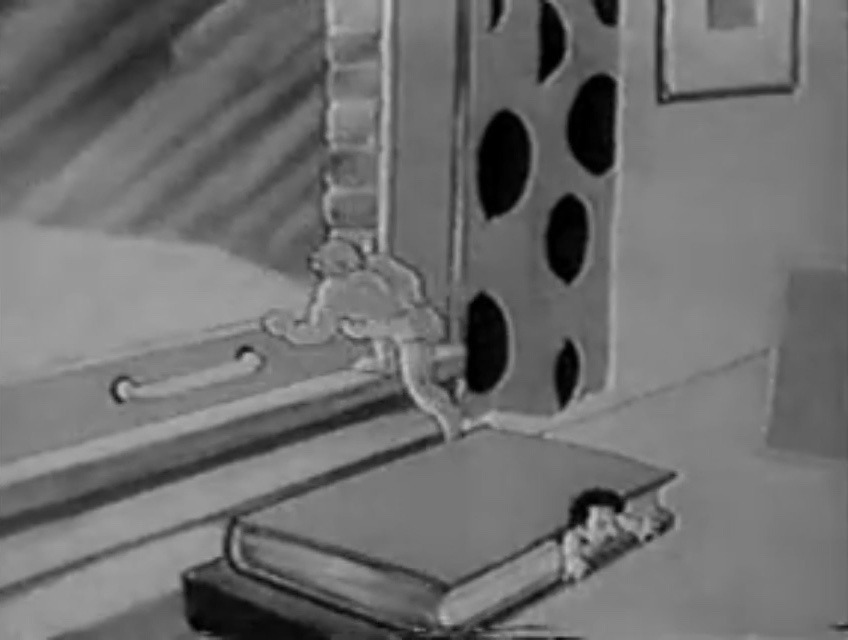
The bird senses the coast is clear, and flies over to the window, which is slightly ajar. A photograph of Buddy and a book also adorn the scene. Finally free for the night, the happy little bird flies through the window, singing its song and doing figure-eights in the night air.

A snowy draft begins to pick up, forcing the bird backwards against the wind. Portrait Buddy is no exception to the perils of the wind as the draft blows through the open window. He clings to the edge of his portrait, losing his hat in the process. A moment of peace as he crawls out of the portrait, opening a book to use as a bridge towards the windowsill. He hops onto the window, but his diminutive size does little to close the window. Another draft rips through, and he cries “Help! Help!” 

Thank goodness for a random statue of Atlas holding the globe. He places the world down gingerly, running to the rescue. He places Buddy inside the book and closes the cover, shutting the window with ease. Our hero plucks Buddy up and positions him back into his picture frame, much to Buddy’s gratitude. Buddy snags his hat from outside the frame and all is well.

Elsewhere, the bird, who has sought refuge on a weather vane, braves the storm and flies back towards Cookie’s house. Unfortunately for it, the window has been closed. The bird wipes away the frost and pecks its beak on the glass to get Buddy’s attention. Buddy notices the bird and enlists in Atlas’ help once more (“Atlas! Atlas ol’ boy! Give us a hand, partner!”) When he struggles to open the window. Atlas lifts up the window, and buddy plucks the frozen bird from the snow, the bird’s talons frozen in an ice block. 

Buddy scoops some snow off of the bird and scratches his head, pondering how he can thaw the frozen canary. He lifts the bird over his shoulder and coos “Poor birdie!” Ideas hatch as he jumps on a window blind, pulling the blinds down and hopping to the floor, bird in hand. He dashes across the floor to another window, riding the blinds up so he can land on a table. Though the “come to life” trope has been tried and true (emphasis on tried), it’s almost nice to see it again. It’s been awhile, or so I believe. The cartoons blend together in the Buddy era.

Turning on a lamp, buddy positions the bird onto an elaborate lamp base with a woman holding out a bowl. Buddy lights a match beneath the bowl, melting away the bird’s ice block restraint. Water fills the bowl as the ice melts, the bird sneezing hot water onto buddy. Buddy grabs a handkerchief and laughs, saying “Blow your nosey!” The bird obliges, blowing its nose (beak?) like a car horn. Once more Buddy gives a laugh and pats the bird on the head, saying “'Atta boy!” Delightfully disgusting and puzzling as he ties the same snot filled handkerchief around the bird’s head. Obviously it was supposed to read as cute and endearing, but instead it comes off as amusingly gross. The bird gives a few hearty chirps and kisses buddy’s forehead in thanks.

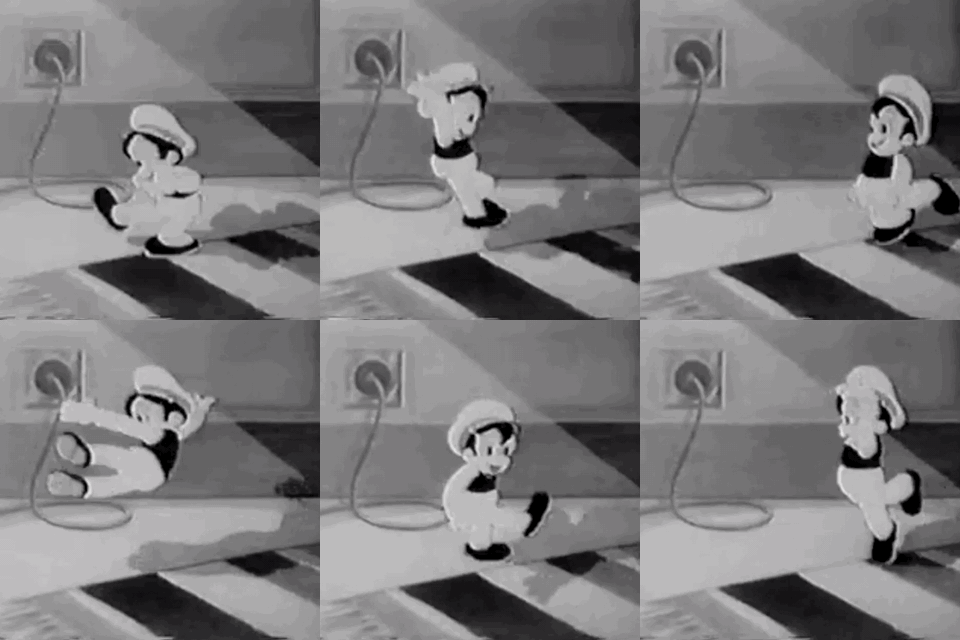
To celebrate its newfound freedom and vitalization, the bird clicks on the radio and chirps another verse of “About a Quarter to Nine”. Thus begins a tap dance routine with Buddy. I’ve really missed the tap dance routines! Whenever I think of Bosko, I always think of that great tap number in Bosko in Person. It’s refreshing to see it make a comeback, even if it is with buddy. The movements are crisp, fun, and flighty, music jolly. A nice detail of one of the knick knacks positioning a lamp like a spotlight.

To further the Harman-Ising nostalgia of tap dance routines, some more objects come to life. A joker leaps out of its playing card and does some not so soft soft-shoeing, whereas a chorus of Campbell’s Soup kids sing “About a Quarter to Nine” in the trademark Berneice Hansell baby voice. A pig on a “SNIFF’S SPECIAL HAMS” label also lends his voice.

Some sort of ambiguous bug also sing a chorus, lazing around in a sink, rowing itself along in the water with a spoon. Conveniently, a tin of bug spray is positioned by the sink. The soldier on the label comes to life and sprays the bug to eradicate it. Naturally, the bug flees. It attempts to climb out of the sink, grabbing at a box of suds instead and filling the sink with bubbles. The bug pops it’s head out of the water, expelling bubbles out of its mouth and singing some more. The Harman-Ising feel is certainly strong in this one.

Meanwhile, an alarm clock perched by the window spots Buddy and Cookie bracing their way through the snow squall. Urgently does the clock ring, its piercing alarm sending everyone scrambling back into their places, including portrait Buddy.

Everyone situates themselves just in time as Cookie unlocks the door. She steps inside and bids Buddy goodnight, Buddy kissing her hand. What a charmer. Cookie admires her portrait of Buddy, sighing “Isn’t he a dear?” She showers the picture in kisses, adding “You darling!” We get a view of photo-Buddy covered in lipstick. He glances at Cookie before glancing back at the audience, giving a lipstick covered wink as we iris out.

As far as Buddy cartoons go, this wasn’t bad at all. It had more excitement than usual. It felt fresh, which is ironic considering it calls back to the days of Harman-Ising. The song numbers were very fun to watch, with Buddy doing his tap routine and Hansell lending her squeaky baby voice for the Campbell’s Soup kid chorus. Both Buddys, real and photograph, lacked discernible personality, and Cookie wasn’t very riveting herself, but at this point you develop a tolerance for it. While I think you’d be fine if you skipped it, this is one where it wouldn’t kill you to watch it, either. Nothing particularly riveting or enthralling, but much more endearing and watchable than some of the other Buddys we’ve seen. His clock is ticking! One more short and he’s kicked to the curb.

Link!

Thursday, May 13, 2021

107. Buddy in Africa (1935)

Disclaimer: this review entails racist imagery, content, and concepts. I don’t endorse any of these stereotypes or depictions whatsoever, I find them gross and wrong. However, it would be just as wrong to gloss over them and act like they didn’t exist. This review is purely for educational and informational purposes. I ask and thank you for your understanding.

Release date: July 6th, 1935

Series: Looney Tunes

Director: Ben Hardaway

Starring: Jackie Morrow (Buddy), The Four Blackbirds (Chorus)

Ben Hardaway’s last Buddy cartoon. Buddy sets up a moving variety store shop in Africa, but a pesky monkey and gorilla cause problems for our little shopkeeper.

Just a normal day where a man is mowing the grass in his African village, or so we think. A pan out reveals that he’s perched on top of a house, mowing the straw roof. Another gag includes a human juicer, a man twisting the bone in his hair to squeeze the juice out of the fruit in the man’s mouth. Some villagers engage in a game of horseshoe, a man tossing children and using their nose rings to get caught onto the stake in the ground. As always, racial stereotypes and caricature are abound and uncomfortable.

Enter chipper Buddy, whistling away as he totes his trailer behind his car, advertising a variety store. A gorilla is hitchhiking, eagerly sticking out his thumb when Buddy approaches. Buddy rides straight on by, bad news for the gorilla, who dismisses him in frustration. There’s a nice (albeit standard) gag of a monkey traffic cop and a giraffe posing as a traffic sign. The monkey directs the traffic, while a kangaroo (in Africa?) stuffs litter in its pouch.

A guard waits by the entrance of the village. He spots Buddy approaching and snags another villager, shaking him and ringing him like a bell. Everyone pokes their heads out to see what the occasion is as Buddy drives through the gates.

Buddy screeches to a halt and begins to set up shop, beating on a drum, his butt, some pots and pans, greeting the crowd congregating before him with “Howdy, folks! Here it is!” Jackie Morrow’s voice acting is very cute, and it’s neat that they got an actual child actor (I believe I read somewhere that he was 9 when he voiced Buddy). I think Jack Carr’s voice suited him more, though—it was an ambiguous child AND adult voice. It could pass for either, just like Buddy’s appearance. I guess it’s just a little strange seeing buddy Buddy a car and own a house and talk in a child’s voice. Just something very petty to nitpick at, Morrow does a very good job of voicing Buddy. The villagers exchange fruit for the goods as the trade ensues.

There’s another rather redundant and arbitrary shot of the gorilla hitchhiker before cutting back to Buddy and his booming business. One of the villagers goes into his hut with his newfound collectibles. He twists two lightbulbs in his ears, which add some much needed light into the dark hut. He placed a lampshade on his head and reads the newspaper, a gag that would be directly used in Friz Freleng's Jungle Jitters. Elsewhere, another villager stuffs fireworks in his mouth and lights them, flying off into the distance. It’s an absurd gag, but the abruptness and almost incoherence of it makes it highly amusing.

Meanwhile, our little salesman triumphantly displays some bottles. “Here’s a drink that’ll cure your jitters,” he announces in rhyme, “Buddy’s famous Jungle Bitters!” One of his customers takes the bottles Buddy was holding in his hands, whereas a pesky little monkey decides to help himself, too. Buddy scolds the monkey, but the monkey isn’t bothered, chattering and slamming Buddy’s car door shut.

Four of the villagers drink the bitters—music strikes. A man plucks his hair like a bass as they sing “Marchin’ Towards Ya, Georgia!” A very catchy song indeed with lovely vocals, but appreciation severely muddled by the blatant blackface caricatures staring you in the face. A man plays an elephant like a pair of bagpipes, a man stretches out his lips and plays them like a muted trumpet, and a woman sings some vocals. She has some sort of pipe on her neck, and a man annoyed with her singing turns a knob that shuts her up. Meanwhile, Buddy merrily juggles his bottles.

Two of the villagers dance, bouncing around doing handstands. Obviously, this whole scene, not to mention entire cartoon is cringeworthy and painful to watch (unfortunately, this is relatively tame compared to other cartoons), but the animation is solid, very bouncy and fun. A turtle plays itself like a banjo while the four singers finish up the song. Very catchy indeed.

Back to the monkey, who’s proving himself to be quite the nuisance. He bangs the bottle against the car in an attempt to open it—Buddy yells at him to stop and to give it back, but the monkey refuses. Buddy chases the monkey around the car—he dives under the car, where the monkey pops out on top and hits the bottle against Buddy’s head. Buddy snags the bottle (which somehow isn’t broken) out of the monkey’s hands and spanks him. Back to the Harman-Ising days of spanking gags! How we miss you! 

Accomplished, Buddy releases the monkey and laughs. The monkey shakes his fist and wanders off, right back to the hitchhiking gorilla. The monkey chirps and squeals about his horrific encounter with buddy, patting his own butt for good measure. The seemingly docile gorilla scowls and rolls up its fur-sleeves (such an overdone gag, but a big guilty pleasure of mine. I can’t help but love it!) menacingly. It puffs its chest out and tips its hat forward, preparing to march along. A nice detail as the monkey follows behind, also puffing out his chest.

The gorilla and monkey come to a standstill as a guard confronts them at the entrance to the village. A lovely little bit of acting as the gorilla shrugs at the monkey for advice, the monkey punching its palm. The gorilla takes its orders and pummels the guard into the ground, the gorilla stepping on his head and the monkey poking his eyes.

Predictably, Buddy gets his. He’s pumping up a tire when the gorilla terrorizes him, stepping onto the tire and propelling buddy upwards. The gorilla catches buddy and slams him down onto the tire, pumping the air pump and propelling him offscreen. Thusly, the gorilla snags the pump and tire, preparing to beat Buddy senseless by swinging the tire like the world’s most painful lasso. The scene reads as incoherent (even aside from the poor quality) as the tire hits the gorilla instead, shooting it into the distance. A tree slingshots the gorilla back to where it was (nice rubbery animation of the tree), and the gorilla barrels right into a lookout tower. The tower collapses, trapping buddy AND the gorilla who are both unscathed. Finding great humor in the debacle, the little monkey laughs at the gorilla. In a moment of camaraderie, the gorilla exchanges a glance with buddy and punches the tire. The tire sends the air pump handle rocketing, which in turn hits the monkey, who flies into the distance. Iris out as foes become friends, the gorilla and Buddy shaking hands.

Hardaway’s Buddy cartoons, in my opinion, were slightly weaker than King’s. In general, they’re all pretty bland—the titles blend together and I can’t even remember if I have a discernible favorite or not. I know I had commended a Buddy cartoon relatively recently and labeled it as good, but I can’t even think of it! Thus proves Buddy’s blandness. This is another bland one, more than usual. Right off the bat the racial stereotypes and caricatures make the cartoon an uncomfortable watch. The monkey and gorilla scenes were amusing, though. The ending battle read as incoherent and incomprehensible, I kept having to rewind it just to formulate what was going on. It was certainly creative and high energy, though, and I applaud that. The song number was nice and catchy, but that’s it. I hate to say “it could have been worse” because blackface is blackface and stereotypes are stereotypes, any inclusion at all is immediately bad. But I suppose there are cartoons out there that are more mean-spirited than this one, more of a “celebration everyone sings and dances for the fun of it and everyone gets along”, but still. Not pleasant and cringeworthy. Even besides that, the cartoon doesn’t have much going for it at all. You won’t miss anything by skipping.

But, as always, I’ll provide a link. Obviously view at your own discretion.

106. Buddy's Bug Hunt (1935)

Release date: June 22nd, 1935

Series: Looney Tunes

Director: Jack King

Starring: Billy Bletcher (Spider, Judge), Jackie Morrow (Buddy), Berneice Hansen (Butterfly, Witness)

And then there were 4. Buddy’s fate is nearing to a close. We have this, Buddy in Africa, Buddy Steps Out, and Buddy the Gee Man, all directed by Jack King, save for Buddy in Africa, which is a Hardaway cartoon. I don’t really hate Buddy as much as I thought I would, but there have been times where I’ve been watching a cartoon and thinking “I miss Bosko”. Jack King probably makes the better Buddy cartoons. Opinions aside, this cartoon also has the neat distinction of featuring the first ever ACME gag. Here, Buddy dreams he’s being tried in insect court for causing harm to bugs. 

Buddy’s eagerly pursuing a butterfly, swatting his net carelessly as he dashes around on a farm. He scales a set of stairs, going back down on a different set of stairs—a cow, a farmer, and a pig. He passed a sign advertising “BE SURE TO SEE SEASIDE BEACH!”, where the butterfly is resting on a broken piece of wood. Buddy swats his net and lands the catch... or so he thinks. An angry woman pops up with the net around her head, her bow serving as the fake butterfly. She throws the net down and stalks away. The REAL butterfly flutters into view, and Buddy runs after it.

The chase continues into Buddy’s bughouse (labeled as such outside a shabby little shack). After some searching, Buddy spots the butterfly resting on a flower in a flowerpot. He runs his hand down the flower, squeezing the butterfly into a glass enclosure below. It turns out his bag is filled with live butterflies—he dumps them into a separate enclosure, satisfied with his work.

Big excitement when Buddy finds a spider. He plucks it off its dangling web, gluing it under a microscope. Wow, cruel! The spider is crying as buddy peers into the microscope with oblivious glee. However, he accidentally turns the knob on a can of ether, the fumes knocking him out. Thus launches the dream sequence.

To begin, Buddy’s victim, the spider, frees himself from the glue. It’s clear he seeks revenge as he gives a good ol’ Billy Bletcher villain laugh. He sneaks to the aid of his other spider victims, trapped inside a jar. With a bit of elbow grease he tugs the lid open, and his comrades are freed. He motions for them to follow, and thus begins a liberation movement.

I wonder if something was cut or if it’s just extremely poor staging. Earlier, the main spider had peered down to make sure the coast was clear—Buddy was still unconscious. However, NOW he’s trapped beneath a web, crying “Help, help! Lemme outta here! Stop!” There was no indication of him waking up, nor any indication of the spiders trapping him. There could have been a scene cut here, but at the same time I doubt it.

Together, the insects work to reduce Buddy in size. Nothing like some “reducing pills” to do the trick! They stuff a funnel in Buddy’s mouth. The pills are mixed in with water, and a frog pipets the mixture through his mouth and into the funnel.

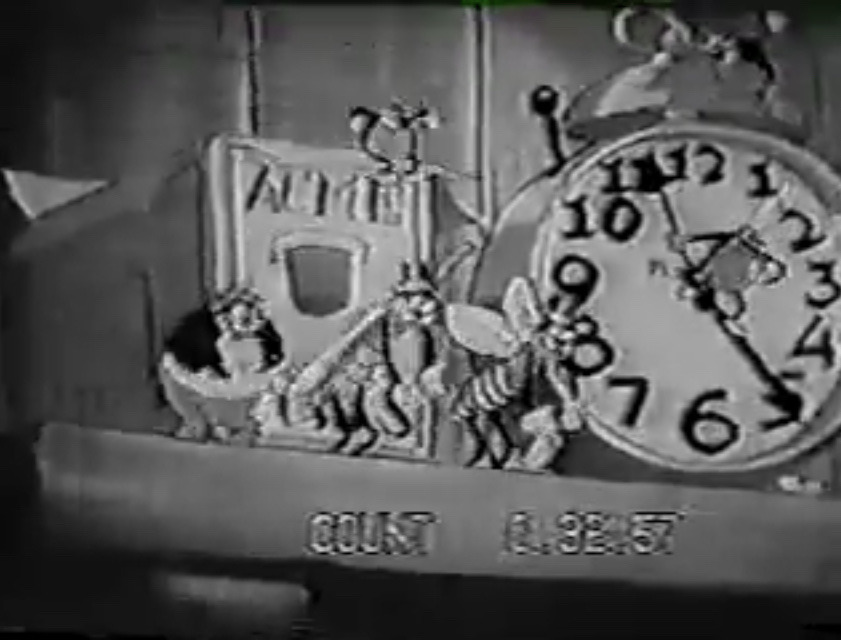
Look, ma! Baby’s first ACME reference! The bugs cheer as Buddy shrinks to their size, no longer a dominant force. All of the bugs gather around Buddy and jeer at him. Song segments have been typically reserved for Merrie Melodies only, but not here. The insects (and frog) launch into an original number, “You’ll Get Yours Today”—a song about how Buddy is at their mercy. The lyrics are amusing, as is a quick dance segment, but nothing mind blowing.

Two of the insects separate a roller skate in half, another poking a tied up Buddy  in the butt with a pen point. He’s forced into the roller skate, the insects typing him in so he can’t break free. Damn, they really want revenge! One of the bugs wheels Buddy through a radio labeled “SUPREME COURT”. Bug court, love it! 

All of the insects in the courtroom are ecstatic to see buddy get what he deserves. Another ACME reference, the ACME fly paper advertising “HEAR YE HEAR YE! BUDDY WILL BE TRIED IN COURT FOR CRUELTY TO INSECTS”. The jury sit patiently in an egg carton, while a bug announces in rhyme that “His Honor’s coming into court”, riding away on a grasshopper.

Sure enough, a cuckoo clock reveals the judge, sitting in typical judge garb (a powdered wig, no less!). He smacks the gavel against the table, knocking water from the pitcher into a glass. He holds up a heart playing card and asks that Buddy cross his heart not to tell a lie. Buddy is dumbfounded and provides no answer—a great gag as the judge hits him over the head with the gavel immediately and grunts “WON’T TALK, EH?” 

The judge then asks to hear from the witnesses. A grasshopper with a clothespin for its leg laments about his experience with Buddy, how he yanked his leg off “and now they call me peg!”. The judge tuts in disapproval and asks to hear the next witness—a butterfly who looks strikingly similar to Cookie. She laments that buddy took her parents away, leaving her to die. Man, Buddy’s seriously got a lot on his record! 

After another witness gives her testimony, the appalled judge whacks Buddy on the head with the gavel once more for good measure, gingerly brushing it off as if it had been contaminated—good gag. He then asks the jury what Buddy’s verdict is: guilty as charged (“Guilty! Guilty! Guilty! And we want to hear him squeal!”).

With that, the insects position Buddy on top of a cigar lighter, plugged into a remote that sends electric shocks. What a twist! They crank up the volts, which cause Buddy to get singed with the flames of the lighter. Buddy flops onto his stomach, yelping in pain.

Back to reality as Buddy comes to on the floor. His magnifying glass is positioned just so it catches the sun’s rays, burning his butt. Buddy hurriedly throws himself into a spare washtub, grinning in relief as the flame is extinguished. He dries himself off, and, with a change in heart, frees all his captives. He slams the door shut once they’re gone, his clubhouse collapsing into a pile of wood. Buddy pokes his head out of the pile in a daze, two frogs using a piece of board as a seesaw as we iris out.

Like Buddy, I had a change of heart. First watch through I thought this cartoon was bad. I thought it was discombobulated, incoherent, and trite. Thank god for those rewatches I do while typing this whole shebang out! This isn’t my favorite Buddy cartoon, but it’s not at all my least favorite. It’s definitely surreal and strange, and I applaud directors who go down that route and try something new. I’ve said before how I don’t like Jack King’s Porky cartoons—they pale in comparison to those put out by Tex Avery and Frank Tashlin in 1936. They’re strange and downright creepy, but I also applaud that. I like that king takes a different approach to things and can appreciate it, even if it doesn’t align with my tastes. Billy Bletcher did a great job as the judge, seeing Buddy get whacked with the gavel is always a plus. It’s not the most riveting of cartoons, but it isn’t a dreadful watch, either. Heads up, though: the rip is pretty worn and has some damage to it, so there’s a lot of flashing and distortion towards the top of the screen.

Link!

Wednesday, May 12, 2021

104. Buddy's Lost World (1935)

Release date: May 18th, 1935

Series: Looney Tunes

Director: Jack King

Starring: Tommy Bond (Buddy), Billy Bletcher (Joe Penner, Bozo)

The first of the Buddy cartoons that includes a shot of his smiling face (à la Disney), a tradition that would be carried on with the Beans cartoons and a handful of Porky cartoons. Considered the first entry of the dinosaur cartoons, a popular genre in the Looney Tunes universe, Buddy and his dog Bozo discover the “lost world”—a prehistoric haven whose novelty wears off rather quickly when its dangers are exposed.

Buddy’s all set to disembark on his quest, his sail advertising “CAPT. BUDDY’S EXPEDITION TO THE LOST WORLD”. He greets a cheering crowd by shaking his fits proudly, eating up the attention. He starts the motor of his boat (meaning the sail is entirely redundant, which I love) and rockets off. Unfortunately for his crowd, he forgot to untie the rope anchoring him to the dock. The entire dock plummets into the waters as his fanbase all try to swim to shore.

A nice back angle of Buddy and his pal Bozo riding in the boat, heading for land (Buddy excitedly proclaiming “Land, bozo! Land!”). If I’m not mistaken, the same shot would be reused with Porky in Fish Tales, another Jack King short. A wave propels them to shore, the boat screeching to a halt. Buddy and Bozo disembark, Bozo yapping happily while Buddy unravels a map. He yells “Oh boy, it’s the lost island! Hooray! Oh boy, oh boy, oh boy!” 

Regardless, Bozo spots a pair of footprints. He sniffs them out, causing them to inch forward slightly. More sniffing, more inching. He follows the footprints through an area decorated thickly with trees, continuing on. The trees are no trees at all, but the legs of a massive dinosaur—good staging. The dinosaur angrily stalks Bozo, who is stalking the footprints. Only when the dinosaur snorts does Bozo realize he’s being followed. Terrified, Bozo zips away, whirling past a woman jump roping.

In the midst of his panic, Bozo comes across a caveman digging at the dirt like a dog. ...Interesting. The caveman growls at his uninvited visitor, both of them circling each other on all fours. Finally, the caveman dips into his hole and brings out a giant bone under his protection. The caveman runs away, and Bozo, now curious, digs at the ground.

Bozo finds a bone... and plenty of them. He unearths an entire dinosaur skeleton, getting trapped inside its ribs. He yowls for help, catching the attention of Buddy, who had been wandering the island. He spots his shanghaied pooch and tries to tug him out, but to no avail. He meanders to the skull of the dinosaur, prying open its jaws and whistling for bozo to come to him. Bozo gratefully darts out of the dinosaur’s mouth and covers Buddy in thankful kisses.

Back to the caveman/dog hybrid, who now has a tail? He didn’t before, which is odd. I wonder if that was an additive or a subtractive—was he originally supposed to have one and they forgot? Or was one of the animators putting his own flair on things? He’s sniffing at some bushes, scratching behind his ear with his foot while Buddy and Bozo discreetly observe. Unable to stand it any longer, Bozo launches after the caveman, Buddy chasing behind.

Bozo and the caveman take their chase into a cave, Buddy getting the short end of the stick and slamming against a rock that closes the entrance off. Unbeknownst to Buddy, a hungry plant licks its lips and looms behind him, a good setup as buddy obliviously calls for Bozo as the plant comes in for the kill. Buddy realizes he has company, but too late. The plant swallows him whole. Buddy tumbles through its inside, a rather creative segue as he pops out of another plant attached to a cliff.

It’s just as well—Buddy stumbles across civilization. The village is thriving, villagers playing croquet, with wishbones serving as the wickets.

Buddy is mesmerized and takes a closer look, sliding down a tree trunk that actually turns out to be a happy dinosaur. Meanwhile, three prehistoric caricatures of The Three Stooges pop up (wonderfully weird) and observe Buddy. Larry shushes Curly, who sneezes, and the typical eye poking slapstick ensues. Back to Buddy, who feeds his dinosaur companion an apple.

Larry devises an incomprehensible plan, sneaking away from the group. Funny how Larry’s the villain, you’d think Moe would be the one. Larry spots Bozo, who’s tied up to a tree (did he escape?). Larry unties him and ties him to what appears to be a giant mousetrap.

Bozo cries for help, and Buddy, still playing with his dinosaur friend, hears him and runs to the rescue. Buddy attempts to free his pooch, but to no avail. Instead, he activated the trap, metal bars enclosing the two as Larry approaches his victims. Moe and Curly come sauntering over, Larry signaling for them to push while he pulls. Moe gives Curly a sock in the head for good measure before pushing the cage.

Who knew The Three Stooges were cannibals? Buddy and Bozo are in a boiling pot while the once happy villagers are chanting on the ceremony. We have a collection of gags to lighten the mood. After all, it is a feast! A man presses down on a dinosaur skeleton’s teeth, chimes reverberating against the ribs. Elsewhere, two cavemen do a waltz, intermittently hitting each other on the head.

Buddy cries for help as the pot begins to stir, and his dinosaur friend hears his shrieks. I love the perspective on this shot. In motion, it’s a little wonky—as though they didn’t know how to truly commit to the perspective all the way through the scene. This is the best it looks in this single key frame (though I’m sure that’s also the result of a different animator for the inbetweens). I applaud them for trying. Jack King’s cartoons aren’t my favorite, but I do like that he has an eye for cinematography, like a predecessor to Frank Tashlin. The dinosaur approaches the crowd, grabbing a caveman (who I think is supposed to be Larry) and tossing him towards the camera, much to the delight of Buddy and Bozo. He tosses another identical caveman, a random rock appearing and disappearing from the scene.

The dinosaur dips its head into the pot and scoops up both Buddy and Bozo. Buddy slides down the dinosaur’s neck and lands comfortably on its back, the dinosaur gingerly placing Bozo beside him. Buddy crowns the dinosaur with his captain’s hat, and we iris out as Buddy gets covered in kisses by both Bozo and the dinosaur.

As far as Buddy cartoons go, this one wasn’t too bad! Still rather mediocre, but less mediocre than others. I wasn’t too excited about this one, but I’m always glad to be proven wrong. Having The Three Stooges as three cannibals was a very interesting plot point I never would have guessed in a million years. Speaking of plots, the weird caveman/dog hybrid... I guess that was just there for the sake of being there? It felt too extended to be a gag, like a plot point in itself, but also feels too loose and discombobulated to the actual plot at hand. Nothing very exciting in the cartoon, but it was cute. Maybe worth a watch just because of how strange it is. I’ll always value absurdity! 

Link!

390. Case of the Missing Hare (1942)

Release Date: December 12th, 1942 Series: Merrie Melodies Director: Chuck Jones Story: Tedd Pierce Animation: Ken Harris Musical Direction:...