Showing posts with label 1937. Show all posts

Friday, May 28, 2021

186. September in the Rain (1937)

Disclaimer: This review contains racist content and imagery. I do not condone any of this content whatsoever—it’s being displayed purely for educational and historical reasons. With that said, I have much to learn myself. PLEASE let me know if I say something wrong or offensive. It’s never my intention to do so, yet I want to learn from my mistakes and own up to them provided that should happen. Thank you for your patience and understanding.

Release date: December 18th, 1937

Series: Merrie Melodies

Director: Friz Freleng

Starring: Mel Blanc (Rubber Glove, Gold Rust Twins), Cliff Nazarro (Al Jolson), Basin Street Boys (Chorus), Harland Evans (Fats Waller, Louis Armstrong)

Original title card courtesy of Jerry Beck.

The final cartoon of 1937 is an interesting one: it’s the shortest cartoon in the WB library, with a runtime of about 5 minutes and 50 seconds. When the cartoon aired on TV in the ‘90s, the blackface caricatures were cut, further shortening the runtime to about 3-4 minutes. Not only that, but a bulk of the animation is recycled from previous cartoons, such as How Do I Know it’s Sunday? and Clean Pastures—both Freleng entries.

Like we’ve seen from many a cartoon before, this short chronicles the adventures of store products coming to life and putting on various acts.

Open to the interior of a store on a rainy night (hence the title), the eponymous song underscoring the scene. The camera pans right, closing into a bottle of blueing singing “Am I Blue?”.

The gags, at least in the first half, are relatively disjointed: immediately after the blueing sequence, a snake charmer prompts a bottle of toothpaste to squirt out a strand of toothpaste and wave in the air like a snake. Little time is wasted cutting to a can of searchlight (salmon), a searchlight on the can’s label sparking to life for a full 3 seconds before moving onto the next gag: maids from “Old Maid Cleanser” doing a dance, a gag repurposed from How Do I Know it’s Sunday?

A loose precursor to the camel’s breakdown in Porky in Egypt (which is much more thrilling than what is presented here), a rubber glove comes to life, inflating itself and serving as a makeshift pair of bagpipes, accompanying a line of camels strutting along on the camel cigarettes logo. Reused from Freleng’s 1935 entry Flowers for Madame, two dandelions perform the highland fling along to the music. 

Wipe to a bunch of apples, where a worm pokes its head out from a hole and tentatively crawls along. Stalling’s bumpkin score of “In the Shade of the Old Apple Tree” is fitting and fun to listen to, as are Treg Brown’s sound effects of the worm inching its way along. 

However, bad news for the worm: a line of hungry chicks plastered on the Bon Ami powder cans (here labeled “My Am I”) pursue the worm, who flees like he’s never fleed before. Stalling’s score is masterful, the score morphing into a flurry of excitement as the chicks all gang up on the worm. One of the chicks manages to swallow the worm, who thus is thrown about and inches along like the worm as it struggles to be freed. Finally, the worm manages to separate itself from the chick, and hurries back into an apple for safety. While nothing new, stalling’s music score manages to breathe some life into a tired scene.

The next scene is directly reused from How Do I Know it’s Sunday?, just with different vocals: the Morton salt girl and the U-Needa Biscuit boy sing a duet together beneath the “rain” from the shredded wheat box’s waterfall. If anything, it’s interesting to see old footage now colorized.

Cue the barrage of blackface caricatures: the Al Jolson caricature from Clean Pastures sings the title song–the Jolson way, of course. The premise of Jolson singing this song would be reused in future cartoons, such as the grand finale to 1941′s Porky’s Preview

He and Aunt Emma (a parody of Aunt Jemima) engage in the whole “sonny boy” shtick–I suppose if anything, subtle movements on Jolson such as the head tilts bring a nice feeling of depth and construction to him (I wonder if this is the work of Bob McKimson?), but the entire sequence is merely too gross and uncomfortable for it to have any merit. 

Jolson finishes the performance by singing “Good evening, frieeeeends!”, an opening/closing line that he sung on his radio show Shell Chateau. Daffy would borrow this as late as 1950, closing out his own rendition of “The Merry-Go-Round Broke Down” in Bob McKimson’s Boobs in the Woods.

Caricatures of Fred Astaire and Ginger Rogers dance together to a perky waltz rendition of “September in the Rain” as an interlude. The animation is rotoscoped, and therefore quite elegant, though I do wish they had attempted to push the caricatures just a bit more, especially when the two of them begin their tap dance routine--the graceful, realistic human designs fit well with the waltz, but seem a bit out of place with the mood shift brought on by the ending tap dance. Nevertheless, props to Carl Stalling for finding a way to turn the title song into a waltz. His music is the highlight of the cartoon.

Fats Waller and Louis Armstrong (whose caricatures are reused from Clean Pastures) don a box labeled “Gold Rust Twins”, a parody of Fairbank’s Gold Dust washing powder--they were also grotesquely caricatured in Rudy Ising's Shuffle Off to Buffalo in 1933. Mel Blanc voice’s Louis’ cry of “SWING IT, BROTHER!” 

September in the Rain, left, and Tin Pan Alley cats, right.

Cue an admittedly rousing rendition of “Nagasaki”, with Fats Waller on the piano and Louis on the vocals. The animation of Waller playing the piano would be directly reused in Bob Clampett’s Tin Pan Alley Cats in 1943, proving to be a rather anachronistic caricature in comparison to the more streamlined--yet equally offensive--caricatures brought on in that cartoon.

Though the entire sequence is gross and uncomfortable, the energy it possesses is much needed in comparison to the rest of the cartoon. It feels much more on par with the energy in Clean Pastures. Ken Harris does some great smear animation of two chickens angrily bobbing their heads to the music, and the animation of Aunt Emma dancing to the music is snappy and jaunty. All of this is being analyzed from a technical standpoint--good animation does NOT make the caricatures or content being animated any more okay, but the techniques put into conveying the animation do constitute some recognition. At the very least, here, it feels as though Freleng actually has his heart in the cartoon. The rest of it, not so much.

The sequence draws to a close, as does the cartoon: we do one last pan across the shop, trucking in to the shop’s window, revealing the rain pouring in the night sky. Iris out.

This cartoon is not one of Freleng’s stellar entries, even without all of the disgusting caricatures. If anything, this is more of an obligation than a cartoon, something to please the boss with song and dance numbers and tired gags that have been antiquated since the mid ‘30s. 

Reprehensible as the caricatures are, the “Nagasaki” number at the end was admittedly the short’s highlight. The animation is snappy, fun, energetic, and Stalling’s score is infectiously energetic. However, that doesn’t redeem any of the content being animated, or the short in total for that matter. You are not missing anything by skipping this entry.

But, despite such a sour end to a great year, 1937 has been a GREAT year for WB, undeniably the best year of cartoons thus far. The acquisition of Mel Blanc was the turning point. Porky is finally growing some personality and is able to display it, more and more notable characters (such as Daffy and even Elmer, despite being a prototype) are popping up, the directors are all feeding off of each other and competing to put out funnier cartoons, etc. This is the year where the tunes become truly loony. 

And 1938 is even better! Porky and Daffy become an established duo, Tex Avery hits the sweet spot with his cartoons, Chuck Jones becomes a director of his own… there’s much to look forward to. We’re only just getting started! 

As per tradition, here’s a link to the cartoon–obviously view this with discretion.

185. Porky’s Hero Agency (1937)

Release date: December 4th, 1937

Series: Looney Tunes

Director: Bob Clampett

Starring: Mel Blanc (Porky, Emperor Jones), Tedd Pierce (Gorgon, Assistant)

The final Porky cartoon for 1937, and what a busy year it’s been for him! Hard to believe he had an entirely different voice, look, and demeanor just 8 months prior. 

Even then, his character still had much to explore, as we see here—in this cartoon, he’s cast as a child again. Curiously, Bob Clampett is often credited as the one who refined his personality into the one we know today (he did give him his iconic suit and tie), but, like everything else, it was more of a collaborative exploration by all of the directors.

The title card is one of the more interesting title cards in the Warner Bros. repertoire—it’s a photo of a Porky statuette! Bob Clampett would make several statues during his time at WB and distribute them to his top animators. 

Here, Porky dreams of the wonders of ancient Greece, prancing around as the mythological messenger Porkykarkus. However, a gorgon has her sights set on turning him into stone, and it requires some quick thinking from Porky to weasel his way out of this mess.

Bobe Cannon animates the expositional sequence, with Porky propped up in bed, sucked into a giant book full of Greek myths. His mother (offscreen) tells him it’s time to go to sleep, but Porky objects, protesting that he was just at the exciting part. Cannon’s animation is easy to spot with his trademark buck teeth, yet the gestures he gives Porky—finger points, turning the page, etc.—give him a nice dose of youthful energy as he recaps the story, telling tales of gorgons and “great great great” Greek heroes.

Nevertheless, a disembodied hand turns out the light, dismissing Porky‘s protests. He heaves a resigned sigh, lamenting how he wishes he could be a great Greek hero. 

The cartoon doesn’t make any attempts to keep the dream sequence a surprise—instead, the face of the book’s cover takes up the entire screen, the pillars emblazoned on the front melting to life as we fade into ancient Greece. And, as to be expected, our favorite porcine hero proudly stands in front of the building, proudly advertising “HERO FOR HIRE AGENCY – PORKYKARKUS PROP.” Porkykarkus is a play on Parkykarkus (”park your carcass”), a character on Eddie Cantor’s radio show The Chase & Sanborn Hour

Truck into Porky’s services as he narrates over the specials: 

“Has anybody any eh-deh-deah-deah-dragons you want seh-seh-sleh-slay-slaye–rubbed out? Or maybe ya have some, uh, fair meh-mai-meh-maide–honeys ya want rescued! It’s a peh-pleasure. Is your daughter safe? Phone eh-peh-Porkykarkus at Olympia 2222!” 

Porky’s narration, as always, is fun to listen to, and the physical advertisement has its own charm and appeal, with discounts and deals on certain rescues. Not only that, but it’s a damn smart way to save money, having just the narration over the still frame. Smart thinking! 

Conveniently, Porky gets a phone call, sparking the tried and true “gear up for a big sprint but merely tinker on over to your destination” gag. As Porky answers the phone, filling us in by repeating the hidden dialogue from the other line, we find out it’s the emperor—he wants one hero to go.

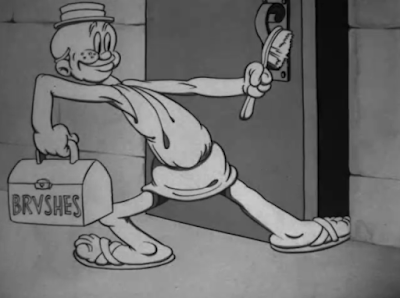
Chuck Jones’ layouts stick out quite strongly throughout this cartoon, especially in the human designs. Porky’s statue of Mercury is no exception–the bulbous nose and rounded body construction are all surefire trademarks of his work. 

Porky grabs the messenger’s hat and winged shoes from the statue, never once taking a beat to stop as he hobbles along, dressing as he prepares to head out. Woodblock sounds simulate the sound of his hooves clopping, but also add an extra jaunty jive to the merry score of “Have You Got Any Castles?” in the background, the cartoon’s motif. It would also be a Merrie Melody courtesy of Frank Tashlin not even a year later.

With that, Porky takes off, soaring in the skies like a pro with his winged shoes. If the scene wasn’t appealing enough with the overhead layouts, the animation of Porky steadying himself is wonderfully smooth and fun—the cherry on top. He circles the palace where the emperor is located, swooping down to his destination. Complete with airplane sound effects, of course.

“Howdy, empy!” Another bulbous-nosed Jones character silences Porky from behind his armchair. 

Emperor Jones (boy, who could that name reference, I wonder?) speaks in a ridiculously hilarious dialect, completed with a thick accent: “Shh! I’m making a fireside chat with my sheeps!” His voice then slips into a Rooseveltian draw as he coos “My friends, Grecians and customers, this is emperor Jones speaking…”

Pan to the audience, which consists of a sea of smiling statues. This entire speech sequence is wonderful—not only is his terrible grammar terribly amusing, (”Statistics show… what last season at this time was population in Greece from 6,000 with 500 with 54 people, with 17 statues.”) but little touches such as one of the audience statues roasting marshmallows and later a hotdog over the fireplace, the emperor making his audience clap by pulling on ropes tied to their arms, and so forth make the entire charade highly amusing with lots of details to look out for. Porky standing idly in the background, awkwardly fidgeting as he tries not to intrude is a great little piece of character animation as well.

The emperor gives the skinny, all while chowing down on a hotdog: a gorgon has been turning more and more people into statues, and they need a hero to steal her life-restoring needle in order to turn all of the statues back into humans again. The hero he has in mind is, of course, Porky  who bashfully accepts the offer. When the emperor asks those in favor to raise their right hand, he pulls on a lever that causes all of the statues to raise their hands in unison, including a hand on a nearby clock. With a handshake, empy concludes “It’s a deal!”

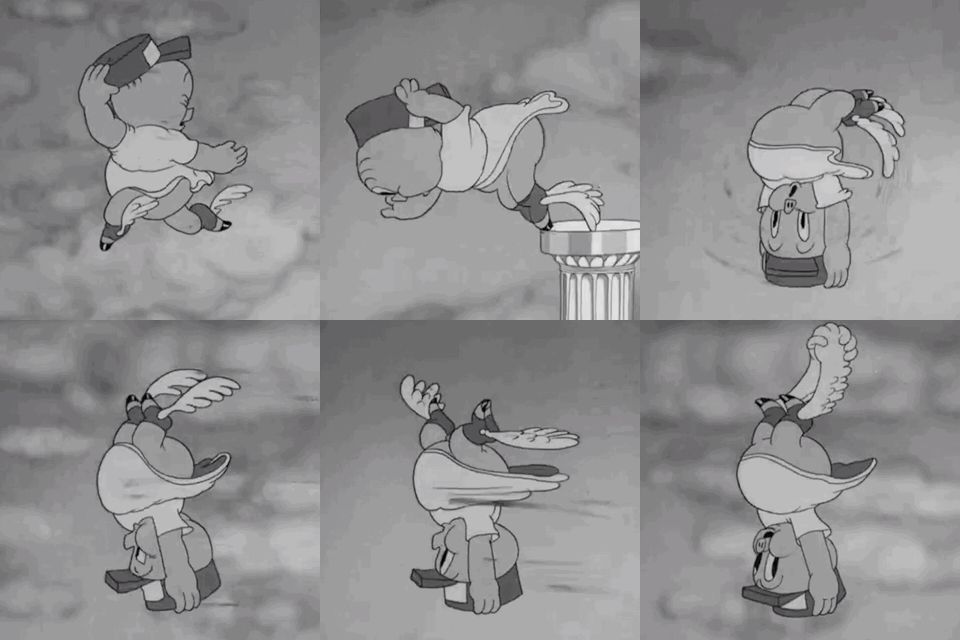
One of the most impressive pieces of animation in the cartoon is when the emperor sends Porky on his way, who waves goodbye as he flies through the air with his winged shoes. Just as he tips his hat, he knocks into a pillar, which sends him tumbling upside down, but still airborne. The wings on his shoes form hands as they shake their fists in the glory of the good landing, with Porky flashing a cheeky grin to the audience before spiraling lower in the air, regaining his balance, and barreling onward towards a smoldering volcano. The animation is full of life and character–though Porky is consistently jolly in the black and white Clampett cartoons, the grin towards the camera as he prides himself in his save is a great little touch of personality. Slowly but surely, bits of character are now becoming more defined.

A gag that took me just now to recognize it—Porky swoops into the heart of the volcano, where we spot the source of the black fumes pouring out the top: the gorgon statue factory. A merry score of “You’ve Got Something There” serves as some easy listening as we’re treated to a sign gag.

Outside of the factory is a human picket fence, comprised of familiar faces: statues of Bobe Cannon, Norm McCabe, John Carey, Bob Clampett himself and Chuck Jones surround the area. 

Directly outside of the factory is the frozen statue of a salesman with his foot in the door—the joke is not only amusing, but the pose is quite strong and readable, too. Though nowhere near the dynamism of Frank Tashlin’s poses in the mid ‘40s, Clampett’s poses in this cartoon are quite defined and exaggerated for the time period. This is especially sharp in the scenes with the emperor.

Porky knocks on the door held ajar by the ceramic statue’s foot, holding out an envelope. “Telegram for the guh-geh-gee-geh-gee-gor-geh–” a hand snags the envelope out of Porky’s grip, causing him to mutter “Aww, nuh-neh-nee-nuh-neh-neh-nut—shucks,” a phrase he echoed in Clampett’s previous entry, Rover’s Rival.

We transition to the inside of the factory, where we see the gorgon herself, positioned in front of a camera, awaiting to take “pictures” of her models. Tedd Pierce voices the gorgon, whose vocal stylings are a parody of Tizzie Lish, Bill Comstock’s character on Al Pearce and His Gang. Interestingly, the cartoon before this, The Woods are Full of Cuckoos, featured a caricature of Lish as well, also voiced by Pierce. 

Clampett and Pierce’s comedic timing is sharp—not nearly as sharp as Tashlin’s timing in The Woods are Full of Cuckoos, but abundantly amusing nonetheless. The gorgon asks for a boy—“a sorta young-ish one”—and in comes a decrepit old man who can hardly hold himself up. The gorgon waits for the man to assume his position on the podium where his picture will be taken, singing a pitchy rendition of “Am I in Love?“, another homage to the characteristics displayed by Lish’s character on the radio.

The gorgon snaps her photo, which turns the shaky old man into a stone statue at once, cheekily labeled “ANTIQUE – $60,000 (P.S.: 000,000)” before he’s yanked off of the podium with a cane. 

“Now let’s try a group picture.” You know it’s a ‘30s cartoon if the Three Stooges come waddling in—they made their caricatured, cartoon debut in the 1934 film The Miller’s Daughter , notorious for being Chuck Jones’ first animation credit. 

As expected, they all beat the tar out of each other while on the podium, rendered immobile only through the power of Medusa’s camera. They turn into the three wise monkeys, labeled “3 MONKEYS OF JAPAN – MADE IN GREECE”. 

Norm McCabe’s animation is easy to spot in the next scene with Porky, characterized by his signature double eyebrows. Porky knocks on a door, parroting a favorite catchphrase from the Al Pearce show that frequented many a cartoon from this time period: “I hope she’s eh-eh-at home, I hope, I hope, I hope, I hope, I hope…” 

Porky shakes the hand of the assistant, unfortunately a blackface caricature (save for the voice, who is just Tedd Pierce speaking in a deep, suave voice) as he greets “Welcome, stranger. Won’t you come in?” 

Before Porky has time to answer, he’s yanked through the iron bars of the door and placed neatly in line for the photoshoot, where he peeks through the door to see the action inside.

A pile of men form a pyramid, where the camera turns them into a literal statue of a pyramid, with some slight imperfections. “Aw, shucks!” laments the gorgon. “You moved!” 

She approaches them with her life restoring needle, allowing the men to form into the proper position, maintaining good balance. She gets her “genuine Egyptian statue”, quipping “Ought to make a handy paperweight!” 

The assistant informs Porky that he’s next. Porky backs up anxiously, echoing a short-lived catchphrase of his from the Joe Dougherty era: “Nuh-neh-no! Eh-nn-nee-no! A-a thousand times no!” 

The decision to make his thoughts visible (his head is slapped onto that of a piggy bank’s) is playful, and also reflects just how big of an influence comics had on Bob Clampett’s work: comic artists such as Milt Gross and George Lichty have been cited by Clampett as inspirations.

In the midst of his panic, Porky backs into a statue of “Dick A. Powello” (Dick Powell and Apollo), causing it to break. But, rather than fuss over the mess, Porky uses the opportunity to hatch an idea instead.

In comes strolling Porky  concealed by Powello’s upper body and a blankett hiding his hooves. The triumphant score of “He Was Her Man” and the gorgon’s smitten woos makes the scene hilarious as is, but the blanket falling off and revealing Porky’s pudgy little hooves is the icing on the comedic cake.

Porky perches himself on a conveniently placed couch, where the gorgon approaches him. “Pardon me, is this seat taken?” She doesn’t wait a wink before snuggling right up to him, a heart symbolizing her affections popping in the air. Though Clampett would play with typography at times and maintain an overarchingly jovial mood to his cartoons, it’s an odd thing to see him play with comic-like visuals in this manner, such as Porky physically envisioning himself as a piggy bank or the heart from the gorgon. I wish he had done it more in this nature! 

With the gorgon too close for comfort, Porky uses this as an opportunity to grab the gorgon’s life-restoring needle, dangling from her neck and lying against her body. 

It wouldn’t be a Clampett cartoon without sexual innuendos— Porky reaches aimlessly around for the needle, prompting the gorgon to let out a shriek, cooing “Why, Mr. A POWELLo!” She smothers the ceramic head in kisses, giving him a nice lipstick finish to boot as she pretends the statue has given her a ring. Her ecstasy is hilarious and WONDERFULLY conveyed through strong, rubbery poses worth freeze-framing. Picturing Porky‘s befuddlement is another humor within itself. 

Finally, Porky‘s disguise is revealed when the gorgon literally crushes the statue in an embrace, stone crumbling around him as he desperately slips out of her grip. As the gorgon makes threats to call the cops, reciting the WB favorite catchphrase of “Calling all cars! Calling all cars!”, Porky makes with the needle and jabs it in various statues, warning them “Uh-geh-uh-get goin’! I-i-eh-it’s the guh-geh-geh-eh-geh-gorgon!” 

As the gorgon chases Porky with her camera, he continues to revive a barrage of statues: the antique, the famed discus thrower (who throws himself out of the scene rather than the discus), the man from The End of the Trail statue, who exits riding his horse like a merry go round (a nod to Friz Freleng’s Sweet Si*ux), a woman who marches off with Popeye’s forearms—note the Bobe Cannon statue in the back here—and a mermaid who unzips her fin and makes a run for it. 

The highlight of the entire montage is when Porky approaches two temples (the two of them together labeled “Shirley Temple”) and injects the needle into them, prompting the temples to use their pillars as legs and run for the hills.

The chase reaches its climax as the gorgon pursues Porky with a movie camera, turning the crank ferociously as she runs. Her plan works— Porky slows down, freezing in mid-air as the gorgon cries “Hold it!” 

Thus, the gorgon pins Porky to the ground, who tries his hardest to fight back, but ultimately flailing around as she commands him to open his eyes. 

We melt into the present, where we find Porky’s mother in place of the gorgon, telling him softly to wake up. He does so, after she pries one of his eyes opens. Relieved that it was all a dream, he embraces his mother, prompting a happy end and an iris out.

This cartoon has a soft spot in my heart—it was one of the first LT cartoons I saw on this whole venture. I thought I was the smartest person alive, understanding the Three Stooges, Popeye, and Shirley Temple references. Who knew just how much I had (and still have!) to learn! Though even without my sentimental biases, this still stands as a very good cartoon.

As I mentioned previously, the poses in this are full of elasticity and energy, especially in the emperor and the gorgon. Porky does a very nice job as well—little pieces of animation such as him fidgeting awkwardly while the emperor rambles on, swinging from side to side as he’s offered the job to be a hero, etc. etc. are full of charm and character. 

While his personality isn’t the most electric in comparison to characters like Bugs and Daffy, it’s the little things like these that really make Porky stand out. With him, a little subtlety goes a long way, and that’s why he’s one of my favorites. He’s so reserved in comparison to such a wild cast of characters that his timidness actually shines through and sets him apart! (Though, on the other hand, he can still have quite the personality, as we’ll discover!) 

Personally, the only gripes I have with this cartoon is the blackface caricatured assistant (which, in comparison to some cartoons we’ve seen and still have yet to see, is relatively mild, but uncomfortable nonetheless). The jokes, while corny at times, still hit, the animation is full of life and vigor, and the short as a whole has a lot of charm, whimsy, and personality. It has my seal of approval. Go check it out! 

Link!

184. The Woods are Full of Cuckoos (1937)

Release date: December 4th, 1937

Series: Merrie Melodies

Director: Frank Tashlin

Starring: Mel Blanc (Alexander Owlcott, Walter Finchell, Milton Squirrel, Wendell Howl, Happiness Boy, Fred Allen, W. C. Fieldmouse, Dick Fowl, Fats, Irvin S. Frog, Fred McFurry, Ruby Squealer, Lanny Hoss, Raven MacQuandary), Danny Webb (2nd Happiness Boy, Joe Penguin, Al Goatson, Andy Bovine), Cliff Nazzaro (Eddie Gander, Bing Crowsby), Tedd Pierce (Ben Birdie, Tizzie Fish, Jack Bunny), Eloise Spann, Lorraine Bridges (Grace Moore, Lily Pons)

This cartoon gets the honorable award of possibly being the most dated Warner Bros. shorts in its vast repertoire of cartoons. Not to worry! This will be a fun cartoon to unpack—I love delving into the shorts that involve extensive research. Learning something new is something that‘s very rewarding to me, and I hope it is to you, too! 

A giant ode to the short lived radio program Community Sing (lasting from 1936-1937), the short chronicles a woodland radio show hosted by a variety of caricatured animals putting on various acts.

Iris in to the ringing of a bell. A pudgy, bespectacled owl rings it as he stands illuminated by the moonlight, preaching to all of the woodland critters, ready to start the show. He introduces himself as “Owlcott”, a take on commentator Alexander Woollcott. He “blandly announces” (his words, not mine) the introduction of the master of ceremonies, Ben Birdie–a bird caricature of radio personality Ben Bernie, “The Old Maestro”.

Birdie’s caricature is not new to audience’s eyes. The caricature, along with a handful of others, is reused from Friz Freleng’s The Coo-Coo Nut Grove from 1936, a short that is very similar in vein to this one. Tedd pierce provides Birdie’s suave, velvety vocals as he introduces the program, only to be interrupted by the nasally cries of Mel Blanc. 

Out pops Walter Finchell, a caricature of Bernie’s faux-enemy Walter Winchell, both of whom carrying a notorious (and fake) feud in the radio-verse. It was common for Winchell to interrupt the smooth-talking Bernie, either throwing pranks or remarks his way, to which Bernie dismissed every time. Indeed, a signature Tashlin upshot angle reveals Finchell dropping an egg on top of Birdie, who blocks it nonchalantly with a handy umbrella.

Art Loomer’s backgrounds for the cartoon are absolutely gorgeous. They’re vibrant in color, very lush and painterly, but remain playful and sophisticated at the same time. They certainly serve as a highlight to the short. And, as always, Carl Stalling’s scores are a blast to hear–his sardonic, wah-wah rendition of “Cause My Baby Says it’s So” is a jolly juxtaposition to the prior score of “Love Is On the Air Tonight”, the latter being the song’s cartoon debut.

Birdie introduces a clever squirrel caricature of Milton Berle, whose routine gets interrupted by a little parrot named Polly. Polly is a take on Eileen Barton’s character, little Jolly Gillette, who was portrayed as the daughter of the show’s sponsor. Polly and Milton go through their act together, Polly bluntly (yet innocently) announcing “My daddy says ya gotta let me sing ‘cause he’s a sponsor!” You can listen to real recordings of their banter here

Volney White’s animation of Milton and Polly is lively and jovial, constantly moving. Milton energetically introduces us to our next star, pointing in the wrong direction and fixing it last second as he gestures towards a bird caricature of country singer Wendell Hall.

Even if viewers don’t recognize the bird’s counterpart, they will most certainly recognize his voice--Mel uses his Foghorn Leghorn voice for Wendell “Howl”. Of course, Foghorn wouldn’t debut for another 9 years, but that’s another story. The animation of the raucous bird is fun to watch as he extends his neck and wraps it around in coils around the microphone stand. Random? Yes, but fun nevertheless.

Perhaps even more commendable is the staggering crowd shot that succeeds Wendell’s scenes. The crowd is mirrored horizontally, but that doesn’t lessen the blow from how claustrophobic it is. Wendell asks the audience to get out their songbooks and turn to page “22… no, page 44. Uh, no, uh, page 28. Uh, 42, uh, 36, uh, 45…” 

Wendell is transformed from an entertainer to an auctioneer, spitting out numbers at rapid pace as his crowd frantically tears through their songbooks. Finally, he concedes. “Oh, never mind. We won’t use the books.” Off screen, the crowd roars in unison: “OH YES WE WILL!” 

With that, Wendell is generously showered with a barrage of books, buried in the pile of rejected papers. The timing of the scene is comedically sharp and energetic, one of the more entertaining acts of the cartoon.

Now, for the real song number, lead by goat and bear caricatures of Billy Jones and Ernie Hare (would a rabbit caricature be too on the nose?) respectively, animated by Volney White. They march out onto the stage--er, tree trunk--and open the curtains to reveal a sing-along to the eponymous song. Thus, the camera pans into the lyrics as everybody bursts into the all-too-earworm-causing song number

As the crowd, Ben Birdie and Walter Finchell all lend their voices to the song, a fox caricature of Fred Allen sings “Swanee River”, clashing with the unity of everybody else. In a nod to Friz Freleng’s Toy Town Hall where the same routine was executed, a little bunny excitedly coos “Ohhhh, Mr. Allen! You’re singing the wrong sooooong!” The fox bursts into everybody’s favorite Mel Blanc Yell as he repeats a frequent ‘30s catchphrase: “WHY DON’T SOMEBODY TELL ME THESE THINGS!?” 

Featured in the song is a seemingly interminable cast of celebrity caricatures, all introduced as the camera pans across the screen, each lending their voice to part of the song. Some puns require more effort than others (Dick Powell as “Dick Fowl” rolls off the tongue better than Al Jolson as “Al Goatson”). 

Caricatures include: Eddie Cantor as Eddie Gander, Sophie Tucker as Sophie Turkey, W.C. Fields as W.C. Fieldmouse, Dick Powell as Dick Fowl, Fats Waller as Fats Swallow, Deanna Durbin as Deanna Terrapin, Irvin S. Cobb as Irvin S. Frog, Fred MacMurray as Fred McFurry, Bing Crosby as Bing Crowsby, Al Jolson as Al Goatson, Ruby Keeler as Ruby Squealer, Lanny Ross as Lanny Hoss, Grace Moore as Grace Moose, and finally Lily Pons as Lily Swans.

Speaking of Grace and Lily, they’re both highlighted as they fight to out-perform each other, seeing who can sing the highest note. Tashlin pulls of a rather intriguing camera move: as the pan settles on the two of them, the background changes. It’s a subtle maneuver, but smart thinking nonetheless--especially since the camera extends into a vertical pan. 

As both women fight to sing the highest note, their necks extend, both of them scaling high into the night sky, harmonizing on one final shrill note. They both crumple back into the stands, exhausted by their efforts. Some fun exaggerated animation for sure--one wonders how much further this would have been pushed had this been Tashlin’s second stint at WB rather than his first. His speed often rivaled, if not out-performed, Tex Avery’s.

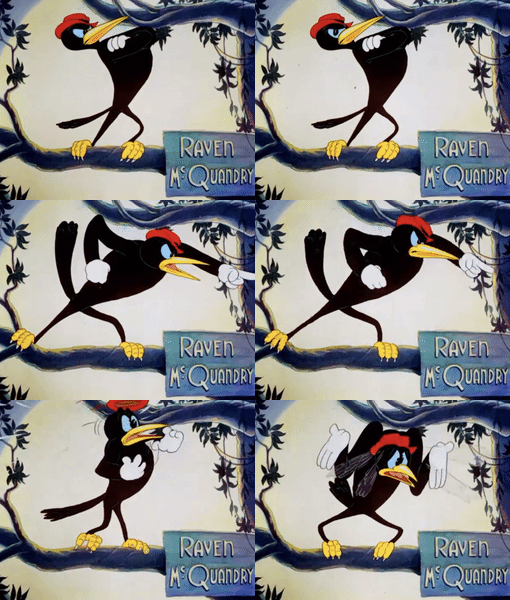
Birdie and Finchell have a brief interstitial together before making way for a raven caricature of Haven MacQuarrie (Raven McQuandry). His sequence is almost jarringly short, but full of fun drawings and poses–the pose of him standing curtly with his arms crossed is awfully reminiscent of Izzy Ellis’ work under Tashlin and later Bob Clampett in the mid ‘40s. 

McQuandry asks “Do YOU wanna be an actor?”, parroting the name of his real life counterpart’s show So Do You Want to be an Actor? The audience shouts “NO!” in unison, causing McQuandry to do a take and shrug dubiously. Though the scene is only a few short seconds, the animation brings forth some much needed vitality.

Next is a penguin caricature of Joe Penner, singing a hilariously out-of-tune rendition of “My Green Fedora”. The animation is reused from the cartoon of the same name (notice how he doesn’t have penguin feet!), which was also used in Toy Town Hall. Not a complaint, but more an observation--this is by far the most humorous performance of the song yet, sung by Blanc rather than Tommy Bond.

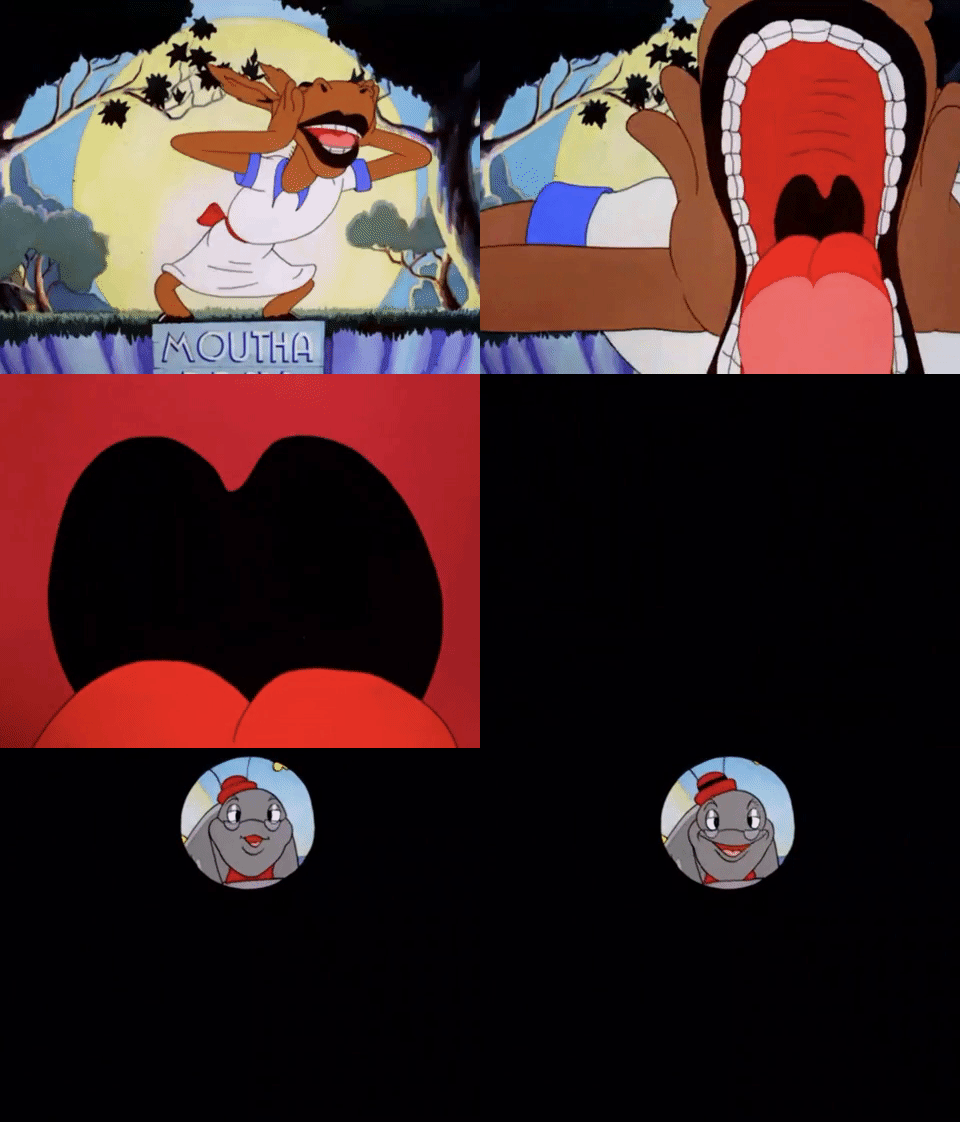
Another fun scene with some vivacious animation is a sequence featuring a mule caricature of Martha Raye (dubbed Moutha Bray), singing a cover of “How Could You?”, which has been featured as an underscore in cartoons such as Porky’s Badtime Story and its later remake, Tick Tock Tuckered

Raye’s large mouth served as prime material for caricatures, as we see here. The animation is snappy, fun, and vivid--she finishes her song by “swallowing” the camera, an old trick that beckons memories of the Harman and Ising cartoons of animation past. 

An interesting trend in the ‘30s WB cartoons is the trend of playing with the iris, whether it was the closing iris out or an iris in between transitions. Tex Avery would consistently play with the final iris out on his cartoons, whereas directors such as Friz Freleng and Bob Clampett would use one as a transition between scenes. Here, Tashlin uses the “swallow the camera” technique as a segue for an iris in, Tedd pierce’s falsetto squeaking “Hello folksies!” as we’re introduced to a fish caricature of Tizzie Lish, a character played by Bill Comstock on Al Pearce and His Gang.

Though Tizzie has long faded into obscurity (as has the entire Community Sing radio show), it’s still quite easy to appreciate Pierce’s vocals and mannerisms as he portrays the character. It’s always a joy to hear him doing voices for cartoons--he’s never been my favorite writer on the crew, but he was an excellent talent as a voice actor. 

His squeaky deliveries, matter of fact deliveries “Mix them up… are you mixing? My friends say I’m a good mixer. Are you? Or aren’t you?” as Tizzie haphazardly dumps food items and their respective utensils into a bowl and prepares the meal are nothing short of hilarious. The timing is very well executed and can be appreciated regardless of background knowledge.

After humming a pitchy rendition of “The Lady in Red” while waiting for her concoction to bake in the waffle iron, Tizzie removes the homemade waffle and discards it, instructing the audience “Now take the ‘wiffle’ out and eat the iron. You must have iron in your system. Or should you?” Thus concludes Tizzie’s act, certainly heightened in hilarity by Pierce’s vocals and timing.

For the final act, Ben Birdie introduces a possum caricature of Louella Parsons, the host of the radio program Hollywood Hotel, which served as a way to advertise upcoming movies by featuring guest stars enacting some of the scenes. Here, we have caricatures of Jack Benny (as Jack Bunny, the first of his many reoccurrences), Mary Livingstone (Canary Livingstone), and Andy Devine (Andy Bovine).

Tedd Pierce voices Andy Bovine, whose voice was burlesqued not only in this cartoon, but to a greater extent in Friz Freleng’s My Little Buckaroo not even a year later. Devine, a western star, was notorious for his scratchy, shrill voice which was rife for comedic opportunity. 

Indeed, this scene here with Pierce’s vocals is nothing short of hilarious: the trio chronicle the prodigal’s return, in which bunny and canary coo over their baby son. Out of the bassinet pops incongruously large bovine, who shrieks “HOWDY MAAAA! HI PAAAA!”, the sheer volume of his voice enough to blow both of his parents away and out of the scene. And, with that, the scene ends, red curtains colorized from Porky’s Romance marking the sequence’s end. Short, sweet, to the point, and hilarious.

Ending right where the cartoon began, the owl caricature of Alexander Woollcott bids us farewell, the iris closing in on the bell he rings as he exclaims that all is well.

Like so many other cartoons I’ve reviewed, this is one that I slowly warmed up to upon rewatching it and typing out the review for myself. I didn’t entirely dislike the cartoon upon my first watch, but it’s undeniably dated and deserves its title as possibly the most dated cartoon. 

Without further research, some of the jokes and caricatures (if not all of them) are difficult to appreciate. The animation has bursts of energy throughout the short, the highlights being the scenes featuring Raven McQuandry and Moutha Bray, but otherwise remains relatively simple and conservative. Tashlin does incorporate a few intriguing camera angles throughout the cartoon, but many other entries of his are far more cinematic.

However, despite all of that, this cartoon is not without its bonuses: Art Loomer’s backgrounds are stunningly gorgeous and rich, and as someone who loves the lush, painterly backgrounds of the 1930s, this is heaven to me. And, as I mentioned previously, Tedd Pierce’s scenes are great--the Tizzie Fish and Andy Bovine sequences are undeniable comedic highlights.

So, if you’re willing to dedicate time to put in the research for this cartoon, you’ll find it’s quite fascinating! I’m certain this was a much bigger gut-buster in 1937 than it is in 2021, but even then, this is a good cartoon for people such as myself who love to learn more information and seek out facts. 

As a result, I’d recommend it to people who fall into that category. If you’re just someone who wants a good laugh and a leisurely watch, there are more interesting cartoons that lie ahead. You won’t miss much by skipping it.

With that said, here’s the link!

183. Porky's Double Trouble (1937)

Release date: November 13th, 1937

Series: Looney Tunes

Director: Frank Tashlin

Starring: Mel Blanc (Porky, Killer, Falsetto), Frederick Lindsley (Narrator), Shirley Reed (Petunia, Female Customers), Danny Webb (Male Customer, Mobster, Cop, Police Chief), Tedd Pierce (Mobster)

The end of an era—this is the final cartoon to feature “fat Porky”. Though he’d been dieting since late 1936 and steadily throughout 1937 with the other directors, Frank Tashlin was the last one to skinny him up. Ironic, since he was such a stickler for streamlined designs! Nevertheless, this is an exciting change, as Porky is finally completing his transformation into the pig we know and love today.

Not only that, this is the final appearance of Frank Tashlin’s Petunia as well. She’d go on a hiatus all throughout 1938, only to be revived by Bob Clampett with a totally new design in 1939. Unfortunately, she was only kept for two more shorts before being discarded again. Parting is such sweet sorrow! 

We deal with not one Porky, but two: an escaped convict kidnaps Porky and steals his identity in order to successfully rob a bank. It’s up to Petunia to put a stop to this criminal’s crime spree… or is it? 

A silhouette of a pig furtively creeps under a blanket of typography from the title card. The pig isn’t our favorite stuttering porcine, but rather a grisly, stubbly Porky doppelganger attempting to escape from prison. He jumps and growls at the spotlight that shines on him, shooting at the offscreen subjects. Not only does he whip out two pistols, he even flips them–such a small detail of flamboyant dramatics goes a long way.

Prison guards shoot back at the convict, silhouetted against the night sky, illuminated only by the glow of the searchlight and the stylized white bullets raining down below. The composition is stellar, its flatness reminiscent of the backgrounds of the early ‘40s cartoons, primarily from the likes of Frank Tashlin, Chuck Jones, and even Norm McCabe. 

A whistle screeches as the prisoners run along, rifles in hand. In all, the dramatic opening rampant with silhouettes feels quite reminiscent to the opening of Little Beau Porky, another Tashlin entry just a year prior.

Callbacks are more blatant as we undergo the signature Frank Tashlin Expositional Montage, footage of cop cars racing out into the street reused from Tex Avery’s The Blow Out, while a close-up of a newspaper press is also reused from Avery’s Porky the Wrestler. All the while, a shot of the convict, identified as “Killer” by one of the newspapers in the montage, oversees the chaos, his eyes drifting along to survey the action, his lips parted in a sneer. The narration is the cherry on top--often times, narration has a tendency to feel redundant, as if it’s a crutch to support the gags (i.e. some of Tex Avery’s earlier entries), but here it elevates the theatrics of the entire prison escape.

Speaking of narrators, ours introduces us to a gangster hideout–an abandoned all girls school by the name of Katz School for Girls--a nod towards studio business manager Ray Katz--no doubt a place frequented by Killer. Tashlin’s cinematography is in full swing as we iris in on an exterior shot of the hideout before panning along the interior, an arsenal of weapons littering the schoolroom of years past. A smooth, clever transition of pans from the classroom to a grandiose hallway, focusing on a door.

Killer’s lackeys crowd around a table littered with alcohol bottles and playing cards, but most importantly, newspapers highlighting killer’s escape. His cronies all mutter words of praise in thick Brooklyn accents (”Yeah, dis guy’s clever, jus’ like Who-dun-y! He can get outta anyt’ing!”). The conversation between the gangsters is surprisingly natural and fun to listen to: one of the lackeys likens killer to “Clark Taylor”, a humorously false remembrance of actors Clark Gable and Robert Taylor combined.

Knocking outside the door prompts the cronies to whip around with their guns drawn, all crowing “Who’s ‘dere!?” in unison. Outside the door stands a rather spherical caricature of Mae West–if there’s a Mae West cameo, it must be a ‘30s cartoon! 

Mae informs the boys that she comes peddling a message from killer. Furtively, they all crowd around the door, stacking on top of each other, each peering out of their own peephole door. The silent film inspiration is strong in this shot. Not only that, its composition also reminds me of some of the shots in Tashlin’s Porky Pig’s Feat, a personal favorite of mine. 

All hesitation to let newcomers in is dropped once the cronies spot their curvaceous company. They’re instantly smitten, batting eyelashes and all, one of the cronies going so far as to stroke Mae the Messenger’s face. Tashlin’s cartoons always had a promiscuous flair to them, especially in the ‘40s--here is no exception. Perhaps it’s only natural, seeing as this entire cartoon is one large parody of all of the gangster pictures churning out from Warner Bros. at the time (Marked Woman, Kid Galahad, San Quentin to name a few.) 

“He said…” Mae lunges a haymaker, causing all four cronies to domino together and knock into the door as Mel Blanc settles out of his falsetto, “NOT T’ FOOL AROUND WITH DAMES, YA LUGS!!!” 

Killer strips out of his outfit (even removing an iron barbell from where his chest is), growling “Let that loin ya a lesson!” As always, Mel is fun to listen to–his falsetto voice sounds rather similar to the voice he’d use for his Lou Costello caricatures. 

Killer eyes a stray newspaper, gloating “Once I was only public enemy numba NINE!” at the sight of his new title as Public Enemy #1. It should be noted that in Tashlin’s first picture, Porky’s Poultry Plant, another “public enemy” gag is used. Gag continuity is always fun to see! 

His eyes drift over to an article on the other side of the page (if you look closely, the date is “Thoisday, Octember 42nd”, the paper addressing the denizens of “Porkysville”.): 

“Hey! What’s dis? Da guy looks just like me! He could be me twin brudda!” 

Frank Tashlin’s disgruntlement with Porky can be felt multiple ways here. Not only did he hesitate until 2.5 minutes into the cartoon to introduce him, the underscore is “Puddin’ Head Jones”, a frequent score associated with Porky on numerous occasions offering not-so-subtle commentary about his intelligence (or lack thereof.) Killer ushers his lackey to take a glimpse at his bank-teller doppelgänger, whispering a plan to them involving Porky and the bank, the narrator clueing us in that “the evildoers carefully plan another hideous crime.” 

It’s not a Tashlin cartoon without his signature up-shot: we iris in on an impressive up-shot view of “Worst National Bank”, a score of “Plenty of Money and You” and even the extravagant car horn of a limo solidifying that yes indeed, this here’s a bank! Inside, Porky dutifully deposits the goods of his spherically designed patrons. Even by 1937, these mathematically proportioned designs were out of style–I suppose Tashlin got the memo, though, seeing as this is the final “fat Porky” cartoon, indicating a transition into more modern, streamlined designs. 

Bob Bentley animates a close-up of Porky depositing the cash of a Scottie dog. Cue the ever prevalent “cheap Scotsman” gag, the Scottie’s coin purse (a sock with a lock on it) revealing a swarm of moths upon its opening. He deposits a lone dime, Porky happily obliging to sign the bank book. The Scottie leaves, and it only takes a few bloated seconds for Porky’s brain to catch up with him, realizing that he just signed a bank book to deposit a measly dime. He smacks himself in the face, a Carl Stalling favorite cue of “You’re a Horses Ass” providing musical commentary as Porky glowers into the camera, hand sliding down his pudgy face. 

Stereotypes aside, this is a fun little scene. It gives Porky some personality, accentuating his gullibility (a persistent factor of his character, no matter who is directing him), and Bob Bentley’s animation is extremely appealing. No discretion to Volney White, who animates the next scene, but there’s a noticeable difference in Bentley’s and White’s styles, Bentley’s animation much more dimensional. I absolutely love how he draws Porky.

Secretary Petunia, once again voiced by Sara Berner, coos at Porky to come over to her desk. She wastes little time flirting with him, asking that the two “step out” for the night. Volney’s animation of Porky is hysterical–his discomfort is exceedingly visible. 

Porky gets cold feet, a stuttering mess (more than usual) as he sputters “Geh-eh-g-eh-g-g-gee, miss Petunia, I’m, uh, buh-beh-bashful… huh…heh, you’re so eh-peh-purrty, and eh-uh-I’m, uhh… yee-you’re, uh…” 

Cue one of my favorite deliveries ever by Mel Blanc as the lunch bell rings. Porky grins, realizing he’s saved by the bell. He doesn’t stutter once as he declares breathlessly “It’s time for lunch, g’bye!” and rushes off. The comedic timing, both from Mel’s delivery and Volney’s animation, couldn’t be better. 

Porky strolls outside, where he stumbles across Killer (disguised as Mae West again) hammering away at a car. Porky’s good nature prevails, which often leads to trouble: with a polite tip of the hat, he asks if the woman needs any assistance. “Would you be so kind?” 

As Porky works on the vehicle, Killer prepares to strike, hammer in hand. His motives are thwarted as Porky turns to offer assurances that the car will be fixed in a jiffy, Killer impatiently hiding the bludgeoner behind his back. The charade continues, Porky turning and talking, putting a stop to the nefarious deeds. 

When Porky turns to say “Eh-nuh-neh-nuh-now, it’s in the beh-beh-eh-beh-bag!”, Killer grunts in his normal voice “SO ARE YOU!”, kicking Porky under the hood and peeling off in the car to certain doom.

The transition from Killer kidnapping Porky to Killer putting on Porky’s clothes (who’s bound and gagged in a chair) is surprisingly snappy, yet comprehensible and smooth. Of course, the narration does contribute to the clarity, but regardless, such a quick transition can be difficult to convey smoothly and clearly. Tashlin does it very well.

Volney White animates Killer’s taunts to Porky: “and, wit’ your sissy clothes on, I can rob da bank! And YOU’LL take da rap, see!? AHAHAHA!” Volney’s animation is fun to watch–before I saw this cartoon for the first time, I only ever saw google images of it, this scene being one of those images. Volney’s eye takes amazed me at how anachronistic they seemed, and I recall likening him to Joe Murray if he made cartoons in 1937. Very fun eye takes indeed! 

Speaking of fun, Bob Bentley does a neat little scene involving a brawl between Killer and his reflection in the mirror. He goes to check out his new pilfered duds (”Now I look like da squoit!”), admiring himself in the mirror. Suddenly, his reflection grows a life of its own, sticking its tongue out. Real Killer gets pissed (if you notice, when he does a take of surprise, you can see where the cel of the reflection gets cut off) and punches the mirror, leaving the glass broken, his reflection now touting a blackened eye. While the “reflection becoming sentient” gag may seem tired, I enjoy how interactive killer’s reflection is, all without saying a word. The staging feels incredibly natural and nonchalant.

With that, Killer makes his way to the bank, whistling along to the underscore of “With Plenty of Money and You” beneath the words of the narrator. You can spot a bit of camera trouble as the camera pans out from the sign at Porky’s desk reading “PORKY PIG – OUT TO LUNCH”: the pan janky, the picture briefly turning blurry before resuming to normalcy. It’s more interesting than detrimental, especially considering Warner Bros. never did retakes.

Cue a montage of “Porky” stowing away the goods of the townspeople into his pocket, pretending to deposit them in the bank. The minor key rendition of “Puddin’ Head Jones” is a nice reminder of Killer’s similarities and differences to Porky. Similar in appearance, maybe, but not much else. 

Petunia engages in her routine from before, attempting to seduce “Porky”. Mel Blanc’s genius shines as killer responds to Petunia’s calls in a gruff, scratchy “YEAH, WHAT IS IT!?” He catches himself, and responds in an authentic Porky voice “Ye-ye-ye-yes, wuh-weh-wuh-weh-what is it?” 

The transition is seamless. Whether it was on one take or two separate recordings, I don’t know, but it remains just as entertaining either way. I especially like how Killer switches from “yeah” to “yes”–Porky’s personality, while still relatively thin at this point, is certainly coming clearer. At the very least, Frank Tashlin knows that Porky would likely say "yes" over "yeah". It’s a little detail, but it says a lot.

And, just like myself, Petunia also understands the distinctions between Killer and Porky–especially when Killer plants a kiss on her as soon as she pulls the same “How ‘bout you and I stepping out tonight, big boy?” routine. Killer grabs her in his arms, sneering “Why wait until tonight, baby?” and gives her a kiss, prompting Petunia to smack him and declare “Why, you’re not Porky Pig!” Killer’s response is full of careful wit and thoughtfulness as he so eloquently answers: “SO WHAT?” 

Ringing the burglar alarm, that’s what. Petunia discreetly sets the alarms off, prompting a flurry of bullets to whiz at Killer offscreen (they sure have good security!). Killer retaliates with his own shotguns, but quickly speeds off to his hideout, goods still in his possession.

Killer and his lackeys admire the treasures stacked on the table, eager to pounce. A clever pan to Porky, still writhing around in his ropes as killer sneers “AND DEY ‘TINK YOU DID IT!” 

Tashlin’s artistry strikes again as we peer at the hideout through the bars of iron gates outside. Truck out to reveal police officers crowding around outside, crouching on the ground to remain discreet. The shot is composed rather nicely, with the ground level nearing the horizon line, elevating the subjects to the middle plane. Even though the shot itself doesn’t linger very long, the clarity is easy to see. A tree placed off to the side cleverly frames the two officers who are on the screen--little things like that make a big difference.

One of the lackeys notices the cops are lurking by, alerts the others, and immediately shoots his machine gun out the window. Watch all of the stuff flying out of his pocket as he shoots–playing cards, knives, guns, jewelry, even a wig! Definitely a fun scene to freeze frame and pick apart all the details. 

The cops retaliate, and an all-out shootout occurs. A gag reused from I’m a Big Shot Now and Porky’s Duck Hunt ensues as a cop shoots up at the building, the impact from his rifle driving him into the ground as each shot digs the hole deeper and deeper. Another rather fun gag includes a woodpecker drilling into a tree, causing the officer in the branch to clutch his heart and moan “They got me!” 

In the process, stray bullets from down below shoot out of the floor, conveniently ripping the ropes bounding Porky to the chair. A quick bird’s eye view of the hideout, and it’s onto Porky to take action. Because we all remember Porky as a suave, charismatic crime fighter, it’s only natural for him to jump onto a chandelier hanging from the hallway and knock all of Killer’s cronies into a door. 

Volney White’s animation prevails for the remainder of the cartoon. Porky hops down from the upstairs landing, plopping down right on top of Killer himself. Both come to fisticuffs, Volney’s hilarious facial expressions and Treg Brown’s masterful sound effects combining to make quite the amusing amalgamation. Certainly a scene worthy of freeze-framing for all of the funny faces! 

Perhaps even more amusing, however, is the drastic tone shift as soon as the cops arrive: no time is wasted during the transition between the fight and an armed cop probing “Alright, who’s the killer!?” The fight breaks up in an instant off screen, and porky (his voice un-sped) pleading “I’m uh-puh-peh-puh-peh-Porky!” 

The transition is almost too swift, but is comical over everything else, so I’m not too slighted by it. Killer insists in his own gruff voice “I’M Porky!” The cop isn’t convinced, and tries again. Both insist that they’re Porky.

That’s when it’s Petunia to the rescue, who assures the cop that she knows how to find out. She cozies up to the real Porky, once more enacting their “big boy” charade from earlier. As Porky flops over his words in all of his collar-tugging glory, Petunia gloats “That’s Porky.” Porky nodding along to her affirmation is a nice, subtle touch.

As we’ve repeatedly discovered, Frank Tashlin was no fan of Porky. Even though he outwardly admits that he didn’t like to work with him, there are multiple clues throughout his pictures solidifying his disdain. Here is no exception, as Petunia outright screws Porky over. 

Her sultry demeanor changes from reassuring to duplicitous as she heaves a sigh and coos “How that killer can kiss!” Porky rightfully grows angry, and allows his jealousy to triumph his bashful, reserved nature as he grabs Petunia’s arms and pulls her in for a kiss. Killer’s eye-boggling, affronted expression and Porky’s triumphant, chest-puffing stance after the fact are both hilarious. Volney White does a wonderful job of conveying personality through his animation.

Here’s the kicker. Despite getting her kiss from Porky, Petunia still isn’t satisfied. She coldly remarks “I STILL take the Killer!” With that, Porky can only gawk in awe as Petunia and Killer march arm-in-arm out the door, Petunia cooing that she’ll wait until Killer gets out of prison. Iris out.

The voice acting steals the show in this cartoon. Mel KILLS it (no pun intended) as Killer, from the falsetto to the Porky impersonation–which is just Mel doing his regular Porky voice–to Killer’s evil belly laughs. Sara Berner does a fine job as Petunia, and Tedd Pierce’s narration is always a joy to hear. I’m unsure of who voices the lackeys, as they don’t quite sound like Mel, but nevertheless, they too are fun to listen to, especially their introductory dialogue. If anything, you should check out this short for the voice work alone.

Frank Tashlin’s eye for cinematography sparkles as it always does. The opening montage is particularly impressive, especially the use of silhouettes. Very bold and striking. His layouts are very well structured, and the cartoon flows very nicely. It’s a snappy one, but it hardly feels like it drags. There’s a lot packed into these 7 minutes! 

Though I do pity Porky, especially at the end, I will concede that the end IS a good shocker, even if Petunia is straight up cruel. Porky’s personality is slowly weeding its way out of the woods, with some traits (good natured, gullible) sticking to his character all throughout his career. Progress is being made! 

And, as I said before, as much as I enjoy the fat Porky design, I won’t shed too many tears over this being its final appearance, because it marks a new step forward for Warner Bros. Cartoons are becoming funnier, snappier, wittier, the Disney influence continually waning. Good things await.

I definitely recommend you check this one out. While it’s not my all time favorite Tashlin cartoon, there’s a lot to admire, from voice direction to animation to even the layouts. 

Link!

390. Case of the Missing Hare (1942)

Release Date: December 12th, 1942 Series: Merrie Melodies Director: Chuck Jones Story: Tedd Pierce Animation: Ken Harris Musical Direction:...