Showing posts with label Roxy. Show all posts

Sunday, February 28, 2021

16. One More Time (1931)

Release date: October 3rd, 1931

Series: Merrie Melodies

Director: Rudolf Ising

Starring: Johnny Murray (Foxy), The King's Men (Chorus)

One More Time gives us Foxy one more time. He’s credited as both Rudolf Ising AND Carman Maxwell… I’m not certain about the validity of that, but again—88 year old cartoon. [EDIT: Keith Scott confirms this is the vocal work of Johnny Murray.] This is the end of Foxy’s very short lived career. Predictably, Walt Disney asked if Harman and Ising could discontinue the use of Foxy for obvious reasons. It’s a shame, as much as a blatant rip-off as he is, I really like his design! I don’t know if it’s the freshness of “Finally, a new character” or just the relief of “Finally, not a caricature”, but he seems to have slightly more personality than Bosko. Still barebones and transparent, but he’s fun to watch. In this short, Foxy assumes the role of a police officer, but maintaining order proves to be difficult when reckless driving and kidnapping gangsters interfere with his duties.

We open with our favorite copyright infringement merrily patrolling the streets. All is well, until a handful of cars speed past Foxy, nearly flattening him across the road. Justifiably his mood turns sour as he launches into “One More Time”, a very catchy, rhythmic patter song. He dodges various cars, cursing “Just one more time!” and shaking his fist.

He turns a corner for safety, when a gangster unprecedentedly rises from a trashcan and shoots Foxy’s hat to smithereens. In retaliation, Foxy pulls a gun on him, and a mouse extends out to give a hearty whack to the gangster’s head. These gags are predictable, but how I love them! They’re just so cheesy and fun. Not to mention, this entire sequence (and cartoon) is paced really well. It’s snappy and quick, but not too breakneck, either. It fits just right with the brisk tempo of the song.

Focus shifts to the hippo from Smile, Darn Ya, Smile! driving a fancy car. A mouse in a tiny car behind honks at her to get out of the way, and both of them battle for dominance. In the midst of their Wacky Races-esque battle, Foxy gets run over by the hippo. Rightfully so, he tweets on his whistle and goes to right her a fine.

The song portion picks up again as the two patter song in argument. What a great sequence! The timing is just right. The beat is catchy and tactile, and the voice acting is relatively good compared to what we’ve seen. Foxy writes her a fine as the hippo tries to negotiate with him before bursting into crocodile tears, occasionally checking to see if Foxy buys it. To get her to shut up, Foxy slaps a trash can on her head and walks away.

Conveniently, Foxy stumbles upon Roxy and her dog (who I bet was not at all influenced by Pluto in any way, shape, or form). The dog is ecstatic to see Foxy and pins him against a wall, showering him in licks. Foxy protests and Roxy giggles, borrowing Bosko’s catchphrase of “Ain’t that cute?” 

She skips away to position herself at a player piano that just happens to be handy and bangs out “One More Time” on the keys. Foxy’s protests and the dog’s licks are executed in time to the beat. Foxy briefly ties the dog’s tongue around its snout as a muzzle, but both become overpowered by the magic of music and join in dancing.
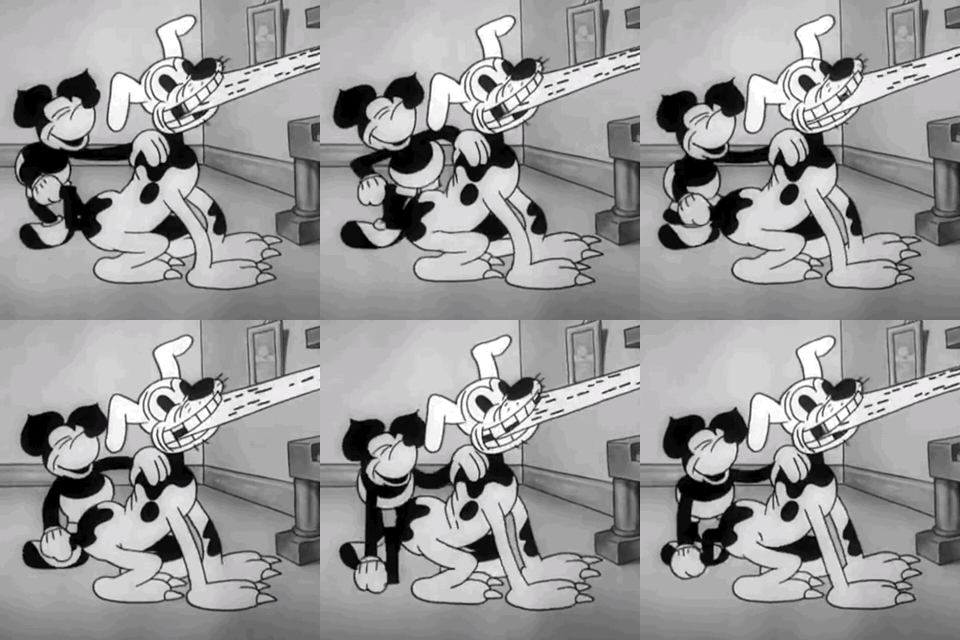
Another predictable gag that warms my heart regardless—Mickey Foxy uses Pluto the dog as a player piano, playing the music with his teeth.

However, they’re interrupted by the sound of gunshots. A bird robs another hippo of a pocket watch and speeds away, with the police going after the criminal (complete with a cat siren).

Foxy chases after the bird (who is driving a tiny excuse of a car). The bird drives through a pipe, and at the other end pops out a much bigger buggy and a gang of criminals who join in the chorus of “One More Time”. We have some shots of the police and then the gangsters singing the song call and response style. Once again, very catchy, with some lush barbershop harmonies.

The gangsters throw a grenade at the police, stopping them in their tracks, leaving Foxy with the responsibility of stopping the crime.

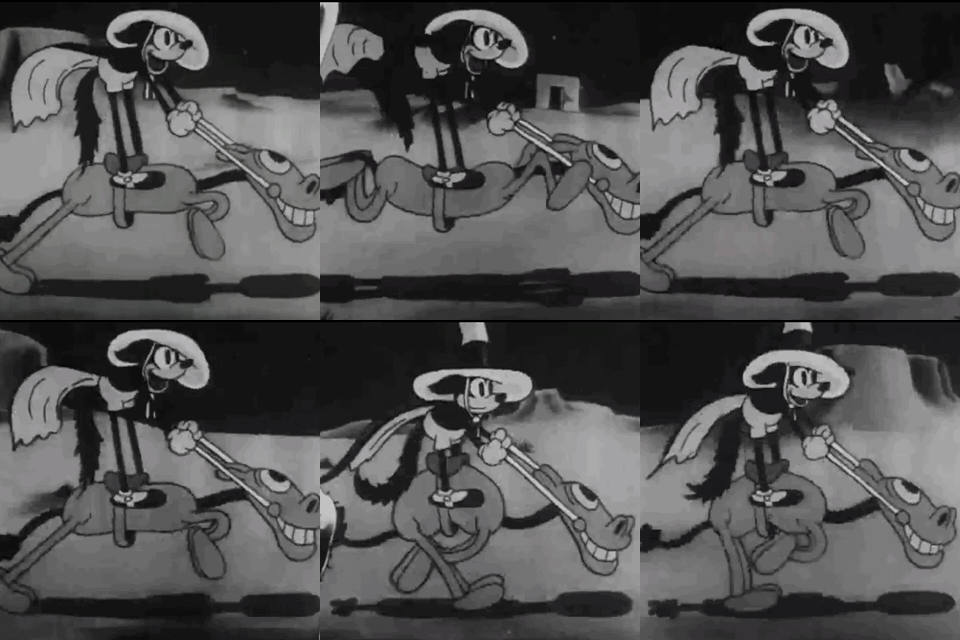
No crime is complete without a little kidnapping! The gangsters kidnap Roxy and drive off, and Foxy chases behind on the same mechanical horse used by Bosko in Ups ‘n Downs. This entire sequence happens like a breeze, it’s so fast! But not entirely in a bad way. The music is fast and it’s the climax, so the fast pace is relatively charming.

Foxy races behind the gangsters, and by pulling the horse’s tail, the horse extends its mechanical head to bite Roxy’s skirt and bring her to safety. The tables turn as the gangster are the ones pursuing the chase instead of initiating it.
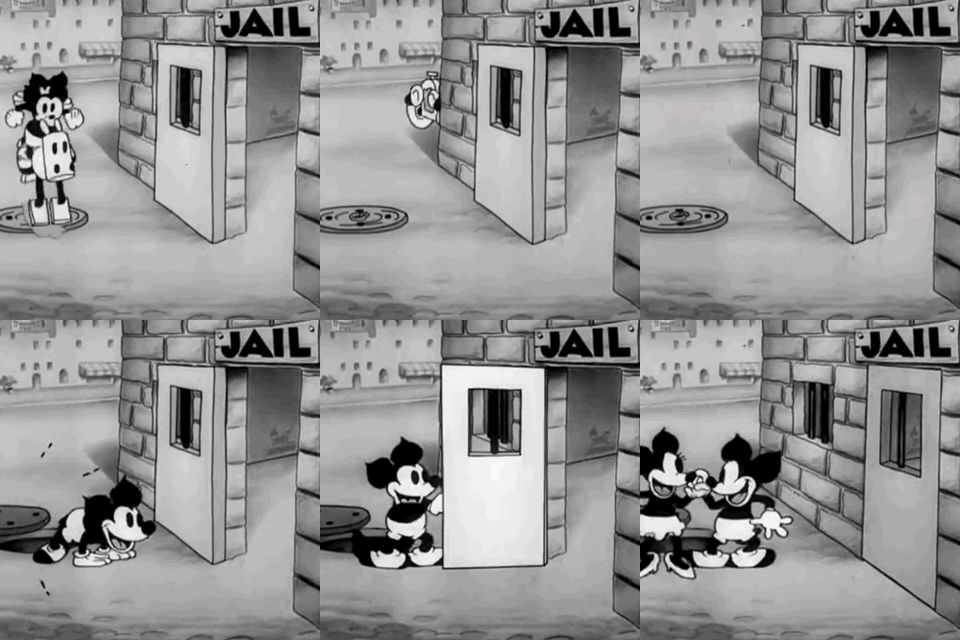
God, I love this! Foxy and Roxy ride into a local jail cell with the gangsters hot on their trail, and pop right out from a manhole cover, locking the criminals in the slammer. It might be a trite gag (as all of these are), but it’s nevertheless amusing.

Everything’s peachy keen as the criminals give a last bar of “One More Time”, and Foxy bows.

That is until the bird also rises from the manhole and SHOOTS FOXY IN THE BACK. Iris out! 

So our loveable copyright infringement was killed off! That scene is set up to be funny and not to be taken seriously, but considering this is the last time we see Foxy, it wouldn’t be stretching the truth to say he was killed off.

What a short! In my opinion, this is the most polished of the Foxy cartoons. The pacing is perfect! There are only some repetitive scenes towards the beginning with foxy walking down the street. The jazzy score of the music picks up the pace and allows the cartoon to be bouncy, swingy, and chipper. Compared to other cartoons, the voice acting isn’t half bad! Very entertaining and a good way to bid goodbye to Foxy. I’d definitely recommend a watch! I might watch it again, just one more time!


Saturday, February 27, 2021

14. Smile, Darn Ya, Smile! (1931)

Release date: September 5th, 1931

Series: Merrie Melodies

Director: Rudolf Ising

Starring: Johnny Murray (Foxy), Rudolf Ising (Cow, Skeleton), The King's Men (Hoboes), Ken Darby (Narrow Collars)

Perhaps the most well known cartoon to feature Foxy (granted, there WERE only 3 of them made). The song “Smile, Darn Ya, Smile!” was even used in the ending scene of Who Framed Roger Rabbit! To further twist the tangled web of Harman and icing’s Disney influence in Looney Tunes, this short appears to be heavily influenced (if not a remake) of Disney’s Trolley Troubles starring Oswald the Rabbit, which Hugh Harman has some influence in creating him (like Mickey Mouse.) 

We’re greeted by the smiling face of Foxy, who starts the cartoon off by singing “Smile, Darn Ya, Smile!” while driving a trolley (and using a cat’s tail as a rope to pull, sounding a bell). God, what an earworm! It’s so catchy! And Foxy doesn’t sound half bad, either. 

Foxy makes a stop to allow any passengers to board. An oversized hippo attempts to climb aboard, but has trouble fitting. There’s a part where Foxy is pushing her and she starts talking backwards inexplicably. Thank god for IMDB trivia: evidently she says “Susie heard one of those Atlantic bells! Whaddaya think?” I guess it isn’t all that inexplicable, probably intended to imitate some angry muttering, but it was a little jarring at first to hear.

To solve the dilemma, Foxy plucks a feather from her hat and pokes a hole in her stomach, which causes her to deflate like a balloon. Embarrassed to be seen in her underwear, the woman marches off as Foxy laughs and hops back into his trolley.

Now we find Roxy waiting patiently by the tracks. Foxy happily picks her up, and together they sing “Good Morning to You” and “Smile, Darn Ya, Smile!”. This is actually the first time we figure out Foxy’s name (“Good morning, dear Foxy!”)—his name wasn’t mentioned in the previous cartoon.

While the lovebirds sing “Smile, Darn Ya, Smile!” we have a few gags with the advertisements on the inside of the trolley, like a long necked dog advertising “Narrow Collars” singing a bass line, the “Sniff Brothers” advertising cough drops, their coughs so powerful it causes a chicken to loose all its feathers and hit the brothers over the head, and an advertisement for “Risk Tires”, the advertisement next to it a picture of a tombstone captioned “Ask the guy who owns one!” like everything else in these cartoons thus far it’s just a simple “objects anthropomorphized” gag, but the jokes land. The pacing of this sequence (and quite honestly the cartoon as a whole) is smooth and quick. The voice acting is decent, no awkward pauses that drag the short on forever. And that damn song is criminally catchy! 

In similar fashion to Sinkin’ in the Bathtub (and, going back to Disney, Trolley Troubles), a cow blocks the path of Foxy and Roxy. Foxy attempts to scare the cow away, repeatedly yelling “hey!” but to no avail.

Cut to a gang of hobos who find merriment in Foxy’s dilemma, transitioning into a BEAUTIFUL barbershop chorus of the eponymous tune. I love the music in all the looney tunes shorts, especially Carl Stalling’s scores during his 1936-1958 career, but I have a fondness for the music in the 30s shorts. There’s an abundance of lush harmonies, barbershop quartets and pseudo-Andrews sisters types. They make for a very atmospheric cartoon. Even if a cartoon doesn’t have much going for it, a good music score can cushion the blow of a bad short (not that this one is bad, I really enjoy it!) 

In pure cartoony goodness, Foxy manages to slide the entire trolley beneath the cow, who sticks up her tail and her nose and carries her business elsewhere.

The influence of Sinkin’ in the Bathtub and Box Car Blues comes into play by reusing the same concepts and animation. After crossing a bridge like a tightrope, the trolley enters a cave and Foxy is catapulted out of the trolley, leaving Roxy to her devices. The trolley heads down a steep decline, and Foxy, conveniently spotting a rope nearby, fashions a lasso and attempts to wrangle the trolley back, but only ends up catapulting himself onto the out of control trolley with Roxy.

We get this beautifully dizzying scene of Foxy attempting to maneuver the trolley the best he can down the decline. I really appreciate the camera angles used in these cartoons. They come off as up close and personal, and therefore tend to be slightly uncomfortable, but good on them for mixing it up! Staging the scene this way from Foxy’s point of view adds a sense of immersion as you yourself feel you’re about to plummet into the unknown with them.

Foxy enters a black tunnel, and the fate of our favorite foxes is floundering and unfathomable...

...until we see Foxy screaming and tumbling out of his bed. T'was merely a dream, all is well! That is until the radio sings “Smile, Darn Ya, Smile!” Foxy appreciates the singing SO MUCH that he tears a leg off of his bed and bashes the radio in.

I enjoyed this cartoon! It had more plot than Lady, Play Your Mandolin! And, for once, the voice acting was tolerable. “Smile, Darn Ya, Smile!” should be criminal! It’s SUCH an earworm, I can’t get it out of my head! Some animation was reused (as was the entire concept from Trolley Troubles), but this cartoon manages to feel fresh, chipper, and energetic, paced well for its time. Overall, I’d definitely give it a watch! AND it’s in high quality. What’s not to love? Watch it, darn ya, watch it!


13. Lady, Play Your Mandolin! (1931)

Release date: August 1931

Series: Merrie Melodies

Director: Rudolf Ising

Starring: Johnny Murray (Foxy), The King's Men (Chorus), Ken Darby (Hippo)

Well, here we are! Our first ever Merrie Melody! This is the first cartoon to be directed by only one director (Rudolf Ising). Characters such as Porky, Bugs, and Elmer (as well as lesser known characters such as Sniffles and Egghead—the debate between whether he’s actually a prototype Elmer Fudd or a totally separate character wages on, similar to Happy Rabbit and Bugs) would all make their debuts in Merrie Melodies cartoons.

A little bit of history here. During the 1930-1931 season, Leon Schlesinger produced a series of live action musical shorts called “Spooney Melodies”, though only the first out of 5 actually was called Spooney Melodies—the remaining 4 shorts were titled “Song’nata”. After production ceased, it was replaced by Merrie Melodies, which would focus on animated musical shorts. To sum it up, all the previous anthropomorphized animals and objects coming to life shorts singing and dancing would now be under Merrie Melodies, whereas more plot based cartoons would be under the Looney Tunes names.

The Merrie Melodies cartoons were, as explained above, musical cartoons. The cartoons served as a way to plug soundtracks from movies made at warner bros, advertising sheet music and recordings.

Beginning in 1934, all of the Merrie Melodies cartoons would be made in color (using the cheaper two-strip Cinecolor process as opposed to Disney’s richer three-strip Technicolor process, which they had the rights to), whereas the Looney Tunes cartoons would be in black and white. Merrie Melodies soon began to phase out their emphasis on musical advertising, and the only distinguisher between MM and LT was the color difference. Starting in 1942, Looney Tunes would eventually go into color, and by 1943-1944 there was practically no distinguishable difference between the two except for the opening title songs (Looney Tunes would use “The Merry-go-Round Broke Down”, whereas Merrie Melodies would use “Merrily We Roll Along”).

On a more technical note, Johnny Murray begins to appear in more concentration as a voice artist. He would supplement voices for the likes of Foxy, Goopy Geer, and Bosko.

Interesting, isn’t it? Anyway, here we have Lady, Play Your Mandolin! by Rudolf Ising. Some notable firsts: first Merrie Melodies cartoon, first appearance of Foxy (and thusly the first appearance of a new character made specifically for Looney Tunes—Bosko was brought into Looney Tunes from the outside), and first cartoon to have Bob Clampett on the team as an assistant animator. He, Friz Freleng, and Bob McKimson (who was an in-betweener) would all be animating at the time and all grow to be notable directors.

The short opens in a Mexican café with a bunch of drunks singing a rousing chorus of “Lady, Play Your Mandolin”. What a way to abide by the rules of prohibition! This scene is very peppy and immediately puts you in a good mood. It almost feels more uplifting than the same premise/scenes with Bosko, but that’s probably because those scenes are overshadowed (for me, anyway) with the uncomfortableness of Bosko’s existence as a black caricature. Nevertheless, highlights including a gorilla stuffing a duck’s gullet with beer, a bird playing a horn and dancing along the keys of a piano, and an enormous hippo bellowing an ear-splitting scream in celebration.

Pan to our hero, Foxy. Foxy would have a pretty limited career, only starring in 3 shorts (and getting KILLED OFF in One More Time after Walt Disney expressed concern to Ising about the resemblance to everyone’s favorite mouse). This entire cartoon is quite similar to Disney’s The Gallopin’ Gaucho from 1928. Enough history, though. Here, Foxy is happily galloping along with his horse when he approaches the café.

Equally as thrilled as Foxy, the horse makes a run towards the café. Foxy grabs him by the tail, and cruelly (albeit funnily and cleverly) ties his neck around a cactus to keep him tied up while foxy heads in to liquor himself up.

Foxy bursts into the saloon and is greeted by thunderous applause and cheers. Seems he’s a regular. He launches into “A Gay Caballero” as he swaggers away in this great walk cycle above. The animation is so smooth! This is the most personality we’ve seen in a cartoon yet! 

An anthropomorphic coat rack comes up and physically takes Foxy’s cape and hat while he orders himself a beer. Foxy flips the coin before giving it to the gorilla we saw at the beginning. The gorilla pushes his nose down and out come his teeth like a cash register as he stashed away his shiny new coin—a very fun and imaginative little gag! 

A duck saunters to the front of the stage in the saloon, and, taking off its sombrero, uses it as a horn to signal the start of the show—the same gag reused from Ups ‘n Downs where his body inflated as he takes a deep breath and gets paper thin as he blows.

We’re greeted with an unnamed female counterpart to Foxy. She appears in an Animaniacs episode under the name Roxy, so to make things easier I’ll just call her that. This post is already a mile long! Roxy and Foxy sing “Lady, Play Your Mandolin” together in a duet. The melody itself is really catchy and upbeat! Foxy’s singing isn’t too bad, but Roxy is a bit obnoxious, but leaning on the endearingly obnoxious side.

We’re reminded of the horse, who frees himself from his restraint with a pull of the tail accompanied by some beautifully smooth animation. The horse chimes in with the festivities (mimicking the sound of a muted trumpet? Trombone? Some sort of horn). Foxy, clearly agitated, smashes a beer bottle against the horse’s head, who gets snookered by the impact alone.

A lot happens next that you sorta need to see yourself to really comprehend. The horse saunters into the bar chugging more liquor as the scene ravages on. Foxy and Roxy are still singing (Foxy a clear imitation of Al Jolson), a dog’s beard takes a life of its own and starts dancing while his teeth pop out of his mouth and chatter to the rhythm while a mouse pops out of his sombrero, various shots of Foxy and Roxy... the pacing is very frenetic and fast. GOOD! It’s a nice change. This cartoon itself is paced relatively quickly—not many of the previous cartoons can boast the same.

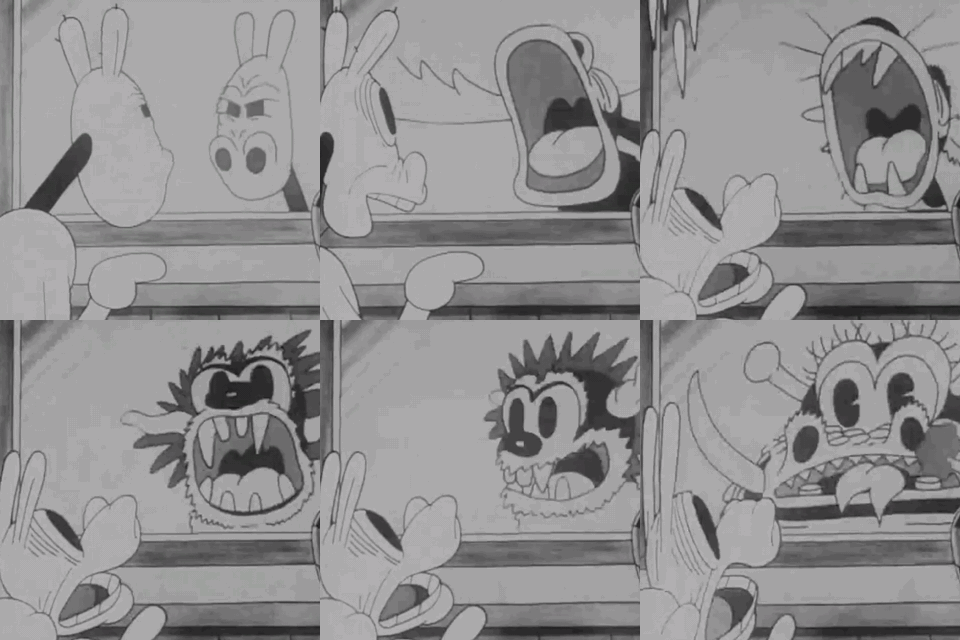
The horse stumbles up to a counter and sees itself in the mirror, when all of the sudden it starts having these wonderfully terrifying hallucinations. The horse lets out a scream and runs down the aisle through the bar, drunkenly dancing and giving a delightfully freakish grin towards the audience.

The cartoon ends with the horse spontaneously combusting and a final verse of “Lady, Play Your Mandolin!”. Foxy closes the cartoon with a “So long, folks”, the tagline that would be used for Merrie Melodies (whereas Looney Tunes would utilize “That’s all, folks!”). The Merrie Melodies sign-offs would change depending on who starred in the cartoon. It wasn’t until 1936 that both series would adopt “That’s all, folks!” written out in script. Porky would use the drum ending from 1937-1946, where the script ending was revitalized against the colored rings instead of a plain black background.

What a cartoon! This is certainly one of my favorites. The cartoon is still relatively plotless, but Foxy seems to have some more personality than Bosko (like that great gif of him swaggering down the aisle). The voice acting is still pretty painful, but the background score is catchy and makes it a bit more bearable. This is a very high energy cartoon with a lot of absurd visuals, it’s hard to pin them down! The horse spontaneously combusting is great. I could definitely see how this cartoon would be scary, but I find it more fascinating than frightening. Overall, it pales in comparison to the shorts that’d be churned out by the end of the decade and onwards through the 40s and 50s, but it’s a nice, cheery change of pace from the Bosko cartoons that tend to drag on and on. I’d recommend a watch!


390. Case of the Missing Hare (1942)

Release Date: December 12th, 1942 Series: Merrie Melodies Director: Chuck Jones Story: Tedd Pierce Animation: Ken Harris Musical Direction:...