Showing posts with label 1934. Show all posts

Monday, May 10, 2021

95. Buddy the Dentist (1934)

Release date: December 15th, 1934

Series: Looney Tunes

Director: Ben Hardaway

Starring: Berneice Hansell (Cookie)

The last cartoon of 1934! I can’t say it was an exciting year—probably the least memorable year yet. The Merrie Melodies started to go into color, though, which is exciting! 1935 will be a big year. Porky makes his debut, as does Tex Avery. Termite Terrace would be born, and the world has never known peace since! Also interesting to note—Jack King gets an animator's credit, despite helming his own directorial unit at the time. I wonder how that happened. For now, we focus on Buddy, who plays dentist after his dog suffers a toothache from eating too much fudge.

Someone’s in the kitchen with Buddy, someone’s in the kitchen I know. Someone’s in the kitchen with Buddy, it’s his pup, Bozo. Buddy’s whipping up a batch of fudge, with enthralling and rigorous instructions such as “Think of a number from 1 to 100” and “Stir until exhausted”.

Bozo sniffs the fudge, to which buddy scolds “Ah ah! Burny burny!” I think that’s the LEAST of your concerns if your dog is that close to chocolate. Nevertheless, Buddy gives his dog one last knowing glance as he strolls off, the fudge unattended. Bozo takes this as an opportunity to lick the boiling death trap, yelping in pain at the burn. Very amusing to watch him sucking up water desperately to playfully lapping it once buddy comes back in, shrugging.

Quite the masterful baker as buddy pours the contents of the pan into a syringe, flipping the pan back on the shelf and balancing the syringe on his finger. He shoots squares of fudge onto a cookie sheet, and one into Bozo’s mouth to pacify him. Bozo instigates, wanting more, but Buddy reprimands him, scolding “That’s all you get. And besides, candy’s bad for dogs’ teeth.” Begrudgingly does bozo mock Buddy once he leaves the picture. Of course, Buddy catches him sniffing the pan of fudge and orders him to come near him.

Buddy rings up cookie while Bozo sulks next to him. I love the detail of the bird listening in on the conversation. Buddy teases Cookie, promoting her to guess what he has for her. He entices her with a promise of some fudge, while Bozo, seeing that Buddy is effectively distracted, seeks out the pan of fudge. It topples to the ground, and his mission is accomplished as he eagerly indulges in a few hearty helpings.

All of the sudden, Bozo yelps in pain as a bell chimes forebodingly. A visit to the mirror confirms he has a toothache, represented by a little figure hammering away at his tooth. Bozo cries in pain, which prompts Buddy to break his goody two shoes persona and shout “Hey, shut up! Shut up!” Ah, misunderstanding, another great comedy point. Cookie believes Buddy is telling HER to shut up and hangs up on him, scoffing that he can’t tell her to shut up. Damn right! 
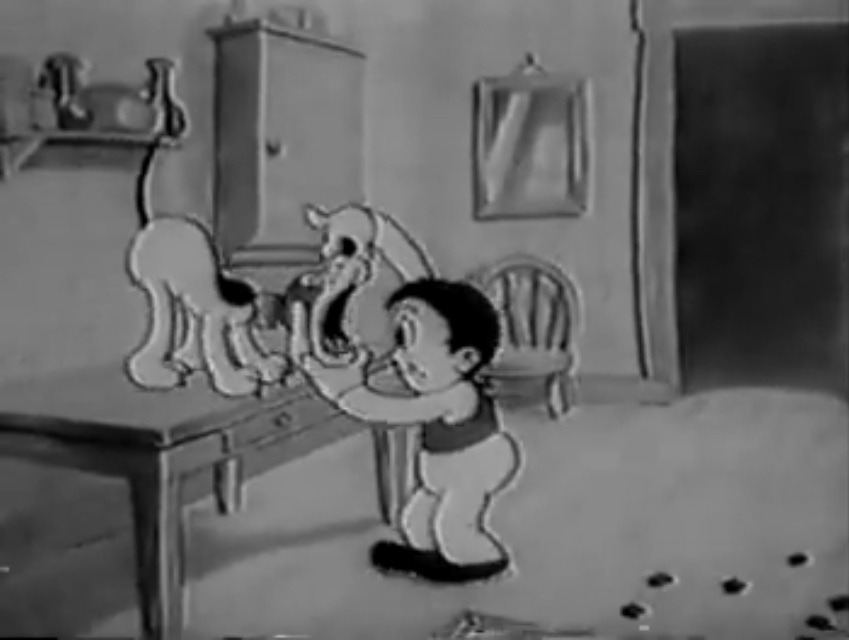
Aggravated, Buddy runs into the kitchen (first time holding the ear piece and accidentally getting yanked back into the living room) to see what the fuss is about. He drags Bozo by the collar and props him up on the table, exclaiming “Now see what you’ve done!” Bozo is too distracted by the pain to be properly guilt tripped, and Buddy  inspects the situation. Instead of angry, he cracks a grin as he tells bozo “See, I told you candy would hurt your teeth!” Considerate as always! Buddy reaches into the drawer and brings out an arsenal of intimidating tools: a hammer, a screwdriver, some pliers... the works.

Buddy painfully struggles to pull the offending tooth, but to no avail. They both fly backwards into a wall, a calendar/advertisement fluttering into the clutches of buddy. It advertises “DR MOHLER — painless dentist, WE USE GAS”. I love the detail of “Octember”, a gag reused in Porky’s Double Trouble. Ah, gas, of course! Buddy is enticed by the concept of drugging his dog. He places a funnel over Bozo’s mouth and turns a gas valve. Jesus, buddy! Of course, this isn’t supposed to be dark. The dog falls asleep and swells up like a balloon.

With some quick thinking, Buddy uses a vacuum to suck his dog back down. Nothing can ever go right for either of them—the vacuum bag explodes, sending Buddy flying against an ironing board and propelling him outside, where he‘s propelled back inside thanks to a clothesline. Buddy hears Bozo crying (now conscious), and finds him hiding under Buddy’s pillow in his bedroom.

The “heavy object tied to a string tied to a tooth” trope, tried and true. By heavy object, I usually mean door. But, for some reason, Buddy has dumbbells in his bedroom and ties the string to Bozo's tooth and around a dumbbell. He tosses the dumbbell, and Bozo merely chases it and returns it to him. Strong dog! They try again, this time with the same results, Bozo sporting a top hat and an even BIGGER dumbbell.

Finally, Buddy  realizes tying the string to the doorknob is the way to go. Of course, Bozo begs no, and Buddy then ties the string to his OWN tooth to prove it isn’t so bad and that it won’t hurt.

Just in time for a random cat to wander into Buddy’s home! Bozo chases the cat, and Buddy is forced along in the chase as he’s tied to his fervent pooch. A wild goose chase ensues, Buddy and Bozo landing in a sprinkler outside as the cat mocks them. Bozo chases after the cat once more, poor Buddy shanghaied as he struggles to keep up. He lands in a wagon and is dragged along the street, nearly run over by a car. A cat knocks over a man digging in a trench, who serves as the perfect bridge as bozo and buddy cross the trench, the oblivious man scratching his head.

The chase carries on into Cookie’s yard, where she’s lounging in a hammock, reading a book. Buddy and Bozo fly over cookie, running into her and knocking the hammock to the ground. Buddy finds Bozo’s tooth, showing it off triumphantly. Cookie finds her own prize—Buddy’s tooth. Iris out as we all laugh it off.

Not the most entertaining cartoon to watch, but it did keep me engaged. The chase scene was nice, lots of pep and energy. I don’t have any major gripes with the short, maybe a bit boring in some parts but it was ultimately slightly amusing. Buddy didn’t have too much personality (like always), but it was refreshing to hear him have some dialogue. I think that’s one of the biggest problems—some of the Buddy cartoons have such minimal dialogue. Not that you can’t have silent cartoons. A cartoon that can convey its message well without dialogue is a very strong one indeed, and there are lots of great cartoons like that. But usually music, animation, ACTING, and of course PERSONALITY carry those cartoons. The Buddy cartoons aren’t there yet, they’re still rather primitive. Not crude, but still in the baby steps. A lot of progress has been made though! This may be worth a watch, just because it’s so absurd.

Link!

94. Viva Buddy (1934)

Release date: December 12th, 1934

Series: Looney Tunes

Director: Jack King

Starring: Billy Bletcher (Pancho, "Caramba!")

Jack King’s last Buddy cartoon of 1934, the next cartoon being a Ben Hardaway entry. Our adventurer Buddy finds himself in Mexico, but trouble arises when Pancho, a caricature of Wallace Beery, shoots up a cantina.

Hmm, it seems Buddy’s hair is greased again? Buddy strolls through the streets of Mexico, strumming his guitar and singing like always. Just a collection of visual gags like always as he strolls the streets, walking up a wagon and crushing a duck, sliding down a ton of sombreros on top of a man’s head. The usual.

His destination? “CANTINA EL MOOCHER”. As predicted, stereotypes are abound. Buddy struggles to get inside as everyone’s snoring blows the doors open. Buddy enters through a window, everyone asleep. A game of checkers is engaged only by some Mexican jumping beans on the tiles.

Buddy tosses a coin in a man’s mouth, who plays the piano with his feet. Everyone is thusly prompted to wake up, the cantina full of life as beer is served and a group of singers sing, the lead singer strumming a corset instead of a guitar. Buddy even shows off his guitar kills, playing with his teeth and hands. The man can do everything! He’s a wunderkind! The guitar comes to life and plays itself as buddy eagerly dances along, playing it once more while doing a handstand and kicking his feet together to the beat of the music.

Gunshots welcome a scene change as a man darts on his hours around town, shooting aimlessly. He urges his gang to follow, and we have a shot of a bunch of men shooting guns while riding in a car... and a nice pan out to reveal they’re carrying sides of the car and running with their feet Fred Flintstone style. The Yosemite Sam wannabe shoots various pots of tequila, one in a poster and one in reality. Just because he can, right? 

His poor horse attempts to flee, but the villain ties him up to a post, licking the horse’s tail to flatten it enough so it’ll go through the hole in the post. A nefarious mustache tug and a physical lift of the doors (like lifting a garage door) and the menace is inside the cantina.

Various gunshots to accompany a grand entrance. The residents of the cantina recognize him instantly, exclaiming “Pancho!” as he shoots around—shaving off some man’s hair, shooting a barrel with a man inside who shouts “Pancho!”, another repeating the routine in a cash register, and my favorite: the Marx brothers emerge from a murphy bed, introducing themselves as “Zeppo!” “Harpo!” “Chico!” “Groucho!” Great gag! 

Pancho even targets Buddy, blowing his banana to smithereens. That does it! Buddy gives him a piece of his mind for ruining his fill of potassium, squirting the remains of the banana right in Pancho’s laughing face. Pancho holds buddy and gun point and backs him into the piano, ordering him to play.

Ah, Cookie’s here too for some reason! Of course! She does a flamenco dance to accompany Buddy's piano music. The dance is cute, but not timed well to the sound effects of the castanets at all. I think it may have been reused from How Do I know It’s Sunday, too. Pancho applauds the performance, clicking his gun holsters together and skating on his spurs. He spots cookie and flirts for her, asking for a “nice kiss”. Cookie gives him a nice slap in the face, sending him skating backwards on his spurs outside, lodging himself in the door.

A nearby goat bucks Pancho back INSIDE, where he continues to flirt like nothing happened. Buddy grunts “that big bozo!” and lodges a fork right in Pancho’s butt. Two suction cups attached together (what we all need, right?) cover Pancho’s pistols, who cries “CARAMBA!” and tosses his pistols to the floor. In retaliation, he summons a whip and snags Buddy, dumping him right into his sombrero and giving a good ol’ Billy Bletcher villain laugh. It’s tried and true, but Billy Bletcher does do a great villain!

Pancho yanks Buddy out of the hat, who punches his stomach repeatedly upside down. A parrot cheers on the fight. Buddy holds onto a chandelier as Pancho swings him around by his feet, nice animation as the two fly off the chandelier and land into a shelf. The two pop out of the debris, and Pancho, suddenly friendly, puts his arm around Buddy and laughs “I was only foolin’, Buddy!”, iris out as the two laugh it off.

Unsatisfying as the ending was, I loved it. What a way to totally backtrack from the entire events of the cartoon! Though it is a bit of a cop out from a “proper” ending, I suppose. That doesn’t bother me, but I can certainly see how that would be a problem. This cartoon was okay, nothing too great. The “lazy/sleepy” stereotypes were cringeworthy and annoying and detracted slightly from my enjoyment of the cartoon, though there isn’t too much to enjoy. Buddy was cute, but not particularly charming or charismatic. Pancho was full of personality and Billy Bletcher’s vocal performance definitely held my interest. The music was good, backgrounds good, animation decent... Just another buddy cartoon that’ll be soon lost from my memory bank. Probably safe to skip it, nothing too exciting.

Link!


93. Pop Goes Your Heart (1934)

Release date: December 8th, 1934

Series: Merrie Melodies

Director: Friz Freleng

Starring: The Rhythmettes (Hummingbirds, Bees), Marion Darlington (Birds), The Singing Guardsmen (Chorus), Count Cutelli (Bear)

If your heart ACTUALLY goes pop, you may need to consult a doctor or a good surgeon. Another bug-centric cartoon. All animals and insects unite in harmony as we monitor their day to day lives—including how beavers deal with a hungry bear.

A bird sings its call, the scene fading out and back in to a lovely spring setting, flowers blooming and grass green. All of the animals and insects are soaking up the spring sun, humming birds and bees collecting nectar/pollen while humming/buzzing, a bird laying an egg and shaking hands with its significant other as a tally is crossed off, keeping track. The sequences with the humming birds, robins, and bees stretch on for quite awhile and lose a bit of their charm, but the backgrounds and scenery are very pleasing to admire.

Elsewhere, we have a grasshopper teaching its children how to spit tobacco. Priorities! It’s an amusing scene, but a gross one at that. The father spits just fine and urges his kids to give it a go, one of them spitting it up all over its face. Mmmm, delightful. 

More parental lessons, this time with turtles. A mother turtle teaches its children how to swim, the turtles lazing on their shells as they leisurely row along with their cattails. Elsewhere, a very beautiful painting of an apple tree. Pan in on two spiders strumming “Pop Goes Your Heart” on a spiderweb—very fun, jaunty, and cute. I’m already hooked to the tune, and there haven’t been any vocals! A handful of worms are also enticed, two groups of worms dancing around with apples as their bodies and a different worm for the limbs: head, arms, legs. Nothing too exciting, but the music is a joy to listen to and the animation is fun and beautiful.

A group of frogs are our destined singers, singing “Pop Goes Your Heart”. Once again, very catchy and fun. A nice shot of their reflection in the water as they sing to mix things up, undoubtedly to flex on their newfound technicolor usage, as if saying “hey, WE have color now, too! Looky what WE can do! Huh? Huuuuh? Top that, Disney!” As the frogs sing, we’ve a gag borrowed from the infamous One Step Ahead of My Shadow, a swan feasting on a few fish before a giant fish eats the swan and licks its lips contentedly. Nutritious! The song ends as the frogs dive into the water, breaking their reflections.

Focus shifts to a nest of hungry baby birds. A curious bird spots a worm writhing in an apple, fresh for the picking. The bird jams its head inside the apple, the worm snaking out another hole and using the opportunity to spank the bird senseless. These are the things they don’t tell you about the food chain. Clutching its wounded butt, the bird hops around and chirps in pain while the worm laughs in ridicule.

Beavers occupy the next scene, specifically two playing ping pong... or tennis... or badminton. The ball looks like a ping pong ball to me, so who knows. They play back and forth with their spacious tails. As always, some sort of conflict must arise. A bear sniffs the ground, searching for some food. A relatively amusing gag as the beat attempts to roar, making a squeaky garble instead. Embarrassed, the bear sprays some throat spray and provides an adequate roar, smiling contentedly at the audience.

The hungry bear stalks a hapless turtle, hurriedly picking up the pace. Eventually, the turtle retreats to its shell, its head popping out where its tail was and giving the bear a good bite on the nose. The bear retreats as the turtle smugly continues its stroll.

Full of fresh rage, the bear vents its frustrations by coming across the beaver community and disrupting all peace. A nice, flouncy, hurries rendition of “Pop Goes Your Heart” as the bear chases after the beavers, who seek refuge in a tree. The bear sticks its head inside the tree while one of the beavers pops out and smacks the bear’s exposed rear with its tail. Lots of spanking going on in this one! Meanwhile, another beaver gnaws at a tree ranch supporting a beehive. The branch falls and the beehive breaks against the bear, plaguing the bear with a swarm of angry bees and some honey on its fur.

Predator quickly transforms into prey as the bear tries to outrun the bees with little success, animation nice and volumetric as the bear twirls around aimlessly and swipes at the bees. Typical cartoon fashion as the bear launches itself into a grassy field, the honey causing the grass to stick to the bear. The bear rolls downhill, a mass of grass engulfing it completely.

Just in time for a farmer to be making hay. The mound of bear-grass lands next to the farmer, who shovels it into the hay bailing machine. Predictably (yet still funny), the bear is turned into a hay bale. Iris out as the bear darts away, much to the bewilderment of the farmer.

Not the most enthralling Merrie Melody, but, as always, not the worst. The colors were very pleasing and intriguing, and the music was certainly the highlight of the short. I especially loved the harp sequence between the two spiders! Not much going on with the plot. The cartoon was enjoyable, but none too engaging. I found myself zoning out at the climax, so I suppose that’s an indicator of something. Nevertheless, the backgrounds were beautiful, as was the music. Might be best to skip, there isn’t much to remark on, but it isn’t a total waste of time, either.

Link!

Sunday, May 9, 2021

92. Buddy's Adventures (1934)

Release date: November 17th, 1934

Series: Looney Tunes

Director: Ben Hardaway

Starring: Jack Carr (Buddy), Jane Withers (Cookie), Billy Bletcher (King, Cop), Jackie Morrow (Joe Penner), The Singing Guardsmen (Chorus)

Ahhh, a promising start, right? Anything telling you that Buddy is on an adventure means it is just going to be CHOCK FULL of action packed fun! Actually, the buddy cartoons WOULD take more of an adventurer turn, a trend adopted by some of the Porky cartoons. In an ill-fated hot air balloon ride, Buddy and Cookie end up in “Sourtown”, where the residents aren’t nearly as open to accepting Buddy’s optimism.

A good start to the cartoon: Buddy dumping sand bags off an ascending hot air balloon, accompanied by an anxious Cookie. Buddy has gotten his final redesign—I like it a lot! I think it looks much better than his Earl Duvall version. He appears much more likable and cute. Cookie’s also gotten another redesign, both reverting to their Tom Palmer roots in a way.

Buddy exercises his genius by remarking “Look, Cookie! In a few minutes we’ll be on Mars!” Cookie laments “You and your dirty inventions, I wish I hadn’t come along! I’m afraid!” Initially, I didn’t think much of the opening. I laughed at the ridiculousness of Buddy suggesting they’ll go to Mars—but now that I think about it, it’s a good opening. Opening right in the middle of some “action”, establishing some personality. Buddy makes inventions and has dreams of exploring, unflappable optimism benefitting him and him only. I think that’s cute! Maybe I’m just desperate for any shred of personality in these darn characters.

Buddy laughs in dismissal, saying “What’s there to be afraid of?” A lightning crack and boom of thunder put him in his place as he sinks in the basket, laughing sheepishly “Must’ve been something I ate.” I think this is the most we’ve ever heard Buddy talk in a cartoon. Well, maybe not, but some cartoons he only says one word! It’s refreshing.

Anthropomorphic storm clouds further put an end to Buddy’s optimism, a cloud blowing the balloon around and another boxing it like a punching bag. There’s a strange scene as the surroundings around Buddy and Cookie melt, like a dream sequence. 

Some snake storm clouds spit lightning at the balloon, snapping the lines to the balloon. Buddy and Cookie tumble in the air, the falling basket thankfully scooping them to relative safety. The basket slides across a few cliffs like a sled, and the couple skids past a sign that reads “TO LEMONIA — THE SOUR DOMAIN”. They narrowly skid under a bird who laughs as they whiz by... quickly eating his guffaws as an anchor hooks on the bird’s foot and drags it along.

An anthropomorphic castle swallows up Buddy and Cookie as they slide into their new domain, the sled breaking against a sign. Buddy’s optimism is endearingly amusing as he announces “...Well, here we are!”, refuted with a “Alright, buddy, where are we??” from Cookie. A sign welcoming them to SOURTOWN answers Cookie’s inquiry. Rules include: NO LAUGHING, NO SINGING, NO DANCING, and NO JAZZ MUSIC. The past 91 cartoons broke down to their bare essentials! 

Of course, Buddy laughs off the arbitrary rules, already setting himself up for danger. Cookie scowls at him and points offscreen—a great gag of Laurel and Hardy in stocks, imprisoned for smiling and laughing respectively, laurel sniveling incomprehensibly.

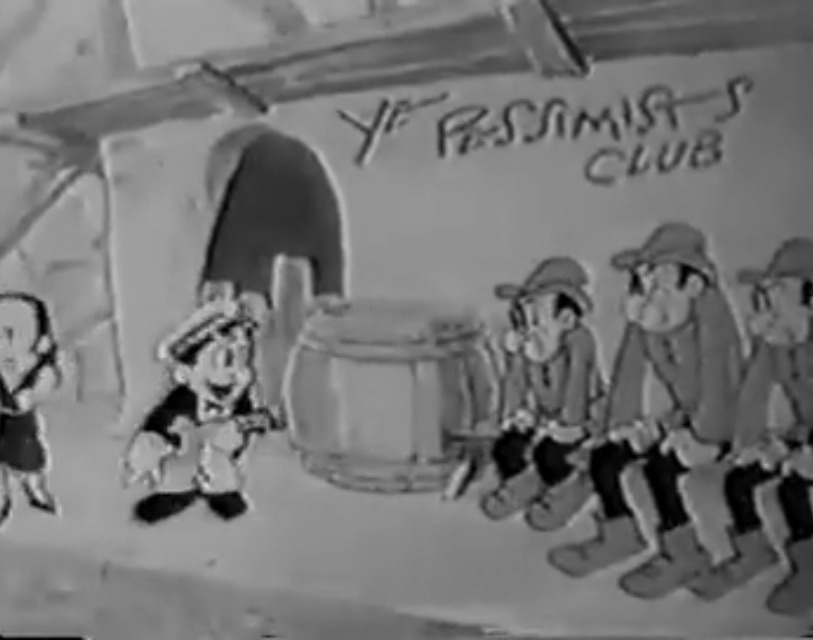
Nevertheless, Buddy is undeterred as he leads Cookie through the town, the two of them pausing to watch a trio of men saunter through the streets, accompanied by furtive music. The men gather in front of “YE PESSIMISTS CLUB” and drink some vinegar, just to show us how really sour they are. It’s certainly coy but amusing. They sing about how they never laugh or smile, life just a bowl of lemons. I thought one of the laws was no singing, and yet they’re singing about how they hate singing? 

Good hearted Buddy interrupts their groveling, correcting in a sing song voice “Pardon me, but you’re all wrong. Life is much more cheerful! That’s no way to sing a song, listen and get an earful!” He grabs the spare mandolin one of the curmudgeons had been using and sings a song of his own. Buddy is still pretty bland, but this is the most personality we’ve seen yet, and I enjoy it! I love my optimistic characters, so maybe that’s it. Various animals and plants scat along with Buddy, an angry woman closing her shutters and silencing any form of singing from the wildlife.

An amusing gag as a police officer takes off his hat and peers inside, a note reminding him that the laws include no dancing and no singing. Hard to remember, ain’t it? He approaches Buddy and Cookie, the pessimists scramming at the sight of the cop. He tells him that they’re headed for the “sour pen”... That’s a new one! He rides away on his scooter, Buddy and Cookie shanghaied in a little box behind him.

We finally meet the king of Sourtown, a man who sequences lemons on his head and drinks the juice. A beverage fit for a crabby king! I love how asinine this entire cartoon is. It reminds me not even of Disney, but like a pseudo Willy Wonka setting. It’s nice that we actually have some story structure and plot, and that Buddy and Cookie converse with each other as have a sliver of personality to them.

The king spots Buddy and Cookie, insisting they’ll “be sentenced to the spanking hand.” sure enough, YE OLDE SPANKING MACHINE awaits. Absurdly strange, but good! I suppose. This isn’t phenomenal, or great, even, but it’s a refreshing change from the monotony we’ve been seeing as of late. Cookie asks “What do we do?”, to which Buddy whispers back “Leave it to me!” and whips out a harmonica from his pocket.

Highly amusing to watch Buddy blare the harmonica in the king’s face, running around to all sides of him and making sure to get up in his business. Buddy is delightfully annoying, on purpose this time. Cookie dances to the harmonica music as a line of knights observe, the king exerting every effort not to succumb.

Gradually, various knights themselves become inflicted with the jitterbug, one of the knights using a leg from a suit of armor as a saxophone. The king’s beard dances, as do his legs snapping together... Finally, he admits defeat, declaring “It’s got me, pal! It’s got me!” 

Cookie conducts the knights, who join in on a chorus, and the whole town becomes enthralled with the power of music! The king shows off his slick moves, animation jaunty and appealing. He even slips off the rug and lands straight into YE OLDE SPANKING MACHINE, breaking into a fit of hysterics. Back to Buddy and Cookie, who are sitting on the king’s throne, cookie sporting buddy’s hat. Iris out as the two of them embrace.

With every review, I watch the cartoons twice. Once for the initial reaction, and once when I’m going back and typing the whole shebang. First watch, I didn’t like it very much at all. I thought it was boring and coy, the ending where they all dance being the true highlight. But thank god for the second watch—this is now one of my favorite Buddy cartoons, if not favorite. It’s not a fantastic cartoon by any means, it still leaves a lot to be desired, but it also fills SOME holes. Buddy’s design is much more tolerable, boyish and cute. His optimism, albeit pretty one-dimensional, is very uplifting and endearing. The absurdity of the whole cartoon was very refreshing, and I’m glad we actually had some plot this time. It felt like a very subtle, subdued, distant relative to Porky in Wackyland. It was an enjoyable cartoon, and I recommend it! It still isn’t perfect, the first half dragged on for quite awhile, but it actually stands out as a cartoon I can recognize and look back on in future reviews. The 1934 season has seldom been memorable.

Link!

91. Those Beautiful Dames (1934)

Release date: November 10th, 1934

Series: Merrie Melodies

Director: Friz Freleng

Starring: The Rhythmettes, The Varsity Three (Chorus)

Back to color, permanently this time! Now we’re using two-strip technicolor, focusing on red and green as opposed to the red and blue two-strip Cinecolor process. This seems to be a follow up to The Shanty Where Santa Claus Lives—a poverty stricken girl longs to have toys of her own, and it seems her wish may be granted after all.

Parallel to the introduction of The Shanty Where Santa Claus Lives, a little girl trudges through the snow, hugging her shawl close for warmth. She stumbles upon a toy shop and eagerly glances inside, enticed by the happy and warm nature of the toys. The scene is staged nicely—I love the detail of the street lamp in the background bent slightly.

Forlornly the girl continues her trek, wrapping her shawl around her and bracing against a terrible wind. The scene of her walking against the wind overstays its welcome slightly, stretching on for awhile, but it isn’t supposed to be a scene that’s urgent anyway. And, of course, Friz’s love of butt gags prevails as the wind blows some snow inside the girl’s pants. Can’t have anything too sad, now! 

She approaches a tiny little shack and warms herself up by the stove conservatively. Even the mice are starving—a mouse that’s all skin and bones checks the contents of a bread box, thoroughly disappointed. The meager flame inside the stove is also disappointing. A few blows inflate it ever so slightly, but melting ice on the inside of the stove extinguished the flare with ease. The poor girl cries herself to sleep as she situates herself in the chair. The first half is drawn out, but again, there’s no need for urgency, and it establishes pathos quite effectively. You instantly feel bad for the girl.

The fun enters once one of the toys from the toy store approaches the shack, a gang of toys approaching behind her. Tentatively the leader creeps inside, finding the girl asleep at the chair. The coast is clear—the toy motions for the others to stroll on in.

A very cute scene as the toys spruce up the place as a nice little surprise. Firefighters eject red paint on the door, a horse spreads glue with its tail on some wallpaper waiting to be hung, and a bulldozer spreads the wallpaper, driving up the wall. The gags aren’t entirely original, but they’re very cute. The newness of the color enhances the scene entirely. I’m sure that same magic wouldn’t be there had the cartoon been in black and white, not that the black and white cartoons are dull by any means because of their appearance, but the cheeriness translates better in bright greens and reds. It’s a fitting cartoon to test out the two-strip technicolor process.

Hours fly by as indicated by a church clock (a very moody and pretty scene). The hands whirl from 9 to 12, and we spot the finished interior. A hearty fire roars in the fireplace, the wallpaper is cheery and happy, there are rugs and chairs galore... the girl has a proper home. All of the toys crowd around the slumbering girl and cheer, waking her up. She glances around in bewildered glee, absolutely delighted.

A few dolls launch into the titular “Those Beautiful Dames”, harmonies beautiful as always. There’s a quick tap dancing sequence from a windup jazz toy (featuring blackface caricatures as always... ugh) and all the dolls sing: a monkey and a trowel, a clown and a paintbrush, a bear with a hammer and saw... two more blackface dolls singing about how they made a chocolate cake for the girl, etc. The girl claps on the performance, thrilled. We have a tap dancing number between two jack in the boxes. Nothing too exciting, but the backgrounds are especially nice, the gaudy green and red floral curtains a nice touch. The color will definitely boost the enjoyment factor in these Merrie Melodies, adding some much needed charm (though black and white cartoons are just as beautiful... I suppose it all boils down to quality of the cartoon, which isn’t the say of the original creators).

Elsewhere, a toy dump truck gorges itself in chocolate cake as the dance rages on. Rude! This poor girl is starving! Both scenes go on for awhile, the dance and the eating, until a doll catches the truck in the act and scolds it. The truck mopes away like a dog with its tail between its legs.

The girl approaches a toy phonograph and gives it a few good cranks, putting on a record of “Those Beautiful Dames”. The animation of the teddy bears dancing on the base of the phonograph is very fun, very smooth, very well articulated, especially when they shuffle along to opposing sides (“turning corners” is the best way to describe it). Even more amusing to watch the dance halt, the bears all hopping on one leg and ogling at the record as it skips. The girl fixes it and the dance continues on. Some amusing moves from the girl herself as she boogies down to the melody. This cartoon isn’t anything too fascinating, but it’s a lot of fun, even if it’s not necessarily funny.

Two toy soldiers march in front of a set of doors and trumpet a fanfare. The doors open to reveal a marvelous, sugar coated feast for the girl, all of the toys cheering and whooping in celebration. Very cute to watch the girl happily walk along the table and fix herself a seat. A little pep is added to the scene as the girl turns the meal into an eating contest, declaring “One, two, three, go!” and all the toys indulging in plates of ice cream. This is a very feel good cartoon, even if it’s not the most exciting. I found myself smiling like an idiot at this part. How can you feel down watching a crane shovel ice cream into the mouths of various toys while happy jazz blares in the background? 

Now, time for the girl to indulge herself. Some nice animation as the girl antics, reeling back to really get a good shovel full of frozen cow juice. Unfortunately for her, her ice cream is a protective layer to hide a jack in the box that springs out at her. She’s a good sport, though. Iris out as the girl joins in with the giggles and jeers of her fellow companions.

Interesting to note, the Merrie Melodies sign off would gain a new mascot. The tradition used to be that the star of the cartoon would sign off, either saying “So long, folks!” or “That’s all, folks”. It got to be quite entertaining when the sign offs with particular characters were reused often—Piggy, who had starred in only 2 Merrie Melodies, was used quite frequently as a sign off. Though it is pretty hard to keep up with a new sign off for EVERY cartoon, new voice and everything. Pretty hard and pretty costly. The jester would serve as the “mascot” for the 1934-1935 season.

A very endearing cartoon, much better than The Shanty Where Santa Claus Lives. It didn’t have much going for it, and was relatively... not exactly boring, but mild. Nothing really stood out to me (except the occasional blackface caricatures, which, at this point, I shouldn’t be surprised by seeing anymore. Still needs to be addressed as always). However, that’s not always a bad thing. This cartoon was very cute, very endearing, very sentimental. The ending was extremely feel-good and warm. I caught myself smiling like a goof while watching it. The girl, although without any discernible personality, was a character you wanted to root for, and thus it was satisfying to see her house all spruced up and to see her reunited with her toy friends. Worth a watch, especially towards the second half where the toys come in.

Link!

90. Buddy's Circus (1934)

Release date: November 8th, 1934

Series: Looney Tunes

Director: Jack King

Starring: Jackie Morrow (Buddy), Jane Withers (Junior)

A slightly more eventful I Love a Parade, Buddy’s Circus details the ins and outs of, well, Buddy’s circus—including saving a baby in peril.

Without a doubt in your mind, you know the title of the cartoon you’re watching as we open to Buddy and various circus animals floating in a hot air balloon. The animation is very jaunty and upbeat, always a plus. Via telescope, Buddy spots a sign that reads “BUDDY’S CIRCUS WILL ARRIVE AT 2:00PM”. Sure enough, a quick check of the watch asserts it’s 2:00. Buddy drops an armful of stakes, an octopus hammering them in—a trip back to our Harman-Ising memory lane! The synchronization with the hammering animation, sound effects, and music is very well done. The hot air balloon hits the surface and literally morphs into a tent, eager patrons filling it up in no time.

We’ve a collection of gags... and, of course, REALLY following Harman-Ising tradition, the bulk of them are racist caricatures. Of course. Start out with Buddy playing elephants’ tusks like a marimba, tugging on their tails and playing them like a pipe organ as they exhale steam through their trunks.

Here’s where things get ugly and you desperately wish for it to be over. Buddy introduces the “Ubangi Boys” (an unsavory sign advertising them as the duck bill twins), telling the audience they’re going to dance and play. One of the twins plays the other’s skirt like a xylophone, occasionally hitting his head. Another act introduces “OSCAR the Ubangiphone—‘he plays a mouthful’”, another gross stereotype using his tongue as a needle to play a record. “ELASTIKO the India-rubber man”, reused from I Love a Parade, stretches and bounces himself around like a rubber hose. The animation does deserve commending, it’s very smooth and bouncy, but this entire sequence is very cringeworthy and not enjoyable. The stereotypes thankfully come to a halt once “ABESTO the HUMAN STOVE” swallows a flame, a pan, and an egg. A quick x-ray displays the egg is indeed frying.

Finally we arrive to the main attractions of the show. Buddy leads a marching band, accompanied by a trombone playing kangaroos (and its trumpeting joey), a man playing a cymbal on another guy’s hat, a man chuffing a cigar and blowing smoke rings for lions to jump through, lions jumping on his stomach and causing another ring to be expelled. Another man holds onto a rope with his teeth, lifting up higher and higher... until a signature terrifying Jack King closeup displays his dentures slipping loose and the man plummeting to the ground below.

A baby in the crowd cheers (“Wee! Wee! Wee!”), dropping its popcorn under the bleachers in the process. Some attentive parents the baby has as he swings from various legs like Tarzan in the jungle. The animation is smooth and fun to watch, possessing some weight and spacing to it. As the baby goes to retrieve its fallen popcorn, an elephant sucks it up in its trunk instead, bouncing the baby happily.

TRY SPIFFS’ HAMS” covers the screen, the advertisement moving away as we see its plastered on an acrobat’s butt—cleverly crude. There’s also a nice gag of the crowd watching the acrobat swing, their bodies and heads moving in opposite directions. A man licks another man’s ice cream cone each time he sways, eventually biting his finger. The oblivious glee as the perpetrator continues to watch the spectacle while the victim angrily glares on is priceless.

Elephants complete a dance routine, accompanied by the wandering baby from before. Albeit nothing too special, it is entertaining to watch the baby straggle behind in poor time as the elephants flawlessly execute their routine. Elsewhere, more gross black caricatures make another appearance as a man swings from two rings, revealed to be nose rings from other acrobats. The acrobat loses his grip and falls on a piece of board, situated on top of a pedestal like a seesaw. Predictably, the other half of the makeshift seesaw is inhabited by the mischievous baby, who flies into the air from the impact.

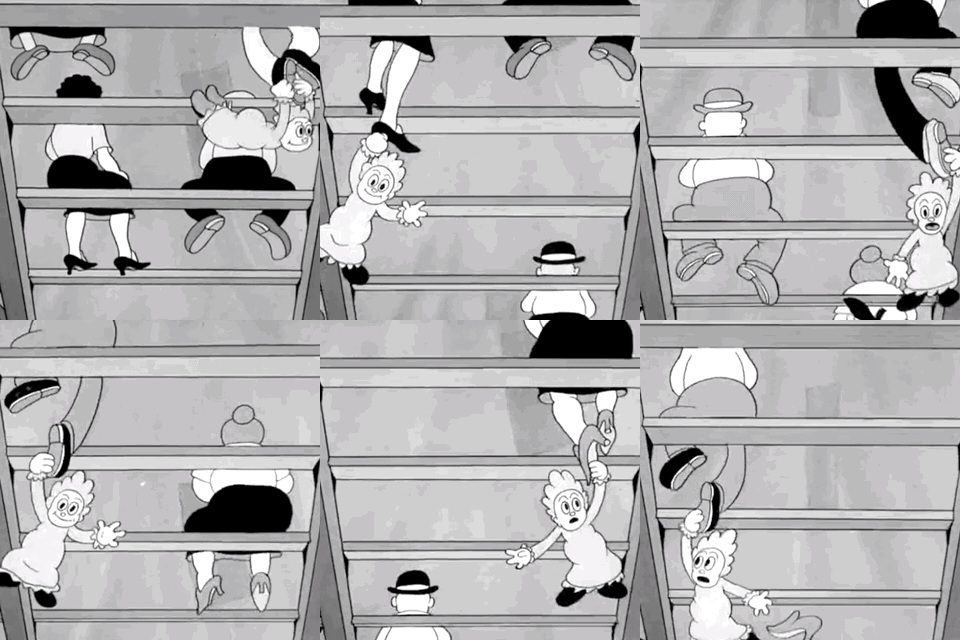
The baby lands itself right into the hands of an acrobat routine, more acrobats piling below the swinging baby. FINALLY the baby’s mother notices, about damn time! She cries “JUNIOR!”, and as the acrobat show falls apart, Buddy also takes notice. The music score in this scene is lovely, jaunty, high energy, and playfully urgent. Buddy and the mother both scale the poles to the supportive netting, buddy lassoing the baby to safety, who pulls off the acrobat’s clothes above.

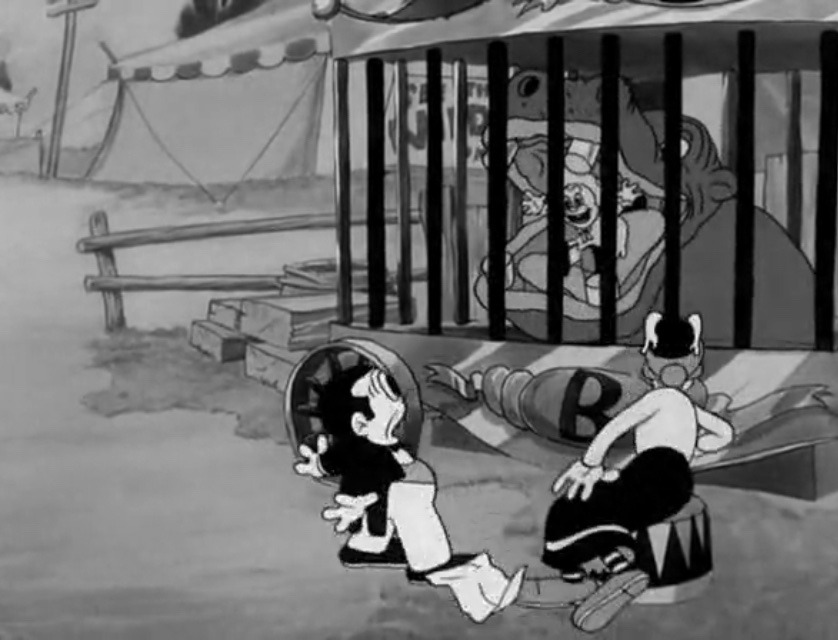
Safely caught by the net, but not for long. The baby, Buddy, and the mother ricochet off the net and spring back up, all clinging to the acrobat for safety. They swing, knocking a man off his bicycle during a tightrope act. Buddy and the mother cycle frantically beneath the hanging baby, the bike crashing into a pole and all three ejected out of the tent and elsewhere outside. A nice angle of the baby falling directly into an animal cage.

Buddy and the mother scale down a giraffe, shredding off all its markings on its neck in the process. The two look for the baby, but it isn’t anywhere to be found. Buddy tries to console the weeping mother, dabbing her eyes and blowing her nose for her (what a gentleman!). Yet, never fear! The baby is safely in the clutches of a hippo’s mouth. The mother reunites with her child, iris out on all three holding hands and dancing merrily.

As far as Buddy cartoons go, this is one of the better ones. With that said, my biggest problem is (as always) the gross racist stereotyping, just one after the other. It ages poorly and doesn’t rise any laughs. The entire first half, including that sequence, felt rather slow and dull, but things quickly picked up once the baby entered. The animation was nice and the music served as a safety net for any poor scenes—the fact that this cartoon has been restored is always a lucky plus. Easier to analyze details that way. I’d say MAYBE go for it—if you do, go to the second half. There’s still a brief scene involving racial stereotypes which is gross, but the baby stuff happens after that. Probably one of the more high energy cartoons, just be wary and view at your own discretion because of the stereotypes.

Link!

390. Case of the Missing Hare (1942)

Release Date: December 12th, 1942 Series: Merrie Melodies Director: Chuck Jones Story: Tedd Pierce Animation: Ken Harris Musical Direction:...