Showing posts with label 1935. Show all posts

Monday, May 17, 2021

118. Flowers for Madame (1935)

Release date: December 14th, 1935

Series: Merrie Melodies

Director: Friz Freleng

Starring: Berneice Hansell (Panicked Flowers), The Debutants (Chorus)

I say this every year once we reach the end, but I truly mean it when I say: what a year! The last cartoon of 1935. Buddy was kicked to the curb, Beans made his debut, Porky made his breakout appearance, Tex Avery joined the crew… things are starting to look up. 1936 would see the arrival of Frank Tashlin and Carl Stalling (both making their debuts in Porky’s Poultry Plant), Jack King made his departure, Porky would surpass Beans in popularity and begin to dominate the screen, Tex Avery released the classic I Love to Singa… lots of exciting stuff ahead of us. To close out the year, we have Flowers for Madame (the first cartoon to use 3-strip technicolor!): flowers join together to host a flower pageant, but a fire seeks to put the event in jeopardy very quickly.

It’s evident everyone at Warner Bros was ecstatic to show off their new 3-strip technicolor abilities, finally able to provide some sort of competition to Disney. We begin with a very lush, colorful, blooming landscape of a bridge as an offscreen chorus sings “Flowers for Madame”. Pan in on some bluebells, who, predictably, ring their bells to the tune of the music. Elsewhere, two flowers engage in a ballet. Definitely Disney, through and through. An offbrand Flowers and Trees. Roses bloom to reveal two kissing bees, bashful at their affections being caught.

A caricature of Harpo Marx plops a bluebell on his head for a hat and strums on a makeshift harp. A line of voluptuous flower ladies dance to the underscore of “Oh, You Beautiful Doll”, an underscore frequented by Carl Stalling. If nothing else, the animation is sophisticated and gentle, nothing too groundbreaking. 

Next, two snails trumpet a fanfare with the aid of flowers. They unveil a flyer, marching away to allow a curious crowd of flowers to congregate. The flyer advertises a flower pageant with promises of prizes. The flowers chatter away eagerly. 

Fade out and back in to a bee making an announcement over the intercom (more flowers), asking for the spectators to display their appreciation. Thus cues the pageant–essentially a floral parade. A pompous flower leads the way, followed by two bees riding on some turtles. A line of fan-faring trumpeters, and thus a display of floral parade floats. The colors are vivid and beautiful, but nothing exactly exciting. Two fireflies hitch a ride on the back of one of the floats. The float halts to a stop, and the fireflies light up their rears like red stop signs, the light fading as things get moving. A clever and cute little gag. Elsewhere, a line of flowers dance to bagpipes, all donning kilts. Animation is smooth and lively. 

Enter a little hayseed cactus, applauding the scene. He, too, wishes to enter. He darts over to his car, plants some flower seeds in the ground, adds water, and instantly vines creep up along the car, blossoming into beautiful blue blooms. He turns the crank and hops onto his makeshift float, soaking up the glory as he's met with cheers and applause.

The judge’s stand thinks otherwise. The judges, perched in little flowers, boo the eager cactus. To make matters worse, his chariot explodes to pieces and he falls to the ground, now the subject of public humiliation. 

More disaster as we focus on a stray box of matches lying around, conveniently positioned next to a magnifying glass. The magnifying glass filters the harsh sun’s rays right onto a stray matchstick, and, predictably, the match ignites. The fire crawls to the grass, and a sea of flames erupt. Celebration morphs into panic as the flowers cry “fire!”, attempting to escape the blaze. An anthropomorphic flame singes the bottom of a lone flower repeatedly. Thankfully, another flower scoops some water into its petals and extinguishes the tiny flame, much to the other flower’s gratitude.

However, that was just one flame out of many. The wall of flames surges on, prompting a snail to race off at super speed. The animation is a tad choppy and thusly loses believability, but the sound effect of a racing fire engine is a nice touch. The snail seeks a lily pad for refuge.

The poor cactus from before observes as everyone runs amuck, unsure of what to do. He spots a sprinkler and turns it on, creating a barrier between him and the flames. He mocks the flames, who hesitate to inch forward–some nice personality. Nevertheless, another little anthropomorphic flame sneaks up behind the cactus and burns him. He flame turns off the sprinkler system, giddily motioning for his pals to wreak more havoc. 

A very clever visual as the cactus approaches a watermelon patch, sticking a point in the melons to cause actual streams of water to gush out like fire hoses. The blazing wall is no match for the force, and the flames recede. The one humiliated cactus is now the hero as he bashfully drags his feet, the flowers cheering him on.

All of the flames are gone… except one. The pesky flame from before hides behind a soapbox, where a grasshopper notices. Parallel to the ending of Crosby, Columbo, and Vallee, the grasshopper lobs a chunk of tobacco at the flame and distinguishes it with ease. Iris out as the grasshopper waves and winks at the audience.

A better entry than Freleng’s previous Billboard Frolics. The excitement at the acquisition of 3-strip technicolor is evident. What’s a better way than to show off color than with flowers? It works, as the backgrounds and the colors are vivid and lush. However, this was a rather typical entry, heavier on the Disney influence than usual. It wasn’t bad at all, there was a lot of personality, especially with the cactus and the flames, but it wasn’t particularly engaging. You’d fare well either way by watching it or skipping out, but, if anything, it’s worth a watch for the historical significance of it being the first 3-strip technicolor cartoon.

Link!

Sunday, May 16, 2021

117. Billboard Frolics (1935)

Release date: November 16th, 1935

Series: Merrie Melodies

Director: Friz Freleng

Starring: Buddy Doyle (Eddie Camphor, Police Announcer), Billy Bletcher (Rub-em-Off), Count Cutelli (Cat, Dog, Chicken), The Varsity Three (Chorus)

The first cartoon to use “Merrily We Roll Along”, which, fittingly enough, would become the theme song for the Merrie Melodies starting in 1936 and all the way through 1964. It wasn’t formally adopted as the theme song until 1936’s Boulevardier of the Bronx, but still worth noting. If my memory serves me correctly, this is also the first Merrie Melody whose title isn’t reflective of the song showcased in the cartoon. As always, billboard advertisements come to life, and trouble brews when a hungry cat preys upon a helpless little chick.

It’s night, and a grassy lot in the city is illuminated by a number of stray billboards. Focus on a billboard advertising old maid cleanser, some other menial posters, and finally a poster advertising Eddie Camphor and Rub-em-off  “and his wioleen”. An obvious reference to singer Eddie Cantor, a star who would find himself in many a Looney Tunes short. Rub-em-off is also a spoof on his violinist David Rubinoff.

Eddie does his signature cartoon “eye roll”, referenced in cartoons such as Shuffle off to Buffalo and Slap Happy Pappy to name a select few. Together they launch into “Merrily We Roll Along”, which cantor sang originally. The impression of Cantor is fun and lively, and Bletcher’s characterization as Rub-em-off is just as amusing. They don’t do much in terms of dance, but it still remains relatively lively.

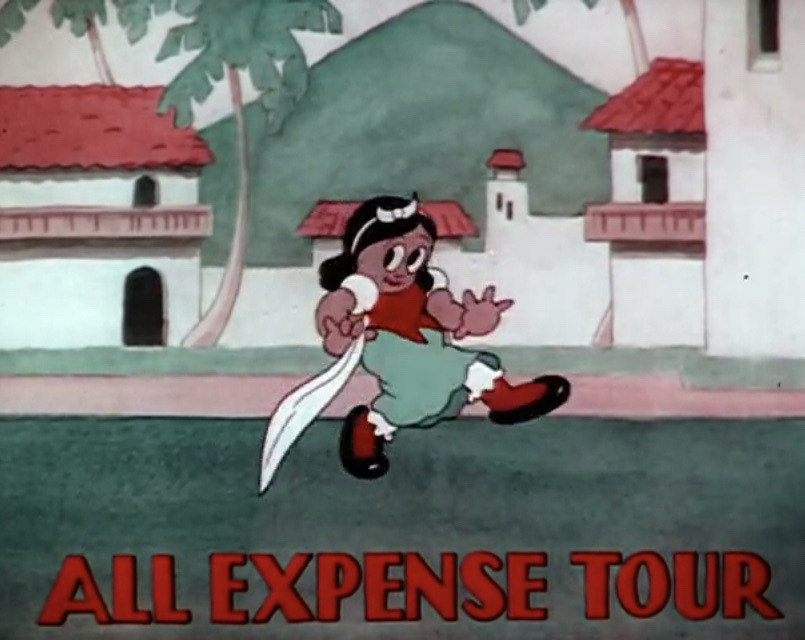
Song number over, dance routine begins. A cocktail shaker in a poster shakes itself like maracas, accompanying a girl advertising all expense tours to Cuba. The animation feels looser than normal, but the dance remains fun and playful. Your stereotypical Freleng girl.

Some hot tamales lend their voices, strumming a fork like a guitar, reused from How Do I Know it’s Sunday, as is a sequence of clogging maids birthed from “Old Maid Cleanser” cans. Now a sequence with Russian rye bread dancing the hopak, their advertisement reading “Baked on the five year plan”—a reference to Stalin’s five year plan(s). Animation is fun for all of these sequences, but none too groundbreaking.

A more upbeat, amusing sequence as a line of penguins engage in a dance sequence, rolling on their mannequin feet like skates and intermittently quacking—because all penguins quack, right? A woman in an above advertisement rains powder below on the penguins to create the illusion of snow. One of the more entertaining dancing sequences in the cartoon, if not the most entertaining. The animation is smooth and flouncy.

The stars of The Girl at the Ironing Board make a comeback and reuse their dances from the aforementioned short. Two tapdancing pajamas do their thing, drumming their buttflaps on upturned wash tubs, while the main “woman” from the short (nothing more than an assortment of clothes) dances as well. Smooth animation, and the addition of color is a nice touch, but nothing extremely wow-worthy. Freleng’s knack for timing is not to be taken for granted, however.

Meanwhile, a hungry chick spots a worm writhing around in an apple. As all hungry, inquisitive chicks do, the little bird jabs its head inside the apple in an attempt to snag the poor worm. Reused from pop goes your heart, the worm crawls out of the other end of the apple and gives the chick a spanking, the chick leaping around in pain and clutching its derrière. Even more determined (especially after the worm mocks the chick), the bird tugs at the worm, the worm clutching desperately to a nearby twig for support. Just as the worm is about to be made into mush, it pushes against the apple, knocking the apple into the chick and sending the chick into a daze.

Enter a chase scene, the worm rolling around like a wheel while the bird nips at it from behind. Truthfully I forget which exact cartoon it was sourced from, Ain’t Nature Grand!? Regardless, the animation of the worm has DEFINITELY been reused in many a Harman-Ising cartoon. After 100+ cartoons, it gets harder to keep track, especially when those early cartoons are so barebones.

The bird chases the worm right into a junk pile, dragging out a long strand... which turns out to be an air pump. Knocking into a branch sends a propped up cellar door crashing straight on top of the pump. An amusing visual as the chick, connector still in its mouth, inflates like a balloon, even floating into the air and flopping to the ground.

Enter the same cat from It’s Got Me Now!, creeping along a fence. It passes by the moon, illuminating the cat’s innards like an x-ray, recycled from Sittin’ on a Backyard Fence. The food chain reminds us of its existence as the cat sees the chick, licking its lips. The cat pounces, providing a menacing meowl (animation of the closeup reused from My Green Fedora).

I LOVE this chick’s face. Full of personality, probably the most this cartoon has had so far. The chick provides a smug, guilty grin as it sways to and fro nervously. A cheeky grin as the bird bids goodbye with a wave, trotting away nonchalantly... and instantly picking up into a hurried run.

An advertisement of a bellhop, labeled “‘CALLING FOR PHILMORE’ CIGARETTES”, notices the chick’s peril and shouts “Calling all cars! Calling all cars!” Two police officers in a “police chief gasoline” ad (a reference to Texaco’s fire chief gasoline that was used until the 1970s) chase after the cat... figuratively. A fun visual as their car speeds along, a jaunty rendition of “Merrily We Roll Along” underscoring the scene, yet their car only speeds along inside their billboard. In reality, they’re merely suspended. One of the officers whips out a machine gun and shoots at the cat (lovely, huh?), the bullets actually breaking the barrier between realities.

An advertisement for “the electric hand” pokes the victor phonograph dog, alerting the dog to the trouble. The dog (fun fact: he actually has a name—Nipper) chases after the cat, running straight into a tube. The conniving cat turns the valves on the tube so as to trap the dog, the dog reduced to a mere barking bump thrashing around inside the metal pipe.

Back to the chick, who runs for its life after realizing the cat is free of distraction. Just as the cat has the poor bird cornered, the arm from the Arm and Hammer logo—this time parodied as “Ham & Armour” conks the cat right on the head with its signature hammer. The little bird perched itself on top of the dazed cat’s head, slapping its sides and crowing like a rooster (parallel to Country Boy). Iris out.

It’s unfair of me to deduct points for recycled animation, but I have a different perspective than a moviegoer in 1935, or even you reading this (unless you’re as much as a nut as I am and have actually taken my recommendations and watched these, to which I say thank you and hang in there). Watching all of these cartoons in rapid succession, you pick up on recycled animation much quicker, and so you can’t help but notice it. The average moviegoer isn’t going to say “Hey! That was used in The Girl at the Ironing Board, directed by Friz Freleng, released August 23rd, 1934 as a part of the Merrie Melodies series!” So, because of that, I won’t try to let that influence my opinion so much. But the retakes were rife in this one, and an indicator that they were either out of time, money, ideas, or all three.

The cartoon felt incoherent and not exactly sloppy, but extremely loose, the closeups of the cat meowing especially. All of the gags have lost their novelty (again speaking as someone who is watching these one after the other), and it’s hard not to say “I’ve seen this before, it’s getting old, it’s not funny.” It’s also difficult to come down from the high that was Gold Diggers of ‘49. Not at all Tex’s best, far from it, but from what we’ve seen so FAR it’s like a huge sigh of relief. And thus, going back to cartoons like these make for a harder transition.

This cartoon wasn’t THAT bad, though. The music was fun (how can you hate hearing the Merrie Melodies theme song, knowing it would be THE Merrie Melodies theme song?) and the Eddie Cantor caricature was highly amusing. Freleng’s musical timing saved a lot of visuals from being too dry and trite. But it just doesn’t have much going for it, it lacks coherence and confidence. It just feels like Friz’s heart wasn’t fully in it. So, I’d say skip it. Yet, as always...

Link!

116. Gold Diggers of '49 (1935)

Release date: November 2nd, 1935

Series: Looney Tunes

Director: Tex Avery

Starring: Tommy Bond (Beans), Joe Dougherty (Porky), Berneice Hansell (Kitty), Billy Bletcher (Villain), Rudy Sooter's Californians (Cowboys)

Where to begin? This is probably the most important review yet, arguably more important than I Haven’t Got a Hat. You’re seeing that right! This is Tex Avery’s directorial debut. Some history before we start: 

Tex had worked at Walter Lantz before working at Warner Bros., where he suffered an eye injury. He was horseplaying in the office—they had a game where one would shoot a rubber band or a spitball at someone and hit them in the back of the eye, yelling “Bullseye!” with each successful shot. The game evolved to using paper clips, and someone told Tex to look out. He turned around just in time for the paper clip to strike him in his left eye, losing vision in said eye. Many have attributed his poor depth perception to the wackiness and bizarre nature of his cartoons.

Avery applied for Warner Bros., bluffing his way through and telling Leon Schlesinger he was a director. Tex is cited as saying “'Hey, I’m, a director'. Hell! I was no more a director than nothing, but with my loud mouth, I talked him into it.” with Ben Hardaway gone, Freleng and King were the only directors there, and Avery was graciously accepted.

Yet, the staff was growing in size, and Avery’s unit was beyond the limit for a single studio. Thus, Termite Terrace was born—a shoddy five room bungalow affectionately dubbed termite terrace as a result of their termite houseguests. He was assigned animators Bob Clampett, Chuck Jones, Sid Sutherland, and Virgil Ross. Instead of animators swarming around to whatever director needed them, Avery now had a solid unit, a model that would continue on and distinguish the animators/units as we know them today.

Tex is attributed to birthing the studios greatest stars. Daffy Duck, Elmer Fudd, and Bugs Bunny (it could be debated whether he created Bugs or Ben Hardaway created Bugs, especially since Bugs was Hardaway’s nickname and literally named Bugs’ Bunny. However, for simplicity’s sake, Tex is virtually the creator of Bugs. He solidified the voice, the personality, and the design, which differed greatly from the hayseed loon that was Hardaway’s Bugs.) He had a relatively short career at WB, leaving in 1941 to MGM, where his potential as a director really exploded. He spawned the iconic yet austere Droopy, as well as Red Hot Riding Hood, the inspiration for Jessica Rabbit in Who Framed Roger Rabbit. This man is responsible for a LOT, including holding the title as one of my favorite directors (the others being, of course, Bob Clampett and Frank Tashlin. Coincidentally, all of them left sometime in the '40s.) 

I’ll run my mouth more at the end of the review, soap boxing on why this cartoon is so important, but let’s actually SEE the contents of the cartoon so we can interpret it. It’s 1849, the heart of the gold rush. Beans and Porky wish to hit it big by digging for gold, but a nefarious villain snatches their findings, resulting in trouble.

Tex Avery loved to play around with words, whether it be sign gags or narrating captions as we see here. Open to a remote western town, rife with cacti and dry land. “THE TIME” is proudly displayed on the screen as we pan to a covered wagon, a calendar inside clueing us in that it’s July of 1849. “THE PLACE”—we pan to a saloon titled “GOLDVILLE SALOON”. And, of course, “THE GIRL”. The opening pan would be repurposed for Friz Freleng's My Little Buckaroo in 1938.

Little Kitty comes bounding out of the general store, joining a crowd congregating around a bulletin board. The newspaper article posted details Beans’ gold digging ambitions: “YOUNG PROSPECTOR TO HUNT GOLD IN RED GULCH”. A picture of a proud Beans, posing with his pickaxe and his mule. Below it: “BEANS — Local boy to brave hazards of red gulch for gold”.

Absolutely ecstatic, Kitty snatches the paper from the billboard and rushes away. Berneice Hansell's delivery is on point and absolutely hilarious as Kitty gives her breathless monologue: “Oh, that’s my sweetie, and I’ll bet he’ll find the gold, and he loves me and everything!” 

Porky makes his second major appearance, this time as a fully grown adult, father to Kitty. Genetics work in mysterious ways. He fixes himself a giant towering sandwich, including a whole fish, a block of cheese, sausage links, and an entire roasted turkey. Sustenance! He scarfs the sandwich down and gives an ecstatic “WWWWHHOOOOPEEEE!!”, a catchphrase of his that thankfully never returned outside of this short. Still extremely amusing. As I said before, I don’t find Dougherty’s Porky “painful” like how some other people find it, but I definitely think this is his most awkward performance, and it’s not even because of his characterization, but the decision not to speed up his voice. Dougherty had a very deep voice, and in this cartoon his voice isn’t sped up at all. It’s a bit jarring, but this WAS his second real appearance. Tex’s next Porky cartoon, The Blow Out, would have him back as a (much cuter) plucky child.

Kitty rushes in and shoves the paper in Porky’s face, continuing her breathless babbling. “Look what my sweetie’s gonna do! I’m so proud of him! He loves me and everything! He’s gonna find gold and we’re gonna be married! And right this minute, he’s way out in the mountains—“ Kitty’s breathless narration continues as we get a shot of the mountains. A long, exposed tunnel goes right through one of the mountains, where we get a distance shot of Beans hacking away at a mountain. “And right now he might be discovering gold!”

A closeup reveals Beans picking away at the side of the mountain, carving a little hole. Just above it are some slots. Beans plucks a button from his shirt and feeds it into the makeshift machine, pulling a branch as a lever. He spins, and lands the jackpot. A plethora of gold coins rush out of the slot, Beans collecting the loot with his hat. If only it were that easy! 

Rightfully gleeful, beans cries “Gold! Gold!” and leaps on his trusty steed. A giant “GOLD!” zooms into view on the screen as beans gallops along on his mule, rushing into town. He bursts into the saloon and declares “I found gold in the gulch, boys! Gold in the gulch!” 

All of the patrons echo “GOLD?” incredulously, deserting their post at once. Even the bartender leaps over the bar, leaving behind some ice cream and other desserts on the counter. A bit of an awkward shot—there’s a still frame of the food on the counter, and you’d expect someone to come in and take the food with them, but that’s not the case. It just sits there and goes onto the next scene. I wonder if there were any cuts, or if didn’t have time, or what. Nevertheless, it’s slightly jarring but a menial thing to pick at.

One by one, the patrons leap on their horses and follow beans to his site. A man flops to the ground where his horse rides HIM instead—a regular gag in the looney tunes universe, but one that tex avery seemed to enjoy in particular. Can’t blame him.

Beans alerts everyone in town—a dog in the bathtub, the dog taking his bathtub with him as he runs, two stereotypical Chinese men at the laundromat (blatant racism isn't the greatest start to Tex's career), and a barbershop quartet singing “Sweet Adeline” outside of a barbershop, animation by Bob Clampett. Beans alerts them, and the quartet runs off... until they rush right back to finish their song. A great gag as they run right back to find the gold.

Next stop, Kitty’s house. Beans rushes inside and exclaims “I found gold!”, holding Kitty by the hands. Porky pokes his head out from the kitchen, wielding a fork and spoon, where he repeats “Gold?” incredulously. No time is wasted as he jogs right out the door, donning a ten gallon hat and a pick axe. Beans excuses himself, kitty refusing to let go. He runs out the door, and Kitty reflects on her sweetie. Good, snappy timing as Beans unexpectedly zooms right back inside, dipping Kitty and giving her a rather passionate kiss. He leaves once more as Kitty collects herself.

Porky has his jalopy all ready to go, and Beans jumps right in. Porky gives another “WHOOPEE!” as they barrel on. More blatant racism as they pass the Chinese men traveling via rickshaw. Porky and Beans zoom right past them, and a cloud of exhaust cover the men. Predictably, they’re now in blackface, talking in a stereotypical accent in an imitation of Amos 'n Andy. Obviously, it goes without saying why or how this is disgusting and wrong. 

Fade out and back in to the site where beans struck it rich. Porky gives another “WHOOPEE!” and strikes his axe into the ground, as do the Siamese twins and Beans. Porky sticks his hand in his hole, where he pulls out a shiny coin and yells “Gold!” so far, his dialogue has been three “WHOOPEE!”s and two variations of “gold”. What a complex character! He stores his find in his back pocket for safekeeping. A highly amusing gag as he sticks his hand down again, this time his hand extending through another hole near his pocket. He fishes his hand into his back pocket (unknowingly) and grabs his find, reaching his hand out of the hole and admiring his “new” loot.

The process repeats until Beans’ voice stops Porky in his tracks. He’s found something. Porky tosses a rope down into the cavernous hole that Beans is in, and with a few good tugs, Beans  pops out of the hole, perched on top of a heavy treasure chest.

Everyone crowds around as Porky and Beans lift the chest. Inside is a tiny little book, covered in a thick layer of cobwebs that reads “HOW TO FIND GOLD”. Beans opens the book, and the answer is right there in the print: “DIG FOR IT”. Tex’s strong sense of humor brings the cartoon much needed liveliness and fun. Tex was definitely a gag man more than an artist, and he has said so. Not that his cartoons are badly drawn at all, but it’s clear he has a priority in humor, which is a great priority to have. Porky and Beans exchange gobsmacked looks.

Enter the villain, creeping along furtively with his horse. He peers through his binoculars, surveying the site. Pan past Porky and Beans scratching their heads over their instructions, past a bag of gold, past a pickaxe... the villain goes back to the bag of gold, exclaiming “Ah! Gold!” He fires his gun, a wonderfully strange hybrid between a gun, a fishing rod, and a grappling hook. As he fires, a lasso extends down to the gulch, tying conveniently around the bag of loot. The villain reels in his catch—some great added detail as he struggles, as if fighting a big one, and even scooping it up in a net.

Porky and Beans spot the bandit. Porky stutters “If you get that bag for me, you can have my daughter.” Beans is delighted and eagerly shakes his hand—it’s a deal. He jumps into Porky’s car and rides off, winding up the twists and turns of the mountain as the bandit makes off with his gold. Visions of grandeur fill the bandits head as he imagines a long, fanciful, costly limo, a driver touting him around as he chuffs on a fat cigar, donning expensive clothes.

His fantasy is interrupted by gunfire. Beans wields duel pistols, firing back and forth at the bandit. Bullets reduce the bandit’s hats to shreds, the hat a shadow of its former self as it plops back on the villain’s big head. Great contrast. Beans continued his fire, shooting a giant hole in the bandit’s pants. A makeshift buttflap falls open, revealing a giant tin pan covering the bandit’s ass for protection. Bullets ricochet off the pan, much to the delight of the bandit.

Frustrated, Beans opts for a rifle instead. A gunfight ensues, and Tex Avery’s need for speed begins to break out. It’ll climax soon, but Tex’s strong point in his cartoons is definitely speed and timing. He can drag out gags or make them ensue in a blink, so much so that those scenes leave you breathless and exhilarated. Some great examples that we’ll see are in this, The Village Smithy, and Porky the Wrestler. The bandit slings his guns back at beans, his arms whirling around at impossible speeds, so much so that he turns into a literal blur, rising and falling back on his horse.

Beans ducks, retaliating. The force of his fire is so strong that his car is propelled back multiple feet with each shot. However, trouble boils when his car stalls out. Empty. Beans pours a jug of moonshine directly into the engine (instead of the gas tank), and the car explodes to life—parallel to the same scene in You Don’t Know What You’re Doin’! but on steroids. The car turns into a giant blur, stretching out to vaguely resemble a race car. With amazing force, the car barrels into the villain, who is thrown into the air with ease. This is where Tex’s speed is magnified and used to a great amount of potential, a potential we haven’t seen yet in a cartoon. It’s exhilarating and breathless, and above all, believable. You feel like you’re right there with them, a must see scene.

The car defies gravity as it speeds along the walls of the caverns, a lovely angle of the car headed straight towards the camera (that would be recycled in one of Tex’s cartoons at MGM, Dumb-Hounded). Beans now barrels whence he came, knocking into the villain once more. Instead of being propelled into the air, the bandit is dragged into the car, reduced to nothing but a mere blur. Around another curve they speed, the loose bag of gold that was thrown into the air with the bandit now landing in the car.

A forlorn Porky paces anxiously, awaiting the return of his beloved gold. He, too, is wiped into the chase, again reduced to a mere blur as he falls into the car. The car zips into town, right past Kitty, who sweeps outside her house. She’s spun around like a top as the shanghaied racecar whirls past.

Finally, the car screeches to a halt. The villain is slumped over inside the car, whereas Porky and Beans are unharmed. Kitty reunites with Porky, who lifts her up lovingly. He places her down in front of Beans. “Well, here’s my daughter!” Beans graciously accepts Kitty’s hand as he thrusts the bag into Porky’s hands, replying “and here’s your gold!” 

A lovely twist as Porky stutters “Gold be derned! That’s my lunch!” Sure enough, he stuffs his hands inside the bag and lifts out a giant towering sandwich, identical to the one he scarfed down at the beginning of the cartoon. He gobbles it up with ease, giving a contented smile as we iris out.

Whether you love this cartoon or hate it, it’s historical significance can’t be denied. This and I Haven’t Got a Hat are probably the most important cartoons we’ve seen thus far, and the two, in my opinion, rely on each other for success. Had Friz not created Porky, who knows what would have happened in this cartoon. Same goes the opposite way. Had Tex not come aboard and used Porky in a suitable role, Porky may have continued to exist in cameos, but how far would Looney Tunes have gotten before inevitably getting canned? 

I personally love this cartoon, and is probably my favorite one so far. Tex Avery was such a pivotal element to the success of Looney Tunes. Albeit this isn’t his most polished work (and the reprehensible racism with the Chinese twins and the blackface gag can’t be overlooked or dismissed), this cartoon is fun, exhilarating, and happy. Tex’s sense of humor is on point, and his timing/speed is impeccable. It leaves you wanting more, almost as if you aren’t satisfied. The whole cartoon revolving around Porky reuniting with his giant sandwich is another plus. Beans is endearing, though bland in personality. Kitty is equally endearing, her breathless excitement indescribably amusing and contagious. Porky is also amusing, but hardly endearing—but, again, second cartoon, still trying to figure things out. Without comparing his appearance here to other cartoons (which is very difficult to do), he fits just fine as the bumbling comic relief character.

This is a major turning point in the world of Looney Tunes. Thanks to Tex, cartoons are going to get snappier, funnier, wittier. I may be biased since he’s one of my favorite directors, but it’s hard to argue with, especially since this is the man who made Daffy, Elmer, Bugs. If anything else, I definitely recommend this for historical significance. Aside from that, it’s fun, happy, energizing, and a great relief to the drab cartoons we’ve been seeing thus far (though Friz deserves much more credit than he gets for his Merrie Melodies). Obviously, express discretion at the racist gag of the Chinese twins/blackface—they aren’t too exhausted, but definitely prominent enough to constitute a warning. This is a cartoon worth watching for its contribution to animation alone.

Link!

115. Hollywood Capers (1935)

Release date: October 19th, 1935

Series: Looney Tunes

Director: Jack King

Starring: Tommy Bond (Beans), Berneice Hansell (Kitty), Billy Bletcher (Guard, Frankenstein’s Monster)

Originally titled Beans in Hollywood, Hollywood Capers centers around beans’ infatuation with the movie industry, dropping in on a recording sessions. However, things quickly run amuck once he accidentally powers on a ferocious Frankenstein robot.

Activity is high as ever at Warmer Bros. studios (a pun frequented in many a cartoon). Actors bustle to and fro, including a humorous caricature of W.C. Fields, sauntering along with a rolling cane, cigar propped in his mouth and showing off some gaudy checkered pants. The guard and Fields (pinned as “Mr. Seal”) exchange “good morning”s. Suddenly, Fields places his hat atop the guard’s head and pops his cigar in the guard’s mouth. He positions his cane like a cue stick, shooting off any ash. Very amusing and creative. He regains his cigar and hat, matching into the studio as the guard scratches his head.

Next comes our favorite Hollywood star, Beans. He putters along in his car, the engine shorting out and making for a bumpy ride, animation fun and flexible. Screeching to a halt at the gate, Beans allows the guard to interrogate him, the guard growling “Who do you think YOU are?” Beans jumps up and puffs out his chest proudly. “Beans is the name, one of the Boston beans!” A nice touch as he tilts his hat forward and holds out his overall straps smugly.

The guard is having none of it. He grabs the car and pushes it backwards, and Beans is sent riding up into a tree, the car exploding. Rubbery, smooth animation as beans dangles on the safety of a tire, bouncing up and down, his butt honking the car horn.

Other celebrities have better luck than beans. A Charlie Chaplin caricature enters with ease, his car wheels moving along like actual feet. Oliver Hardy also saunters into the studio, greeted by the guard. Hardy briefly acknowledges the guard’s “Good morning, Mr. Hardy!” as he strolls inside the studio. Once far enough in, a familiar hand unbuttons the jacket’s buttons, and beans steps out of the disguise as his Hardy getup, nothing more than a bundle of balloons and clothes, rise into the sky. This could also be paralleled with Porky’s attempts to disguise himself as Hardy in order to enter the WB lot as well in Friz Freleng’s You Ought to Be in Pictures, Freleng’s approach much more amusing and rewarding. Still a nice gag here, though.

Giddy at the fact that he’s in, beans wanders the lot and enters one of the studios, a sign posted on the door indicating that they’re filming.

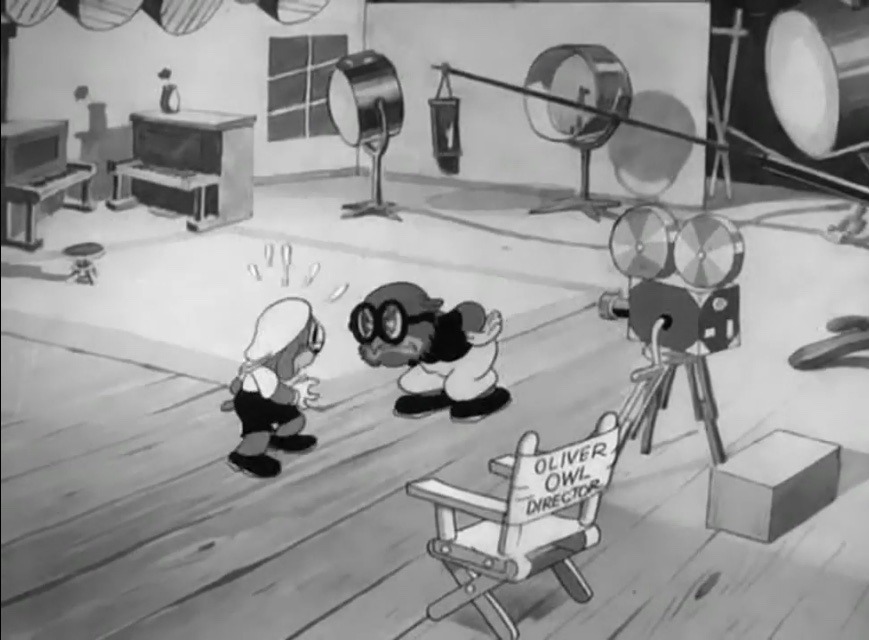
I was wondering if Oliver Owl would ever make an appearance again! Here, he’s an adult, a crotchety, anxious director pacing around, accompanied by a dog assistant who matches his pace. The dog bumps into Oliver, who isn’t pleased. He orders the dog to go back to his post at the camera.

Oliver loops himself down in his director’s chair and barks “Quiet!” A tanned Porky makes a cameo as he shushes the bystanders in the studio. A shot of a man asleep on the rafters, blowing out a candle that also aligns with a chorus of hushes. Beans’ shadow also shushes him, as does an anthropomorphized microphone.

The cameras are now rolling. Lovely animation as the camera man runs over to film the scene, his camera running like stilts. Little Kitty is the star of the film, singing “Sweet Flossie Farmer” as a turtle  accompanies her on piano. A barbershop trio lend their voices, as does the piano playing turtle. Beans observes in awe as he stands on the rafters.

A brief interlude as a man plays “Chopsticks” on a cash register, reused from those were wonderful days. It’s been awhile since we’ve seen any recycled animation, or at least to my knowledge. The piano playing turtle tickles the ivory as he lies on his shell playing dueling pianos. Animation is also reused from Buddy’s Beer Garden as a bartender fills up various mugs with some beer to the beat of the music.

Back to Beans, who’s still ogling in awe at the scene below—the stuttering dog from Into Your Dance attempting to woo an indignant kitty. Disaster strikes when a nearby workman passes by, carrying a long piece of board. As he turns the corner, the board smacks Beans and sends him flying. He attempts to grab onto a rope for support, yet the rope is tied to nothing. Despite his best efforts, Beans is sent tumbling down, right into the arms of the dog.

Rightfully so, everyone is shocked, especially Oliver and his anthropomorphic director’s chair (King’s Disney roots seeping in once more). He marches over to Beans, who dutifully introduces himself, once more repeating his “Beans is the name, one of the Boston beans!” greeting. It didn’t work before, and it doesn’t work now. Oliver grabs Beans and throws him out (another future parallel to You Ought to Be in Pictures).

Beans rockets through the studio, landing right onto the set of Frankenstein. Granted, a robotic adaptation, but still. He discovers a bench obscured by a white sheet. Pulling back the sheet, Beans is met with the grotesque face of Frankenstein’s monster. In the midst of his shock, beans stumbles backwards and trips over a power switch, which brings the robotic monster to life. Beans runs for his little life as Frankenstein’s monster limbers up, stretching before barreling right through a wall leading to the prop department.

The dog camera man is rolling, just in time to catch the metal menace marching towards his camera. The sound effects are a bit misplaced as the monster literally swallows the camera (a Jack King trademark), the sound of crunching already playing as his mouth is still gaping open. The sound effects are a little off in this one. Sometimes it isn’t noticeable, sometimes it is—nothing against Bernard Brown, there’s only so much you can do. Treg Brown’s ingenuity and creativity in his sounds is sorely missed. Nevertheless, the monster devours the camera whole, wincing as he chomps on a bolt. He spits out a plethora of camera parts, including a film strip—accompanied by a jarringly funny machine gun sound effect.

Kitty spots the monster, a fun take as her bonnet spins above her in shock. She darts away as the monster stumbles across a mirror, sticking out his tongue and mocking himself. It’s a useless and arbitrary gag for sure, but also funny for that reason alone. Like a baby or an animal discovering its reflection for the first time. He gets closer to the mirror, mocking himself once more. His reflection leans back and punches his actual self hard, a gag that would be reused in Porky’s Double Trouble to the same degree.

The monster is sent flying right into a tub of water, where he squeezes his head to pour out the water from his ears and scalp (his hair rising like a toupée as a geyser of water spurts out from his head). The animation is fun and amusing, always entertaining to see particularly hard substances turned to rubber. Though this IS the rubber hose era of animation, so that’s a given.

Beans spots a metal rod propped up to a spotlight, which he can use to his advantage. He sneaks up behind the robot, who’s still drying himself off. His plan is sent into action as Beans wraps the rod around the monster, constricting him into place. Of course, a simple puff of the chest and the binds are broken free by the monster. A fun indicator of personality as beans flashes a guilty, sly smile, bashfully dragging his feet.

Cue a triumphant chase sequence as Beans runs from the monster, who snags him by the overalls. A slightly incoherent cut as Beans is seen flying through the air, crashing into many doors that pile up beneath him like dominos, one by one. The animation is very smooth and tantalizing as the doors collapse to the ground, beans skidding across the floor like butter.

He slides straight into a giant fan (or in this case, labeled as a wind machine). An idea hatches as he disregards any instructions to turn off the fan. He turns the switch, and a harsh breeze blows against the approaching monster. Beans slides the fan closer to the monster, and eventually the monster is chopped to pieces as he walks right through it. His remains splay out on the form, forming a makeshift engine of a car. Robotic arms smack the monster repeatedly in the face as we iris out.

Not bad at all—I found A Cartoonist’s Nightmare to be more entertaining and smooth sailing, but this was more enjoyable than any Buddy cartoon by king. The biggest downfall to this cartoon was slight lapses in coherence, often gags falling short of their intentions and jarring animation cuts. The sound effects also felt occasionally out of place. Nevertheless, high energy and decent. A neat way to reprise the cast of I Haven’t Got a Hat. Ham and Ex, the two curious pups, were missing from this cartoon, but they’d make prominent sidekicks for beans in his cartoons as troublemaking tricksters. This cartoon felt very similar to You Ought to Be in Pictures (one of my favorite cartoons). Protagonist has trouble entering a studio, and once he manages to get in, trouble is never ending. Ultimately, a bit soupy at times, but a decent, entertaining short that makes for an amusing watch.

Our next review is our most important yet—Tex Avery makes his debut with Gold Diggers of ‘49, which could be debated as to why Looney Tunes is the phenomenon that it is today.


114. Little Dutch Plate (1935)

Release date: October 19th, 1935

Series: Merrie Melodies

Director: Friz Freleng

Starring: Carol Trevis (Dutch Girl), Billy Bletcher (Vinegar Bottle), Tommy Bond (Dutch Boy), Bernard Brown (Cuckoo Clock), The Rhythmettes (Chorus)

Not to be confused with any other cartoon that features a) a Dutch figurine of some sort or b) anthropomorphic kitchen utensils. A little Dutch girl on a plate and a Dutch boy salt shaker are smitten for each other, but a villainous vinegar bottle plans to put a halt to their happiness immediately.

The cartoon opens with a lovely, warm, rich chorus of The Girl on the Little Dutch Plate”. The sound is exquisite as always, full of charm and sentimentality. Open to streets of Holland, specifically a cottage along the canal. Inside the “little Dutch kitchen” on the “little Dutch shelf” is the girl on the little Dutch plate. She sighs, smitten with a salt shaker boy who reciprocates her infatuation. Cute animation as the boy strolls over coyly to meet his sweetheart, a collection of plates narrating the event in song.

Finally they meet, and the two engage in a fun clogging routine. The animation is solid, fun, and fluid, a joy to watch. Elsewhere, other kitchen utensils contribute to the fun. Two beer steins exchange alcohol, a pair of overalls does a clog dancing routine, and the singing women on the plates do a lovely dance number as well. A great bit of animation as they roll the plates around and hang upside down, their many layered skirts piling up one by one. They sink their legs through the exposed hole and pop right side up, back to normal. A gag difficult to describe, but certainly a must see.

Interesting to note for the girl and boy clogging—animation was done by Ken Harris, legendary animator most commonly associated with Chuck jones. According to animator Greg Duffell, Harris made his debut by working with Friz first. He wanted to assert that he could animate, and Friz assigned him this scene as a test. Harris worked his magic and impressed Freleng, and the rest is history. Harris worked for Freleng, later switching briefly to Frank Tashlin's unit. Chuck Jones inherited the Tashlin unit in 1938, and Harris stayed with him all the way until 1962, the longest time an animator has stayed with a director at Warner Bros.

Anyway, enter the villain, a nefarious looking salt shaker who swats his way past a thicket of cobwebs. He spots the clogging couple and hatches an idea—to reach them, he fires a mousetrap beneath himself and rockets up a long, curving candlestick. His hat smashes against the candle holder as he reaches the top, and he struggles to get it off. Wonderfully amusing animation as he (now on the safety of the shelf) gets on all fours, sitting like a dog scratching its butt across the floor and pops the hat off with the aid of his feet.

Meanwhile, the boy escorts his sweetheart into her real home, a model of a windmill. He serenades her with a whimsical little love song, as the villain watches in disgust. He snags a paper from his pocket, adorned with a ribbon. Must mean business! He saunters to the couple and wastes no time heckling them, insisting they have until 12:00 to pay their mortgage. A very similar premise would be reused in a Tex Avery cartoon, Milk and Money, where a mustachioed villain characterized by Billy Bletcher heckles Porky’s father on the matter of paying mortgage, or else he’ll take the farm (and in a good bit of Tex Avery humor, the villain whips back to the camera and whispers “He’ll never make it!).

All of the characters speak in prose as the Dutch girl begs for the villain’s mercy. The villain’s motives are revealed as he suggests the girl marry him, and the matter of the bill will be gone. The little Dutch boy insists he’ll have the mortgage paid on time, met with a Billy Bletcher belly laugh.

A cuckoo clock reveals its cuckoo bird, who announces that it’s 11:30. A figure of a Native American is perched on top and whacks the bird in the head with a tomahawk, sending him back into the confines of his clock. The girl is clearly distressed, but the boy reassures her everything will be fine. He gives the a villain a nasty insult of “You old meanie!”, to which the villain terrorizes him in response.

Time passes, and the clock hands reach 12. The cuckoo bird opens his beak, about to signal the demise for the couple, when the Native American socks him on the head once more with the tomahawk and winds the hands back to 11:30.

The poor boy paces around, seeking the help of a piggy bank, but to no avail. No matter! He spots something much more intriguing. An amusing set up of dentures lined up on a shelf, labeled “PAW”, “MAW”, and “SONNY BOY”. Paw’s dentures have a big cigar clenched between the false teeth, which the boy trades for a stick of dynamite. He strikes a match and the dentures explode, a shower of false teeth raining down. I love how random and interesting this is! Dentures, the answer for everything.

Once more, the cuckoo clock and the Native American repeat their charade. The Native American wallops the bird before he can open his beak (taking off the bird’s helmet), winding the hands of the clock back to 11:30.

Elsewhere, the villain continues to pester the girl, proposing she marry him. She does the right thing by kicking him in the face multiple times and exclaiming “I hate you, I hate you, I hate you!” Good for her! Finally, the villain gives up his polite act and drags the girl along, right into the belly of a grandfather clock where he attempts to advance on her.

Back to the boy, who has shoved all of the false teeth into a sack. He lugs the sack over his shoulder and runs to the rescue. We get a shot of the villain and the girl, and the mood has drastically changed. As archetypal as it gets as the girl is tied to a wooden plank, heading straight for a whirring saw. She cries for help, and the boy, who has been puzzled as to why she wasn’t in the windmill, hears her pleas and rushes to the grandfather clock.

The villain steps out of the clock to confront the boy. Finally, we see the use for the perplexingly amusing bag of teeth—perfect for hitting. The boy slams the bag right over the villain’s head, the force enough to get the villain’s hat stuck on his head.

The boy is then able to rush inside and free his sweetheart from her peril. They both run outside hand in hand, just in time to see the villain get his head unstuck from his hat. He swings a punch at the boy, who ducks and returns the favor, this time hitting him in the face. The villain’s head spins and flies up and down with each punch he receives from the feisty boy. Eventually, he receives a punch so hard the villain’s head flies towards the great unknown.

Headless, the villain bumbles around, attempting to reconnect with his head. He stumbles upon a DIFFERENT head on a perfume bottle, a much more handsome and appealing head. Just as the boy is about to sock the villain hard, the girl protests, saying “Don’t you dare hit him!” I LOVE endings like these. She cozies up to the vinegar bottle, cooing “You handsome man!” they stroll away arm in arm as the boy is left to his own devices.

Another great ending that would become a Looney Staple—random bursts of gunfire. The cuckoo bird pops once more out of its hole, and just as the Native American is about to conk him on the head, the bird retaliates and pulls out a machine gun, blowing him to smithereens. Iris out as the bird is free to cuckoo to his heart’s content.

Very cute little cartoon! The quality of Friz’s cartoons are getting much better. The song was fun, flighty, and endearing, and the Dutch couple were very cute. The villain was entertaining (and archetypal) as always, and both endings—the girl falling for the villain and the machine gun wielding cuckoo bird—added a nice element of surprise. The choice of putting a Native American on the clock was... odd, but that's probably my only complaint. The story was archetypal but executed in a manner that makes it fun and intriguing. Worth a watch! 

Link!


113. A Cartoonist's Nightmare (1935)

Release date: September 14th, 1935

Series: Looney Tunes

Director: Jack King

Starring: Billy Bletcher (Beast, Villains, Pianist), Tommy Bond (Beans)

Beans’ first solo cartoon! This is an interesting case to note. Beans (and of course Porky) would be the first star to debut in a Merrie Melodies cartoon as opposed to a Looney Tunes cartoon. There was a rule that Merrie Melodies couldn’t feature reoccurring characters—I hesitate to say that with confidence, since Peter Rabbit was used in Country Boy and My Green Fedora, and a Buddy facsimile was used in Mr. and Mrs. is the Name, but generally characters weren’t reused, much less brought over into other divisions. So, Beans is the first to be brought over! Tex Avery would also break the rule with Daffy Duck and Egghead in 1938, bringing Daffy over from Looney Tunes to Merrie Melodies and also reusing Egghead from Egghead Rides Again.

In terms of synopsis: a cartoonist is dutifully working on a Beans cartoon, but falls asleep. The villain in his project comes to life and kidnaps the cartoonist, and it’s up to Beans to save the day.

Animators bustle to and fro in a cartoon studio that looks like it was spawned from a love affair between Dr. Seuss and Tim Burton. A highly prestigious studio, as indicated by the sign out front: animated cartoon studio. A rather bored, anthropomorphic whistle (Jack King’s Disney roots seep into its design, animated by Bob McKimson) nonchalantly checks it’s stopwatch and gives a tired bellow to indicate the day’s end.

The distance shot of the studio is impressive as all of the animators leave, lights switching off and even an animator jumping off the roof and traveling via umbrella. Various workers bids the elderly groundskeeper goodnight as he locks up for the night.

A lone cartoonist diligently pumps out more work, adding to a towering stack of frames. The groundskeeper pokes his head in, asking “Ya gonna work all night, son?” The cartoonist shrugs. “I gotta finish tonight.” With a bid of good luck, the groundskeeper leaves the animator to his work.

We then spot the fruits of his labor as a close up of the animator’s work is shown. He’s working on a Beans cartoon, drawing a ferocious monster and painting him in. The monster comes to life and gives a terrorizing grunt, cornering a terrified beans. A fun choice to make the animator analyze his work, Chuck Jones providing the animation of the animator commentating “Well, Beans, I guess I’ll have to save ya from the villain again!” He sticks his hand into frame and pulls the monster off of Beans. Furious, the beast turns his attention to the animator instead. The animator uses this as an opportunity to paint some protective iron bars in front of Beans, essentially jailing him. Delighted, Beans teases the beast by blowing a party streamer in his face.

Eventually, the animator tires himself out and falls asleep. Time marches on, and his drawings remain sentient. Trouble arises as the villain reaches out of the frame and drags the animator inside, Jack King providing one of his great perspective shots (above). I’ve come to really appreciate how he plays around with different perspectives and closeups, it brings a lot of liveliness and interest. Obviously, the animator is wide awake by now, struggling as the villain takes him away. Beans speaks his first lines— “Hey! Let go of him!” 

The beast drags the poor animator through the dungeons of the animated world—not far off from some working conditions at certain studios. As the beast drags his victim down a set of rickety stairs, a loose piece of board flies up and clobbers the villain on the head. The beast, assuming it was the work of the cartoonist, punches the sheepish animator in the face.

Past the gag department, story department, and music department they go, each department barred behind an intimidating iron door. There’s some sort of weird lawn mower weapon—like a barbed mower. Essentially, a painful prop. The animator accidentally prompts the handle to thwack the beast in the head, who gives him another pounding.

Finally, the beast arrives at his destination: the cartoon villains chamber. Sound effects are jarring and unfitting (yet almost humorously so) as a laser sound effect accompanies the monster punching the cartoonist, sending him flying. He bumps into a portrait of a kangaroo labeled “Battling Barney”. Barney’s joey leaps out of its pouch and sends the cartoonist hurtling once more towards the main villain.

One by one the animator receives a plethora of beatings, from the beast to the octopus from Mr. and Mrs. is the Name. Thus sparks a musical segment from the villains, the villains lamenting about how they’ve been mistreated and now the cartoon will finally get his, the song a parody of “The Teddy Bear’s Picnic”. I find it interesting that Jack King included musical numbers in his cartoons. From the beginning, those working on the Merrie Melodies complained about how a nice story would be rolling along and then an arbitrary song would disrupt momentum. It seems as though King had the opposite gripe—he wanted to insert more music into his cartoons. An interesting choice. The lyrics are amusing and dark, the chorus going “The tables are turned and now you are in our clutches!” Bletcher also reprises his role as the mad pianist from Buddy the Detective.

The villains reveal their motive: they want to force the animator down a bottomless pit, making him draw his demise. The poor cartoonist has no choice but to obey. He hesitantly draws a giant circle on the ground, preparing for his demise.

Elsewhere, Beans is still behind bars, sulking. Someone dressed in a woman’s disguise sneaks Beans a loaf of bread (the scene animated by Bob Clampett), much to Beans’ delight as he exclaims “Food!” He takes a big bite out of the bread, but recoils. Inside the bread is a handsaw, perfect to cut the bars with. Beans saws his way through the metal as we cut back to the kidnapped animator, peering into a bottomless pit.

After some stalling, the animator is thrown down the pit. It seems there IS a bottom, inhabited by a hungry alligator. Narrowly does the cartoonist escape being eaten, a branch catching him by the pants. Regardless, the cartoonist momentarily dives into the alligator’s mouth, the gator’s dentures dangling off his head. Paul Smith animates a closeup of the toothless and tearful alligator. Not to fear—the cartoonist returns the alligator’s dentures, who thanks him with a snap of the jaws.

Beans manages to saw his way out and make his escape. He runs ACROSS the stairs, floating on air instead of descending—a cartoon staple. Sliding down a giant pole, beans skids along the ground and knocks into a barrel, the metal rings constricting around beans. A crash to the wall sends the rings flying back into their respective place on the barrel.

Curious, Beans  pokes his head in to watch the torture. All of the villains are gathered around the pit, having a hearty laugh. Concocting a plan, Beans places two boots at the doorway of the chamber. Don Williams animates the two boots who come to life, matching forward towards the hairy beast and giving him a swift kick in the ass.

Undoubtedly, the villain takes notice and spots beans teasing the villains at the door. Beans dashes away and a chase breaks out as the villains follow. They all pass by the barrel from before... which is inhabited by a proud Beans. The coast clear, beans darts back into the chamber and analyzes the pit, scratching his head as he thinks of a way to help the cartoonist. The cartoonist cries for help, the hungry jaws of the alligator nearing him as he perches on the branch that saved him.

With some quick thinking, Beans yells “Hey, catch this pencil!”, tossing down the pencil the cartoonist used in his suicide mission. The cartoonist catches it, beaming as he acknowledges his power. He draws an extendable ladder, turning the crank and scaling to safety.

Never a peaceful moment in the cartooning business as the main beast pokes his head inside the chamber, growling at beans. They have a mini chase sequence as the animator scales to safety. The beast momentarily loses Beans, who notices the animator and shushes him. An abrupt jump cut to beans holding a grease gun, lubricating the floor. He whistles to summon the attention of the villains, and his plan unfolds swimmingly. All of the villains slide straight into the bottomless pit. The cartoonist gives the hairy beast an extra punch for good luck, the beast struggling to stay on the ground. Once all of the nuisances are in the pit, the animator enlists in the help of an eraser and erases the pit in the floor. Beans and the cartoonist slap and shake hands together, beaming at their teamwork.

Bob McKimson animates the scene of the elderly watchman shaking the animator awake as we fade back to the present. The cartoonist ogles at the audience, exclaiming “Wotta dream!” A very literal title to the cartoon. He resumes his work, back to where he left off: the beast terrorizing beans, who’s cowering behind bars. In the style of Bosko, the Talk-ink Kid, the cartoonist sucks the beast back into his pen, as well as the iron bars.

But his work isn’t done yet. As a reward, he sketches out a heaping plate of jello that has Beans’ name written all over it. He calls “Come and get it!” Beans doesn’t have to be told twice—he gorges himself gleefully, eventually disregarding the spoon and licking it straight from the source. Iris out.

This was a very creative and fun cartoon! A good choice for Beans’ first solo act. I like Beans—probably just the relief at the newness of a character and knowing things are starting to gain traction, but he’s cute. The animation was intriguing and fun in the cartoon, as was the music. I certainly think this is King’s best entry yet. I haven’t seen all of King’s cartoons, but out of the ones I have, this is my favorite. A fun premise and lots of personality. The story doesn’t feel too dragged out or redundant, a nice balance between the cartoonist, the villains, and Beans. Overall, a fun, high energy cartoon that’s worth a watch. Though it doesn’t have many gags, the story and premise are interesting enough, as is the historical significance of it being beans’ first solo debut.

Link!

390. Case of the Missing Hare (1942)

Release Date: December 12th, 1942 Series: Merrie Melodies Director: Chuck Jones Story: Tedd Pierce Animation: Ken Harris Musical Direction:...