Release date: December 19th, 1936
Series: Looney Tunes
Director: Frank Tashlin
Starring: Joe Dougherty (Porky), Billy Bletcher (Jean-Baptiste), Berneice Hansell (Benny Beaver)
Release date: December 19th, 1936
Series: Looney Tunes
Director: Frank Tashlin
Starring: Joe Dougherty (Porky), Billy Bletcher (Jean-Baptiste), Berneice Hansell (Benny Beaver)
Release date: December 5th, 1936
Series: Looney Tunes
Director: Tex Avery
Starring: Earle Hodgins (Narrator), Tex Avery (Blacksmith), Joe Dougherty (Porky)
A few reviews ago, I said that Porky in the North Woods was the first cartoon to debut the “Porky Signature” opening. Turns out I was wrong, it’s actually THIS one! (a small error, though, considering Porky in the North Woods is the cartoon right after this one. Still, my mistake!) A witty retelling of the longsfellow poem that pins Porky as a clumsy smithy, which results in trouble.
Earle Hodgins does a wonderful job as the narrator. We open to him literally setting up the scene—after he says “Under the spreading chestnut tree”, a chestnut tree falls to the ground, the “standing” village smithy not far behind, lazing on the grass and most certainly NOT standing. The narrator sighs. “I said STAND. Stand up, you lug!”
The smithy does so, his back to the audience. “Hey, this way!” He whips around to ogle at the audience before swaying bashfully. While lauding the smithy’s physique, comedy’s greatest friend, juxtaposition, strikes hard. Instead of seeing the smithy’s brawny arms, we’re met with twigs, hilariously accompanied by his overly large, sinewy hands. Recognizing the folly, the smithy takes a moment to inflate his muscles by blowing into his respective thumbs.
“...and now, the blacksmith shop.” The smithy throws up his dukes and boxes at an unseen foe as the shack falls into place right behind him. Contented with his new shop, the smithy goes inside to investigate, while the local schoolchildren come to observe the smithy at work. “They love to see the flaming forge and hear the bellows roar.” A wonderful closeup as the bellows lets out a ferocious lion’s roar, the narrator remarking “Boy, what a roar!”
One of my favorite gags in the entire cartoon is when the children are observing the smithy. The narrator suddenly grows hotheaded, shooing them out. “Alright kids, get out of the scene now! You bother me.” Even better is the reaction from the kids, all grumbling and trudging away, one even kicking a van across the screen in defiance. Hodgins’ voice combined with Tex’s timing make for a wonderful end product of comedy.
With the smithy now alone, he pumps the bellows up and down and up and down and up and down up and down up and down up and down—the narrator repeats “up and down” at a furious pace, the smithy struggling to keep up, pumping frantically with his giant tongue hanging out of his mouth in exhaustion. Another wonderful gag that is succinctly timed. Even better is the dialogue spawned from the gag: fed up with his mistreatment, the smithy tosses away the bellows and directly addresses the narrator. “Listen, chief! Take it easy. We got plenty of time, this cartoon ain't half over yet!” Tex Avery provides the voice of the smithy, and I believe this is Virgil Ross animation.
So, with that reassurance that we have plenty of time, the narrator introduces our hero, Porky Pig. Great juxtaposition with the triumphant fanfare and then the pan over to reveal tiny, portly Porky shaking his fists in the glory. The narrator takes a moment to recollect himself. “Let’s see, we have the blacksmith—“ the smithy sticks his tongue out at the narrator “—the blacksmith shop... now, boys, we need a horse.”
Bob Clampett animates the scene of the smithy and Porky looking for the horse, Porky hilariously lifting up a magazine and a barrel on the ground, as if a giant horse would be hiding under such menial and small objects. The fated horseshoe clops grow louder, and a camel struts into view. “Oh, my mistake. This little fellow belongs in our foreign feature picture.” A cane drags the camel offscreen, and the void is soon replaced by a white horse, thrown onto the scene.
The smithy pulls the horse out of his reins and leads him to a barrel, where the horse sits down like a human. Measuring the horse’s hoof, the smithy declares “Size 6 and 7/8ths!”, a number that would be frequented in quite a few cartoons. Porky dutifully salutes and scours the shop for a suitable horseshoe, stacked in shoeboxes in neat rows of shelves. Another director attempting to pull off such a literal gag may have gotten a few polite chuckles, but Tex ensures that it’s funny. It’s not that wild of a gag if you think about it, but Tex approaches it like it is. His love of jokes and gags really breathe life into his cartoons.
Absentmindedly, Porky reaches into a box of rubber horseshoes instead of iron horseshoes (cleverly named Bad-Year, a take on the Goodyear tires.) Rubber horseshoes were all the rage in the ‘30s, presumably because they were much quieter than iron and much more comfortable for the horse. Unfortunately, being rubber, they aren’t so easy to smelt. Lots of bounce-back.
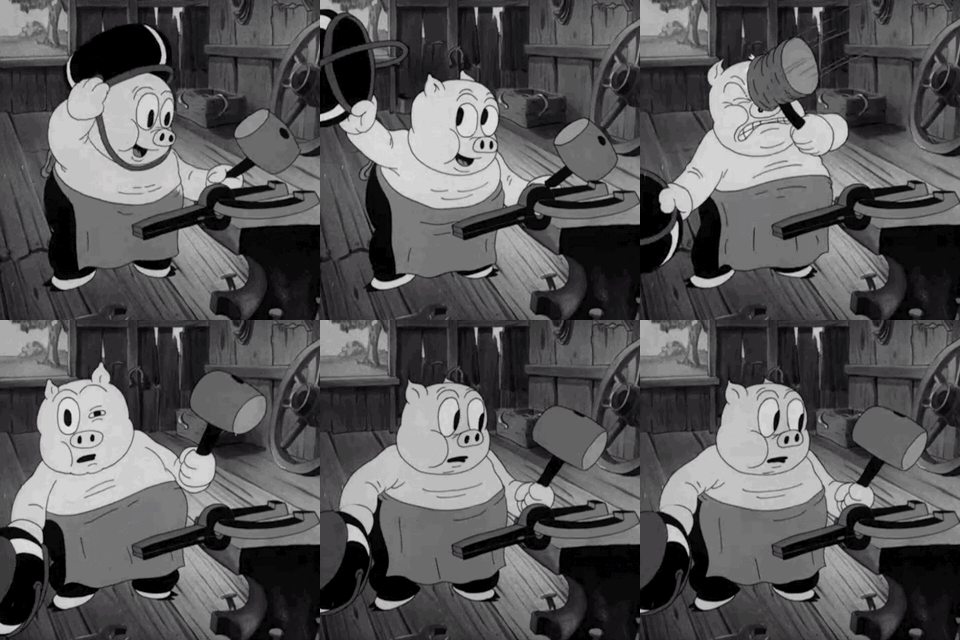
Porky finds this out fairly quickly as he goes to hammer the horseshoe, then getting whacked in the eye by the hammer and glaring at the horseshoe suspiciously. Very funny animation by Bob Clampett. Porky tries again, getting hit once more. Instead, he ducks out of the way, so the hammer can’t hit him. Of course it does, konking him on the head. Ah, but wait! The perfect solution! Porky places a nearby kettle on his head like a helmet, and braces for impact as he pounds on the horseshoe. Nothing. Now complacent, Porky takes off his “helmet”, and the hammer wastes no time whacking him in the face, completely unprompted. Porky’s befuddled stare is lovely after the fact.
Horseshoe in hand, Porky goes to hammer the horseshoe to the horse’s hoof, but accidentally nails it to the smithy’s outstretched foot instead. Porky gives him the okay (a high pitched “Okey dokey” reused from Little Beau Porky), but quickly comes to realize his mistake.
The animation is quite literally bouncy, rubbery, and amusing as the smithy walks through his shop, practically skipping as the rubber propels him into the air with each step. His footsteps grow higher in height, to the point where the smithy bangs his head against the ceiling. Aggravated, he pries off the horseshoe, throwing it out of the shop in frustration. It bounces against a tree, and, being rubber, knocks right back into the smithy like a boomerang. This time, the smithy tosses the shoe out and slams the door shut, thinking he’s outwitted the horseshoe. Not the case—the horseshoe flies in from behind courtesy of an open window and hits the smithy, a gag that would be reused in Porky’s Badtime Story and later Tick Tock Tuckered.
Instead of letting his temper get to him, the smithy gingerly places the horseshoe on the ground with the utmost patience and grace. Of course, the horseshoe comes back with a vengeance, slingshotting into the face of the smithy from just the slightest contact with the floor. A lovely gag with perfect timing.
Now visibly furious, the smithy places the horseshoe in a clamp, locking it so as to keep it still. Locked in place, the horseshoe causes the entire shop to tremble vigorously as it tries to break out of its vice. The smithy puts the shoe out of its misery by shooting it with a gun, the shoe flopping down motionless. In all, a great sequence that really takes advantage of rubbery animation. Not unlike Porky’s dog drinking rubberizing solution and literally turning into a rubber hose character in Porky’s Tire Trouble.
A befuddled Porky wanders into the scene, bringing the smithy his trusty steed. The smithy orders Porky to get him a (proper) horseshoe. The smithy literally smacks the horse into its reins, pushing its entire body through the exposed hole, while Porky prepares the horseshoe, smelting it.
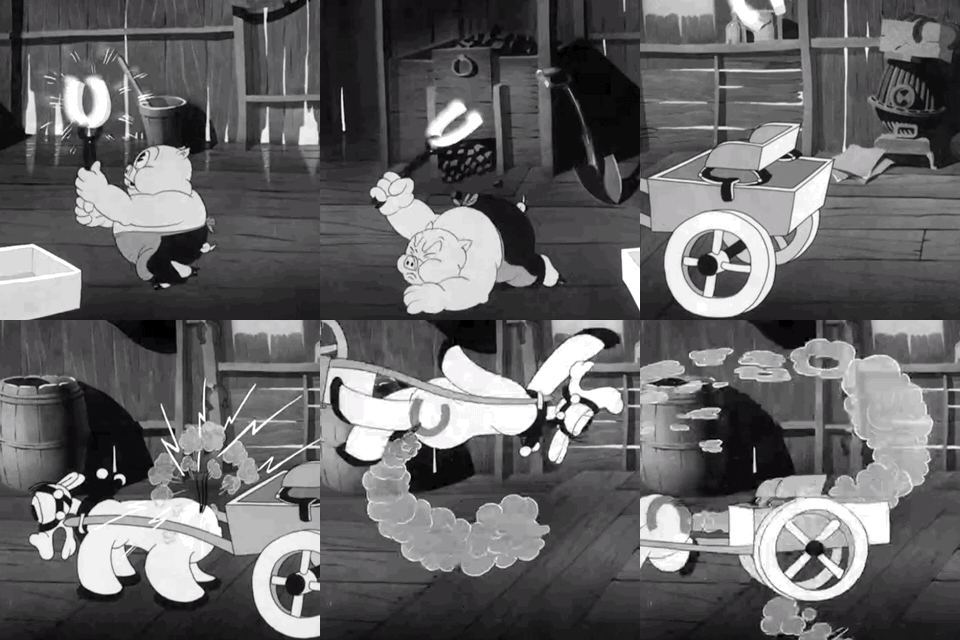
In many of my Tex reviews, I often laud him about his use of timing and speed. A few times i’ve mentioned how the timing has thrown an entire cartoon out of proportion. This is always the scene I have in mind. Porky grabs the smoldering hot horseshoe, running across the shop with the searing death trap unsecured in a clamp. Porky trips, and the horseshoe is sent flying into the air, landing right on the horse’s butt and essentially branding it. The horse justifiably leaps up in agony, and with the cart attached, barrels into the smithy. Thus, the smithy is sent toppling into the wagon, pulled uncontrollably by a burning horse.
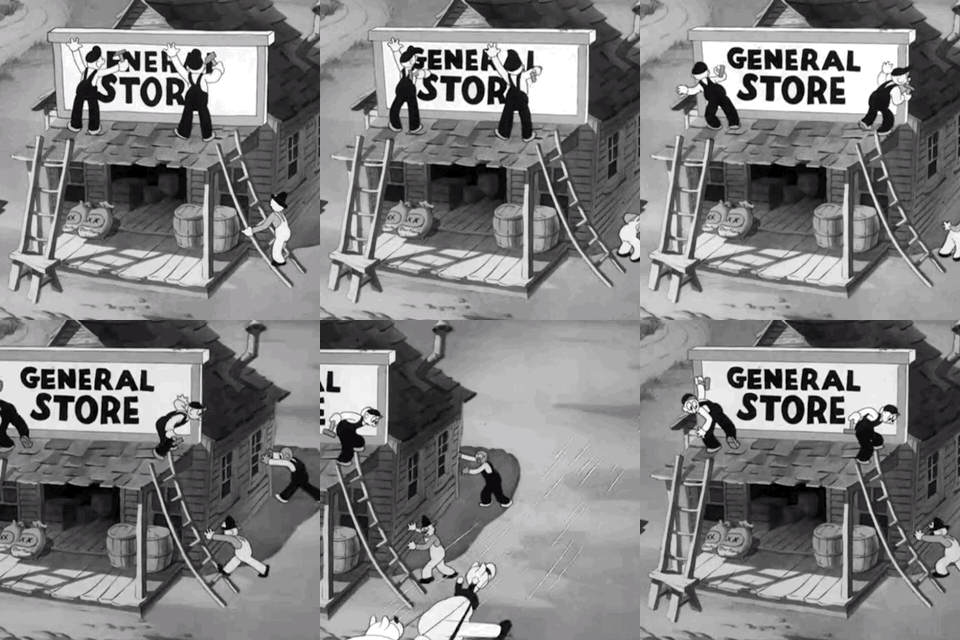
Just a great number of gags, one after the other. The chase leads out of the shop and right through a general store, reducing it to nothing but wood planks and half a foundation. Past the traffic guard they zoom, spinning the guard around like a top in the process. Whirling past a bank destroys the façade, and the interior is exposed as we spot a robber trying to hammer his way into the safe. A ditch digger ducks just in time for the horse and the smithy to race by, the digger popping his head up from the hole and ogling at the audience nonplussed.
A sign reads HERE THEY COME!, and certainly they do come, spinning the sign in the process so that the other side reads THERE THEY GO! The horse manages to flip the cart and itself over a chasm, maintaining no breaks in the chase. Just a great setup as the sequence freezes for a moment, the smithy addressing the audience, “Whew! What a buggy ride!”
The chase is led to a fence, the pulled string slingshotting them BACKWARDS. As expected (yet still exhilaratingly so), the entire chase scene plays out backwards—a classic Averyism. This entire chase scene is highly reminiscent of a chase scene in Tex’s first Droopy cartoon, Dumb-Hounded, though to a higher degree. Same exhilarating chase, same exhilaration reversed. Here, the damage is essentially reversed—the sign is flipped back to HERE THEY COME!, the ditch digger almost gets his head cut off once more (though this time he asks “Say, am I missing something?”), the bank façade is restored and the robber concealed, the traffic guard is put out of his interminable top spin, A newly constructed general store with workers putting on the finishing touches is moved out of the way just in time for the horse and the smithy to not so safely return to the shop.
Winded, the smithy wipes the sweat off his forehead. “Say, listen,” he addresses Porky, “tell me how all this happened.” Porky re-enacts the scene. “Well, I just had a hot horseshoe like this—“ he holds up another scalding hot horseshoe, “—and I was running like this, and uh...”
As he runs with the horseshoe, he trips over once more, and the horseshoe is sent flying into the horse’s rear a second time. We iris out as the entire chase scene starts from the beginning, the smithy sent toppling into the cart and barreling into the general store.
So much to address! But, in all: this is one of my favorite Tex cartoons at his tenure at Warner Bros. Earle Hodgins does a fantastic job as the narrator, Tex as the smithy. The cartoon is so anti-Disney, so sardonic, so wild and out there, so unconventional. It’s still hilarious (and then some) 84+ years later, and still innovative and new.
The fourth wall breaks are strong and feel natural, not at all forced or obligatory. The animation is fun and amusing, especially in conjunction with the increasingly frustrated narrator. And that chase scene is just impeccable. Truly a scene that just goes off the rails. Remember, all of that destruction and havoc occurred because Porky TRIPPED and a horseshoe burnt the horse. 10 seconds in and the chase wasn’t even about the burn anymore, it was just a chase for the hell of it. And it totally works. I definitely encourage you to see the scene, if not this entire cartoon in general. I can’t implore you enough to watch it. I truly think this is one of the best cartoons we’ve seen in this journey. See for yourself and allow the cartoon to succeed in where my words have failed.
Link!
Release date: November 28th, 1936
Series: Merrie Melodies
Director: Friz Freleng
Starring: Peter Lind Hayes (Walter Winchell), Berneice Hansell, Shirley Reed (Dionne Quintuplets), Tedd Pierce (W.C. Squeals), Martha Wentworth (Mae West), Jeane Cowan (Helen Morgan), Melvin Gibby (Horse Noises)
Disclaimer: This cartoon contains racial stereotypes and caricatures. While perhaps not as extreme in depiction as other cartoons, the racism and stereotypes are still very much there and deserve addressing. I do not at all condone these depictions, I find them gross and wrong, but to gloss over them would be just as wrong. Thank you for understanding.
Release date: November 14th, 1936
Series: Looney Tunes
Director: Frank Tashlin
Starring: Joe Dougherty (Porky), Billy Bletcher (Ali-Mode, Le Commandant)
Frank Tashlin’s second cartoon, and it’s yet another foreign legion short. Bosko had one, Buddy had one, and now Porky has one. Porky would have another legion short in 1940 with Bob Clampett’s Ali-Baba Bound. This time, a bumbling yet eager Porky is ready to go out and get the treacherous ali-mode. Unfortunately, his snobbish commandant dismisses him to camel scrubbing duties, deeming him incapable of the mission. But no matter—while holding up the fort, Porky receives an unexpected visitor.
The opening sequence is an impressive one at that. Essentially a montage of silhouettes at the foreign legion, the execution is very well done. A silhouette trumpets a fanfare, while another shot displays the shadow of a flag being raised, the shadow reflecting across both the floor and the wall. A legionnaire begins a drum march, and we get this lovely marching scene, the silhouettes weaving in and out as they travel across various walls, some receding into the distance, some not. All in all, a very impressive scene that displays Frank Tashlin’s eye for staging and cinematography. This right here is why he’s one of my favorite directors—his cartoons are so innovative in approach.
Next, we pan across a long wall, getting to a sign that reads LE COMMANDANT. The mystery of offscreen jangling is solved as Le Commandant himself pompously marches on screen, his plethora of medals clanging profusely against his giant chest with each step. Man, I would not want to animate that. (I find myself saying this often in some of Tashlin’s cartoons) the animation of the commandant turning around to face the audience isn’t as smooth, feeling a bit rough around the edges (maybe an assistant did it?) but the scene of him marching along is very strong and humorous.
Another rolling pan ot the legionnaires, all standing at attention. Though they vary in all shapes and sizes, their respect for the commandant is front and center. Each stiff as a board, going down the line... and then there’s Porky, slouched over asleep as he leans on the guy next to him. A lovely display of devotion and veneration. The commandant takes notice, barking “PORKY PIG! ATTENTION!”
Porky snaps awake and dutifully stands at attention. In fact, he tries so hard to prove that he has been dutifully standing still the entire time that he kicks his leg out to snap it back in position, knocking over the entire line of legionnaires in the process like bowling pins. Another “ATTENTION!” reverses the bowling pin soldiers, who all pile up back into place, cleverly accompanied by the reverse sound effects of bowling pins being knocked over.
The commandant calls for Porky once more, and there’s a long, drawn out, hilariously timed pause as Porky doesn’t move. One more “PORKY PIG!” snags his attention. Porky stutters profusely (more than usual), “Wh-wh-w-who-uh-wh-who-uh-who-uh-who-uh-wh-who, me-uh-m-mm-me-uh-me-mmm——me?”
Great combination of sound effects as the commandant mocks Porky furiously, the angry jangle of his medals drowning out his retort as he stutters back “YE-YE-YE-YE-YE-YES Y-YO-YOU-UH... YES, YOU!!!” With a dutiful march forward, Porky arrives at the commandant’s side and gives a salute. “FORWARD MARCH!”
The commandant turns around, his giant saber sheath knocking Porky to the ground. Porky recovers, and we get this wonderful scene of Porky mocking the commandant. He winks at the audience, shoving his hat forward on his face he and following in time with the commandant, swinging his belly around pompously and all, even popping one eye open at the audience as if to make sure they’re still watching. He gives another wink, completely oblivious that the commandant has stopped his march. Porky climbs up the saber sheath, bumping into the commandant’s arm and tumbling down to the ground. He recovers in no time with a dutiful salute.
“YOU, SCRUB MY CAMEL! AND BE CAREFUL YOU DO NOT HURT HIM!” the commandant orders. Porky makes his way towards the camel, situated by a wash tub and a ladder for convenience, giving a high pitched “Okey-dokey.”
Porky scrubs his brush against a bar of soap, whistling a jolly rendition of “Fella with the Fiddle”. He climbs the ladder and prepares to scrub the camel, when the camel lies down on the ground in protest. Porky shrugs, making his way back down to the ladder, the camel standing back up. Thinking for a moment, Porky winks at the audience and inconspicuously saunters to the ladder slowly, whistling nonchalantly, when he scrambles to the top of the ladder as fast as he could, just in time for the camel to duck again. What ensues is a great scene of Porky repeatedly climbing up and down the ladder, the camel standing and sitting when necessary. Combined with Carl Stalling’s score, the musical timing is excellent as both Porky and the camel rocket back and forth, the ladder eventually breaking under Porky’s weight, Porky flopping to the ground and glaring at the audience in exasperated defeat.
Elsewhere, an urgent legionnaire bounds through the desert on his camel. Animation is smooth and bouncy as the legionnaire bounces up and down on the camel, not unlike a similar gag in Porky in Egypt. A guard spots the legionnaire and pulls a lever to open the doors into the legion. Eventually, the legionnaire slides off of the camel’s neck, still galloping frantically. Grabbing a paper, he yells “Le Commandant, Le Commandant!”, tripping over a rock in the process. The paper flies over to the commandant, who glares at it with steely eyes as the paper floats around him like a paper airplane. Finally, the commandant uses his sharp, needle point beard to pierce the paper in place.
Another amusing facial hair gag as the commandant’s mustache furls into a pair of glasses. The animation is a little rough, but the joke is still there. The telegram (or, in this case, camelgram) alerts the commandant that Ali-Mode’s gang is on the attack, and that he must come at once. Great detail of the hole pierced through the paper from the commandant’s beard.
Next up is a lovely sequence of overlays. A legionnaire trumpets a fanfare, and images flash by one by one of the preparations. Legionnaires running through the barracks, shouting and yelling, grabbing their rifles, and embarking on their camels. Another great cinematographic trick of Tashlin’s that works in his favor, successfully adding moodiness and a sense of adventure.
All of the legionnaires stream out on camelback, with Porky not too far behind, jauntily making his way towards the exit. Now I know for certain this animation was reused in Porky in Egypt, or at the very least inspired from. Porky’s sense of nonchalant confidence is interrupted when the commandant yanks him back by the camel’s tail. We then get another Tashlin favorite, characters getting up close and personal to the screen. The commandant barks at the screen, “Where do you think YOU’RE going!?” Cut to a closeup of a tearful Porky lying on the ground. “We need MEN, not CAMEL SCRUBBERS!”
With that, the commandant leaves on his camel, catching his hat that flew off his head with his saber. Porky grovels on top of a fitting accompaniment of “Am I Blue?”. “Shucks! So I’m a camel scrubber, huh? I’d rather be a camel scrubber than an old jingle bell general.” This is the most controlled delivery I’ve ever heard Joe Dougherty give, and probably the longest. He really does have talent, he can voice act, and he sounds good once he gets his stutter under control, but I think people are so put off by his stuttering that it’s easier to pity him than commend him. I’ve also seen all of this cartoons before, though, so maybe I’m used to it.
Pan to a threatening poster of Ali-Mode. WANTED DEAD OR ALIVE — “PREFERABLY DEAD”! Porky shuffles up to the poster, rambling about how he isn’t afraid of Ali. “I’d like to meet him face to face. I’d punch him in the jaw, the big sissy!”
Caught up in moping, staring at the ground, Porky finally glances at the poster. His tough guy act is extinguished immediately as he screams and dashes to barricade the open door shut. Even better, Porky rushes back to the poster, dismissing it as “I wasn’t scared! I just felt a draft.”
Next cut reveals the legion being viewed by a pair of binoculars, belonging to none other than Ali-Mode himself. He whistles to signal for his gang to follow. There’s some wonderfully bouncy animation as Ali tiptoes to the door of the legion. As I mentioned in the disclaimer, the stereotyping is certainly there (and he’s also... inexplicably in blackface? The lips aren’t too noticeable, but when they are they are rather prominent), and I’m not defending his depiction, but in terms of technicalities he is a very good villain. Billy Bletcher’s vocal talents shine with this next scene, and his overall animation is very smooth, flouncy, and calculated. He isn’t as harshly caricatured as other depictions I’ve seen (but that’s not for me to decide in the first place), but it was enough that it turned me off from this cartoon for awhile, and I forgot how many good qualities this cartoon did have.
Ali knocks on the door, mimicking the sound of Porky, who’s nailing boards to the other side of the door. Porky shudders, tentatively hammering a few times, with Ali knocking right back. Porky looks at his camel and hilariously declares in a womanly falsetto, “It’s an echo!” Ali also mimics the falsetto, Bletcher just as entertaining as Dougherty. “It’s an echo!”
Porky (poorly) yodels, eagerly awaiting a response. Ali yodels right back with an impressive, jazzy twist. I’m not sure if that’s Bletcher doing the entire thing or not, but kudos to him if so! Porky, thinking it’s himself, announces to the camel “Pretty good, huh?” Ali mocks porky’s stutter, answering “Pr-pr-pre-pre-pretty g-g-g-good, huh?” Finally, his egotism gets to him. “HECK! That’s PERFECT!”
Now realizing he’s most definitely not conversing with an echo, a timid Porky dives under his camel for safety and asks “Who’s there?” Ali puts on his womanly falsetto. “I’m a poor little sheik with no place to sleep. Won’t you please let me in?”
Sound familiar? It should—it was used in Disney’s The Three Little Pigs in 1933, with “sheep” in place of “sheik”. Bletcher, as you may recall, voiced the wolf in that same short. Funnily enough, Frank Tashlin would head to Disney in 1938 after leaving Schlesinger’s. Porky checks to see who’s outside, and recognizes the man plucking his machete as Ali-Mode.
Ali demands to be let in, slamming on the door repeatedly as Porky refuses. Porky insists “No, no, a thousand times no!”, a short-lived catchphrase of his. Tashlin’s next cartoon, Porky in the North Woods, would have Porky nailing a ton of signs that day “NO” on a bunch of trees, eventually ending with a giant sign that reads “A THOUSAND TIMES NO!”
Ali-Mode speaks in pig latin to his followers, eventually yelling “AMSCRAY!” His followers dig in the ground, making it to the inside of the legion. Porky hacks away at a palm tree, which falls and konks all of the enemies on the head in succession, sending them flying back outside.
The climax fires at rapid pace, almost too rapid for coherency. I’d rather take too fast than too slow, though, and it isn’t TOO detrimental to the cartoon. It adds a sense of urgency and exhilaration, and forces you to be captivated so you don’t miss any details. A gunman fires his machine gun at Porky who’s running up a tower. The stairs disintegrate beneath him from the shower of bullets. Porky reaches his own machine gun and fires back from his respective tower, the bullets breaking the gunman’s perch and sending him toppling into a water well. He lands in the bucket, causing the handle on the well to spin repeatedly and smack the guy firing next to the well.
Ali-Mode is making his way up towards the tower, poking his head out of the floor hatch. Porky stomps down on the hatch, which sends Ali flying down his ladder and down to the ground. This charade is repeated again, as is the handle smacking gag as another gunman falls into the bucket and smacks the bystander. When Porky goes to squash ali a third time, he misses the door and falls right down with Ali. Ali flops onto Porky’s camel, who beats him senseless with its humps. Very amusing, quick animation. Porky whistles for the camel, and the camel bucks Ali into an open barrel of syrup. With that, Ali-Mode is taken care of, the camel repeatedly licking his face.
Iris in to the familiar jangling of the commandant’s medals. In fact, it’s a different commandant: a smaller, piggy, stuttering commandant, marching along with his medals twice as long as his body width. Porky whistles for his camel, and even his camel struts out, his humps decorated and his tail high in the air. Iris out.
Not Porly’s best cartoon ever, but this is a VERY good entry, especially for the Dougherty era. Maybe the best one yet. The stereotyping is not nearly as abundant as I remembered it to be, but they’re still very much there and deserve addressing. With that said, though, and I’m not defending the depiction, Ali-Mode is a good villain. Billy Bletcher’s vocals are absolutely phenomenal, whether it be voicing the commandant or Ali. Lots of falsettos, lots of yelling, even yodeling. That, combined with the amusing character acting where Ali tricks Porky into thinking he’s an echo at the door, makes for some amusing entertainment.
Also, Porky was full of personality in this one, probably the most we’ve seen thus far. I’ve noticed that Tashlin’s Porky is a lot more personal than Tex’s at this time, Ub Iwerks’, and Bob Clampett’s in 1937. Lots of winking towards the audience or talking to the audience. There’s a scene in Porky’s Railroad where Porky has a closeup on the ground, straight up lamenting towards the audience. Tex Avery was, of course, the fourth wall master (as we’ll soon see in The Village Smithy), but Tashlin harnesses a much more personal feeling that is still sardonic and amusing.
The pacing of this cartoon seems to be at opposite ends: it’s a rather lengthy cartoon, running over 8 minutes. The beginning seems a bit too slow, and the end too fast, but in all it’s a highly entertaining cartoon that’s worth of watch. Again, there are stereotypes and caricatures, so view with discretion. I don’t try to be like “This short is racist. Watch it!” (though I know that’s what I sound like), but I do think it’s worth at least a one time watch. There’s a lot to absorb and learn from this one: voice acting, character acting, camera angles, silhouettes, overlays, etc. It’s worth a watch.
Link!
Release date: November 7th, 1936
Series: Merrie Melodies
Director: Tex Avery
Starring: Tex Avery (Preacher), Berneice Hansell (Cathleen, Bear Cubs), Timmy Bond (Devil, Cupid, Cuckoo Bird), Martha Wentworth (woman woodpecker), Billy Bletcher (Devil Cuckoo Bird), Shirley Reed (Tortoise, Skunk)
Release Date: December 12th, 1942 Series: Merrie Melodies Director: Chuck Jones Story: Tedd Pierce Animation: Ken Harris Musical Direction:...