Showing posts with label Earl Duvall. Show all posts

Thursday, May 6, 2021

75. Buddy's Garage (1934)

Release date: April 14th, 1934

Series: Looney Tunes

Director: Earl Duvall

Starring: Bernard Brown (Buddy), Jane Withers (Cookie), Billy Bletcher (Villain)

Get a load of that fancy title card! This would be Earl Duvall’s last short at Warner Bros. His short career was put to an end when he got into a drunken argument with Leon Schlesinger (presumably over budgets) and was fired. I’m relatively indifferent to Duvall, nothing really speaks to me about him, but I do have respect for him in that he kept Buddy’s character going and gave him a total redesign after Tom Palmer’s disaster of  Buddy’s Day Out. Anyway, Buddy works at a garage, but his duties are interrupted when Cookie gets kidnapped.

Our happy little boy scout persona is whistling away to “Puddin’ Head Jones”, an underscore that would be used frequently by Carl Stalling, while sewing a patch to a tire. A family of cats accompanies buddy, all sucking on their mother, save for one who opts to suckle on the air tube of the tire instead.

A car comes to life and scrubs itself under a shower, buddy squirting some oil on it for the finishing touches, including inside the car’s “stomach” and prompting it to giggle. A happy and upbeat scene, yet unoriginal and a standard.

Towser’s asleep near a car with a flat tire. Buddy, the master of ingenuity, puts an air hose in Towser’s mouth, causing the tire to blow up with air.

Of course, we can never have things go too smoothly. A pesky bee sharpens its stinger—which happens to be its nose—and prepares to pop the tire, sweeping the dust off and giving it a little elbow grease.

Sure enough, the tire pops, jolting Towser awake. Towser spots the culprit immediately and tries to eat the bee, repeatedly chomping down and gnashing his teeth to no avail. Finally, he succeeds, the bee swallowed. A little moving bump in Towser’s fur and continued happy buzzing to “Puddin’ Head Jones” signals the bee is alright and still a nuisance. Towser spits the bee back out (a nice little detail on his pupils expanding in various circles with shock), and the bee is free to go.

Back to our musical buddy roots as he uses a hammer to play chimes against a wall of chisels. A “Yoo-hoo!” from Cookie disrupts his concert, and eagerly he goes to see her. She’s packed lunch for him, and together they set up a little picnic in the garage—complete with a great gag of Buddy peeling the skin off the pineapple so it’s just a yellow (“yellow”) blob. A monkey wrench is also used to crack open some walnuts. There’s a cutaway gag of a gas nozzle spraying Towser for just sniffing around. Rude! The gag feels out of place and added in last minute. Back to Buddy, who uses an air nozzle to inflate a turkey, which pops. A true genius at work! 

The reoccurring jailbird character makes an appearance as an impatient customer. While he waits for buddy to give him his fill of gas, he uses the candle the baby from the classic "Time to Re-tire" poster as a means to light his cigar. Man, I’m sure that’s overused, but I love it regardless! 

As Buddy fills the brute’s car with gas and inspects the motor, the brute wanders into the shop, right over to where Cookie is reapplying her makeup. The kidnapping traditions never die! He grunts “You go with me, yes?” and before she can object, he scoops her up and runs off.

Buddy hears Cookie’s squeals and runs to put an end to the kidnapping. Cookie the Riveter takes a riveter to the crook’s butt, who jumps up in pain before he can strangle Buddy. Nevertheless, he snags cookie again and pours a shelf full of tires on buddy to restrict him. The brute and his damsel in distress make off in his car, the exhaust fumes exploding in Buddy’s face and freeing him. Buddy grabs his own car, a tow truck, and off to the races.

Two cars narrowly avoided beating folded into scrap metal as the chase whirls right past them. The cars manage to jump away just in time, shaking hands in camaraderie. A road closed sign blocks the villain’s path, but his car gallops over it and jumps like a horse. Funny gag and concept, but drawn out a bit too long, one of those “too deliberate” setups. That could just be my short attention span talking, though.

Crashing into a toolbox allows a pair of handsaws to be attached to the rear wheels of the getaway car. Perfect for cutting a bridge when going over it! That IS clever—the saws cut the bridge and poor Buddy plummets into the waters below. The hook on the back of his tow truck snags a fish that is quickly devoured by a gang of hungry cats following behind him. The setup is a little strange, but works. One shot the fish is alive, one shot Buddy is driving, suddenly joined by a chorus of meows, and the next shot the cats are chasing a fish skeleton on the hook. It’d be more entertaining if there were some eating sound effects, or maybe the cats fighting with each other, but at the same time it works nicely. Now you see the fish, now you don’t.

A fork in the road stops Buddy in his tracks. However, his loyal car sniffs the ground and points out the right direction, and together they speed—crashing into a laundry truck along the way, adorning the car in a bra and some panties. Another staple, but an amusing one. Buddy nears the getaway car, crashing into a house and dragging along a frightened couple in bed with him, their bed reduced to a mere mattress as it drags along the ground.

Nevertheless, Buddy uses his hook to tow Cookie back to safety, and the crook, too—dragging HIM along the road. A nice underscore of “California, Here I Come” blares triumphantly in the background—a future favorite of Carl Stalling’s. Iris out as Buddy embraces Cookie while covering the crook in exhaust fumes.

This is probably the best Buddy cartoon so far—it wasn’t exactly riveting, but it was a good balance of action and upbeat happiness. The music enhanced it like always, and the visual gags were amusing. The cartoon seems to focus more on the kidnapping aspect than the garage aspect—not that that’s necessarily a detriment, though. This is certainly more amusing than some of the other Buddy cartoons we’ve seen, but the plotline remains relatively thin, some gags amusing and some all too familiar. It wasn’t bad at all, though. Nothing made me say “this is terrible”. Maybe worth a one and done watch.

Link!

73. Honeymoon Hotel (1934)

Release date: February 17th, 1934

Series: Merrie Melodies

Director: Earl Duvall

Starring: The Rhythmettes, The Varsity Three (Chorus), Bernard Brown (Bug)

Notice anything different? That’s right, our first color cartoon! Until 1936, the Merrie Melodies would be in Cinecolor, a two strip color method consisting of reds and greens. For comparison, technicolor was a three strip color process, and thus a whole array of colors were able to use. With that comes prices: Cinecolor was cheaper and faster, and Disney also had the rights to technicolor at the time. Cinecolor went out in the '50s, whereas technicolor isn’t commonly used today, but is sometimes used in films set in the mid century to convey the aesthetics of midcentury movies.

Enough history! The song “Honeymoon Hotel” would be a frequent score in Warner Bros. cartoons. Two doting bugs room in the honeymoon hotel, but never seem to find some privacy.

Look at those gorgeous colors! The cartoon opens with some bugs singing the titular “Honeymoon Hotel”, advertising folks to come to their very own home of Bugtown. The vocals are rich and beautiful and inviting as always! 

While the painters sing, we’re shown the bustling streets of Bugtown. Cars amuck, happy bugs frolicking, living in their teapot houses, eating in their toolbox lunch rooms, exiting a chamber of commerce pot, riding a trolley, even getting locked up in the city jail bug trap.

Elsewhere, we view our happy couple, skipping hand in hand. The man snags a spare pea pod and dumps the peas out, fashioning a canoe for him and his sweetie to lounge in on the river. The musical underscore is sweepingly romantic and gorgeous, like the climax of a Hollywood romance film in the '30s. The atmosphere is also heightened and appreciated more with the freshness of the Cinecolor and excitement of change and progress in the cartoons.

The happy couple go from smooching in a pea pod to exiting a church as a married couple, riding along in their car advertising their vow exchanges, the gag reused in Porky’s Romance.

We have a lovely moody shot of the honeymoon hotel at night as the ladybugs prepare to make their stay. Their car is anthropomorphized (like all cars), bidding them goodnight with an envious sigh. They check into the lobby, greeted with more happy verses of “Honeymoon Hotel” as the hotel advertises its facilities.

A birdcage elevator takes the newlyweds to their room, and they enter so happily, tipping the caterpillar bellhop graciously. But what’s a hotel without a serial peeping tom? The peeping tom peers into the keyhole, which is moved up to the top of the door with a hook from the inside. Discouraged, the tom sneaks around to other rooms, getting the same harsh treatment. A spit in the face via keyhole and a punch in the face via keyhole. Two hands from the adjacent doors reach out from their keyholes and shake at their handiwork as the peeping tom lies unconscious on the ground.

Back to the ladybugs, some attempts at flirting occur, interrupted by knocking. A few bugs sing some more of the eponymous tune, bringing in refreshments. A parade of housekeepers also bring in some bedding. The male ladybug finds the disruptions disturbing, asking merely for a goodnight. The staff bid them goodnight as they finally make their exit. Side note, I love the detail of the thermometer on the wall! (it’ll come into play later.) that’s such a vintage thing—actual mercury thermometers, or those like it, are rarely on anyone’s wall anymore, obviously replaced by the practical electronic thermometers. 

Finally alone, the bugs return to their business in private... or so they think. After a gag of all of the staff peeping in on the couple, the moon outside their window bursts into their love life, and unsuccessfully they pull the curtain down, it rising back up each time. The moon might just be a regular moon character, but his voice reminds me of the Jack Benny caricatures that would soon frequent the WB library. Anyway, look at that beautiful shot! The magic of the color certainly enhances this cartoon and adds to the excitement.

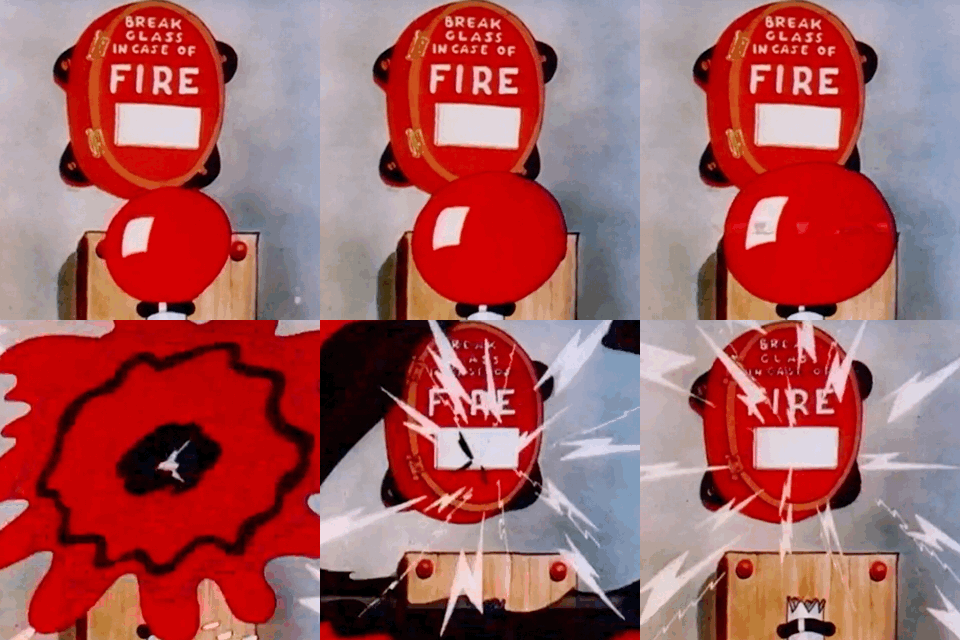
With much needed privacy, the bugs kiss. A heart pops up and rises into the thermometer above, breaking the glass and starting the fire alarm. I love the explosion of the heart, the experimentation with color is evident. However, and I know it’s a cartoon, the heart sparks an ACTUAL fire, a fleet of fire trucks racing to the hotel, which is now ablaze. I know it’s a metaphor for their red hot blazing love, but it lacks coherence, especially since there was no prior indication of any fire. Not even stray sparks to light things on fire. Nevertheless, suspension of disbelief! 

Gags galore as various patrons jump to safety on a water pack trampoline. One bug loses his pants, who jump right after him. A screwdriver serves as a slide for others to whirl down and get to ground.

Our main couple isn’t so fortunate. Fire blocks their every path, smoke filling the room and serving more as an imminent hazard with each second. With all the doors blocked, they run into the bedroom and seek refuge in the bed, that conveniently flips upward like a door.

The firefighters are no match for the blaze. The hotel explodes, a charred shell of its former self. All is gone...

...except for the ladybugs’ bedroom. The husband runs to the doorway, blocked by rubble, and slings a DO NOT DISTURB sign on the door. Privacy at last! He dives back in bed, the two winking as the bed flips back up. There’s a calendar on the bed turned door with a baby on it, which winks knowingly as we iris out. Innuendos! 

I know for a fact this is because of the newfound use of color, but I really enjoyed this cartoon! It was very cutesy and cozy, yet promiscuous at the same time. The colors were beautiful and a delight to see, the music was phenomenal and moody, animation good—nothing too impressive, but good, and the happy couple were likable and believable on their quest for some gosh darned peace and quiet. The whole love turning into a physical fire element is still slightly unclear and vague, but it’s a cartoon and the metaphor gets across regardless. It’s worthy of a watch! 

Link!

Wednesday, May 5, 2021

70. Sittin' on a Backyard Fence (1933)

Release date: December 16th, 1933

Series: Merrie Melodies

Director: Earl Duvall

Starring: The Rhythmettes (Chorus), The Varsity Three (Chorus)

The last cartoon of 1933, and what a year it’s been! Bosko’s out, Buddy’s in. 1934 would mark the start of the Merrie Melodies going into color (via the cheaper two strip process, so lots of reds and greens), Friz Freleng would get his first directorial credit (which is actually our next review)... exciting stuff! Here, we end out the year with a Merrie Melody. Two alley cats fight for the affections of another.

A handful of gags involving sleeping inanimate objects opens the cartoon. An alarm clock, a telephone, a book, even dentures in a glass of water all asleep, along with their owner, an old man. We pan over to the window, where the man’s cat is perched on the window sill. She spots another cat, who sings (yowls) “Am I Blue?”, and eagerly she hops over to join him.

She seems to be quite the catch: multiple cats follow her as she trots along the fence in the night. I love the cartooniness of the cats. Surely there will be better cat designs as years go on, but these are a good start. Always refreshing to see something other than little clones of Mickey.

I love this gag! As the cats traipse past the moonlight, the moon acts as an x-ray and the insides of the cats are revealed. I’d hate to animate all those bones! 

Elsewhere, posters of some cows and a bull flirt with each other. Quite the flirtatious atmosphere! Together they launch into the eponymous “Sittin' on a Backyard Fence”. Vocals are lush and catchy and the atmosphere is fun and amusing, full of charisma. As the cows sing, there are some shots of pajamas hanging on laundry lines doing acrobatics.

The rest of the alley cats join in, using various scraps as musical instruments. Very catchy and fun, albeit a standard. Even the cat from the beginning and his sweetie yowl a few bars. The yowling is annoying, but would make for a good laugh, especially watching him play a gridiron as an instrument.

Elsewhere, there’s a scraggly cat lapping up a bottle of alcohol (labeled katnip) and becoming inebriated. I love his design, even though he isn’t too different from the other cats, the eyepatch indicates he knows his way around the alleys. He spots the girl cat on the fence and becomes enthralled. In an attempt to woo her, he places a record on the face of a clock in a scrap pile and saunters his way over.

I love this shot: three different archetypes of characters. The ruffian asks the sweetheart for a dance, and she happily obliges, much to the other cat’s chagrin. There’s an awkwardly long sequence as the cat jumps off the fence and peers into a hole below: it’s not THAT long, but there’s little weight to the animation, and feels as if he’s floating. Just a minor gripe, though. The animation has been improving and I really enjoy this cartoon so far.

A very fun dancing sequence ensues with the girl cat and the ruffian, as well as a group of kittens slapping their tails together to the beat of the music. Spirits are high and the atmosphere is present! There’s also a shot of two cats playing tic tac toe with some paint.

At last, the charmer cat allows his emotions to boil over and throws a brick at the ruffian. Cue a wonderful chase sequence! Well, soon to be wonderful. There are some awkward reuses of animation, one scene almost playing over 3 times in a row, and the cats have that weightless, indecisive feel to them.

Nevertheless, things get good once the two cats land on a mirror that spins them around. They chase each other up a telephone pole, sword fighting with their tails once they reach the top. Someone in one of the nearby buildings puts a stop to the clamor by throwing a rolling pin out the window. The rolling pin knocks the cats over, both of them holding on opposite sides with their tails.

Look at that animation and those camera angles! The perspective is fascinating to watch and keeps you on your toes.

Eventually, they get knocked off and plummet to the ground, where they tussle in a scrap pile. Covered in junk, the chase rages on as they chase each other into a shed.

Unlucky for them, a menacing bull dog was also in the shed. The bull dog bounds after them as enemies turn into teammates. There’s also a neat shot of the girl cat perched on a pole overlooking the scene and turning to the camera in awe.

The cats think they’ve chased the dog away, shutting a fence gate closed. Of course, this means that the dog is right behind him. He gives them a good pummeling and walks off, satisfied with his work.

Suddenly, the girl cat from before peers out from the gate and sees her lovers unconscious, smiling. The reason she’s so happy is that she’s found ANOTHER guy, and together they walk off arm in arm. I love twists like that! You come to expect them, but don’t at the same time. Finally beat, the two feuding felines shake hands once and for all, and we iris out as they flop back to the ground in exhaustion.

Wow, this is one of my favorites! The gags are funny, designs are appealing, sound effects not too obnoxious. The cats have personality, and the SETTING has personality. Very atmospheric. I always love my alley cat cartoons, not sure why. There would be a lot better entries into the alley cat genre—The Hep Cat comes very close to this one in terms of plot—, but it certainly isn’t bad by any means. A nice breath of creativity and imagination. It’s evident that Earl Duvall encourages innovation in his work, such as the rolling pin scene on the power line. I say: watch it! I don’t think it’ll disappoint at all! I really, really enjoyed it. Another favorite added to the pile.

Link!

69. Buddy's Show Boat (1933)

Release date: December 9th, 1933

Series: Looney Tunes

Director: Earl Duvall

Starring: Bernard Brown (Buddy), Shirley Reed (Cookie), Charlie Lung (Seal), The Singing Guardsmen (Chorus)

The Mickey Mouse persona is amplified in Steamboat Buddy Buddy’s Show Boat as Buddy operates a ferry turned show boat. However, as always, things don’t always turn out as planned.

Our hero is whistling behind the wheel of the ferry, happily tugging on his whistle to the beat of the music. The whistle blows a sour note, and Buddy grabs a handkerchief so the whistle can blow into it. Good as new. The animation is nice and actually has some weight and bounciness to it.

The link I used didn’t have this scene because it was cut from television (which is what it was ripped from), but there’s a scene with blackface caricatures loading coals into the engine and singing “Swanee Smiles”. That explains why there’s a sudden chorus of voices as we observe various characters on the ship. Two men are holding hotdogs over the wheels, where dogs are turning the wheels to make the ship move, Cookie is peeling potatoes (above), and the jailbird from Buddy’s Beer Garden is peeling his toe nails (yes, it’s as gross as it sounds). I’m glad that the blackface caricatures were cut, but still need acknowledgement.

Buddy’s showboat (which looks much more like a ferry in some shots) allows an actual ferry to pass, both of the boats anthropomorphized. The animation is rubbery and smooth, a plus. The showboat arrives at the docks, greeted by applause and cheering patrons. An anchor wakes up and tosses itself into the water to dock, and falls back asleep.

Man, Buddy must really be a likable figure. He conducts his own parade as the baton twirler in the lead, allowing spot gags to get highlighted such as a particularly rubbery man playing the drums with his feet, a cat holding a music stand for a woman playing a large saxophone, her skirt dropping to reveal that she’s perched on a unicycle, a man playing a drum on a horse, and some ducks marching along.

The main attraction of buddy’s showboat seems to be Cookie, “The Star of Capt. Buddy’s Show Boat”. We then see the star herself in her dressing room, blowing a kiss to the Captain Buddy poster. Elsewhere, the jailbird himself is getting all spruced up, blowing a kiss to a poster of Cookie. The sound effects ARE actually fitting and innovative, a dinky little bell tinkling with cookie’s kiss, a heavy, large bell reverberating at the crook’s kiss.

Another awkward romance scene between Buddy and Cookie. Buddy calls Cookie just to give her a kiss over the phone, which she does the same. The scene is supposed to read as cutesy and funny, but it drags on and reads more as a coy nuisance. However, there is some amusement in the jailbird giving cookie a kiss through the phone, cookie walloping him back.

There’s a nice transition as a sign advertising Cookie and Buddy twirls into an umbrella, sported by Buddy and Cookie. They do a dancing routine to “Under My Umbrella” (NOT Rihanna). It’s mildly entertaining, but a former shadow of great dance routines we’ve seen in the Bosko cartoons, namely Bosko in Person. I see why Buddy is called Bosko in whiteface—the buddy cartoons feel like a shadow of the Bosko cartoons.

There’s also a blackface caricature (ugh) doing a Maurice Chevalier impression. I guess it would be funnier if you were an audience member in 1933 when he was a big name. Still, the blackface, as always, hinders the gag greatly. Pan over to a kangaroo and its joey playing on the piano.

Buddy cartoons really ARE a shadow of Bosko cartoons. The jailbird snags Cookie from backstage and kidnaps her. Buddy hears her shrieks of terror and stops the crook by doing nothing. Actually, that’s not true. The crook decks him and he’s sent flying across the ship. He knocks back into the crook, sending HIM flying into an electricity board and electrocuting him. Once more, as the crook makes his way back to buddy and Cookie, Buddy knocks a spare safety boat into the crook, knocking him back into a walrus’ cage.

The walrus is freed and tackles the crook. It turns out the walrus is also part seal: it balances the crook on its nose like a ball and tosses him into an exposed pit in the ship. Buddy, Cookie, and the walrus celebrate as we iris out.

Another mediocre cartoon, but with some fun animation. It’s certainly improving, which is a relief. Buddy has no discernible personality, just another “you’re supposed to like him and hail him as a hero”. There are some amusing visuals, but nothing too groundbreaking. That umbrella spin was a nice touch, though. This definitely feels like an offbrand Bosko cartoon, trying to reach the same level but something just not clicking. The blackface caricatures, albeit brief (and the ones at the beginning are even cut from this particular recording) still rise discomfort. Nevertheless, nothing too riveting, and wouldn’t hurt you if you skipped it. But, as always, link!

68. Buddy's Beer Garden (1933)

Release date: November 11th, 1933

Series: Looney Tunes

Director: Earl Duvall

Starring: Bernard Brown (Buddy), Jeane Cowan (Mae West), The Singing Guardsmen (Chorus)

Tom Palmer’s been kicked to the curb, and now we have Earl Duvall, Buddy’s creator, directing Buddy's Beer Garden. Exciting to note, this is Frank Tashlin’s first animation credit (as Tish Tash)! He’d get fired from the studio in 1934 because he wouldn’t give Leon Schlesinger a piece of his revenues from the comic strip he ran at the time, Van Boring, a take on his former boss Van Beuren. He’d rejoin Warner Bros. in 1936 and make cartoons until his departure for Disney in 1938, and then ONCE MORE come back in 1942 until a solid departure in 1946.

Back to the cartoon: prohibition was on its way out the door, officially ending less than a month after the cartoon was made—beer had been legalized in march of that year. Beer gardens were popping up everywhere, and Buddy’s own beer garden is no exception. We follow the antics of Buddy, Cookie, and his dog (who looks different than Happy) in a beer garden.

Buddy’s gotten a total redesign, which would stay permanent until another redesign later in his career. As poor as Tom Palmer’s cartoon was, I wish they kept his design from Buddy’s Day Out. He looks a lot more unlikeable, but that’s just my opinion. Buddy is strolling around, swinging some beer on his platter and singing “Auf Wiederseh’n”. A wiener dog trots along behind him, pretzels stacked up on its tail.

He places the beer down on a table (beer flying out of the glasses in pure cartoon fashion) and whips out the table cloth from beneath the mugs with no problem, snapping it and placing it back under with ease. The sound effects are an improvement from Buddy’s Day Out, but still feel rather present instead of integrated into the cartoon. The animation is a lot better, too. Maybe a little less so than the Bosko cartoons.

Any beer garden has a live German band, right? There are an array of spot gags involving the band, including a clarinet player popping his head out of a tuba and playing a very catchy melody. There’s another scene where the bartender pours beer into the mugs in synchronization with the music, and a trombone player sliding the glasses down the counter with each slide (accompanied by the music). This actually made me realize that there was no musical timing in Buddy’s Day Out—well, all of the timing there was wrong and discombobulated, but it’s strange to think about when, at this era, music was always a priority.

Cookie makes an appearance, making pretzels by knitting the dough. Buddy’s dog salts the pretzels with a salt shaker in his tail. Another standard gag, but creative and amusing. At this point, I’m always glad to see creativity and some imagination. I won’t take it for granted any time soon.

Another gag I love, tongue sandwiches with actual tongues singing and licking up mustard.

Elsewhere, there’s a man who looks like he’s an escaped convict, booming “Where’s my beer!?” A tiny little waiter dashes over to him with a beer. Not waiting for any further invitation, the brute picks up the waiter and tosses back the beer into his mouth. The music they used is really jarring: when he drinks the beer, it sounds like a murder mystery cue?? Like the dramatic chipmunk video. It feels out of place and hinders a potentially funny gag.

Meanwhile, more musical antics ensue as a gang of drunks sing “It’s Time to Sing ‘Sweet Adeline’ Again”. A man gets beer foam thrown on top of his bald head, which he uses a comb to comb out, another man plays spaghetti like a harp, and Buddy plays beer steins like chimes. Also a good gag of the beer mugs kissing (above) when they clink together.

Cookie has gone from dough-knitter to cigarette/cigar seller. The ex-jailbird from before flirts with her, tossing a coin into her box and snagging a cigar, cutting the tip with his stein. The animation is nice and fluid, almost jarringly so, like there’s no weight. Nevertheless, I’ll take it over the jankiness of Palmer’s cartoons. An amusing gag ensues as the brute uses a flamethrower to light his cigar.

Back to the German band, the man popping out of the tuba sporting maracas this time instead of a clarinet. Seemingly out of nowhere, cookie saunters out into the middle of the garden and does a “sexy” dance (not really sexy at all). The setup would be amusing, just randomly popping out of nowhere and doing some sort of a flamenco dance after German oompah music has been blaring in your ears, but it comes off as too slow and careful, too deliberate. Nevertheless, the power of her dance intrigues her patrons. A goat on a poster blows its horns, the dog bounces the pretzels on its tail, a very cartoony piano comes to life and imitates Cookie’s dance, as well as the brute from before. Buddy is also tossing the beer in the mugs he’s holding, whereas the brute now chews up some olives and spits the pits into a nearby spittoon.

Once more to Buddy. His surroundings get more screentime than he does! Suffering from Bosko syndrome, I suppose. He slices up bread and cheese, shuffling the two piles together like a deck of cards. Elsewhere, the man inside the tuba now comes out with a piano. The gag is funny, but relied on too heavily.

Buddy slides the tray of food off his back and tosses sandwiches onto a table, the man paying him back accordingly. Buddy places the tray on his head (I guess another one of those “He can do anything!” indicators) and the beer steins slide and clink together as he walks. One of the steins comes to life and protests “Hey, you mug!”, prompting the other to growl “Don’t call me a mug, you mug!” I actually enjoyed that, a little bit of cleverness for a change.

This is great gag with great visuals. Two men are literally playing their pipes, the smoke anthropomorphized as dancers who sway along to the jaunty rhythm.

Suddenly, Buddy squeezes himself into the spotlight and says “Hold it, folks! A big surprise! This will open up your eyes! Introducing someone grand—give the gal a great big hand!” his voice sounds drastically different from Buddy’s Day Out, almost exactly like Johnny Murray’s Bosko. Still trying to fill mickey mouse’s shoes, I guess? The animation is jarring, too. Melty and blobby, no weight, no spacing, just constantly moving and changing.

Beats me how Buddy somehow got a caricature of Mae West to perform at his beer garden, but nevertheless she struts out and belts her stuff. There’s a shot of a conductor whose lapels roll up and down, but it mainly disrupts the flow of the song, especially with the slide whistle sound effects.

The jailbird finds her to be hot stuff and flirts with her, asking “Hello, baby! Give me one big kiss!” The brute is perched under a table, his butt sticking out the other end. The goat on the poster from before headbutts him, causing him to barrel straight into Mae. She flies into a tree, whereas the brute flies into a mirror (complete with an OW sound effect with no lip movement). Mae falls back to the ground.

The reason Buddy got Mae West to perform is because HE was her all along. Our first drag joke, I think? Well, it did one thing effectively: it caught me by surprise. The surprise was slightly ruined, though: when Buddy was in the tree (still as Mae) you could see him adjusting himself, the wig slipping off slightly. I think it would’ve been better to just wait until he fell back down and crashed, THEN revealing the surprise. The parrot in the cage he used as a makeshift butt turns into a Jimmy Durante caricature and scoffs “Am I mortified!”, iris out.

This was a much better effort than Buddy’s Day Out and I’ve Got to Sing a Torch Song for sure. The animation was an improvement, gags were an improvement, sound effects were an improvement, and so on. It still felt rather bland and unmemorable, though. Not terrible! But once again, we know little about Buddy and are assumed to just know everything about him. It wouldn’t hurt to skip this one, but it wouldn’t kill you to watch it, either.

Link!

390. Case of the Missing Hare (1942)

Release Date: December 12th, 1942 Series: Merrie Melodies Director: Chuck Jones Story: Tedd Pierce Animation: Ken Harris Musical Direction:...