Showing posts with label Kitty. Show all posts

Tuesday, May 18, 2021

129. Plane Dippy (1936)

Release date: April 30th, 1936

Series: Looney Tunes

Director: Tex Avery

Starring: Joe Dougherty (Porky), Billy Bletcher (Sergeant), Berneice Hansell (Kitty), Jack King (Professor Blotz, Kid)

The first cartoon to proudly display “Featuring Porky”—a trend that would continue on for years and years. Beans makes his last ever appearance, reduced to cameo, while Kitty also bids goodbye by clinging to a small role. Porky’s time has finally arrived! Our hero wishes to enlist in the air force, but quickly discovers he isn’t much good at it. Instead, he’s sent to clean a voice operated airplane, and things quickly turn sour—and destructive.

We begin with our hero strolling down the street. He comes across a poster: JOIN THE ARMY — INFANTRY DIVISION. Porky thinks it over with careful decision, yet decides it’s not for him. Another: SEE THE WORLD — JOIN THE NAVY. The same thoughtful mulling, the same rejection. And finally: LEARN TO FLY — JOIN THE AIR CORPS. The perfect job. Porky gives his affirmation with a dutiful salute, and marches inside to speak about the job.

Right away, he approaches a burly (and surly) general, who is scribbling away at his desk. Porky wordlessly salutes at attention, and is blown back from the impact as the sergeant growls “WELL?” Porky says “I wanna learn to f-fl—I wanna learn to f-f-f—“ He can’t quite get it out, and instead resorts to making airplane noises while imitating a plane with his arms.

The sergeant grunts “What’s your name, bud?” and once more Porky gets tripped up in his words. The sergeant instead hands him a slate and some chalk and instructs him to write his name. A gag too good for words as Porky physically writes out “P-P-P-P-P-“ as he continues to stutter his name. To get him to spit it out, the sarge whistles—a common Dougherty era gag as I mentioned previously—and Porky gives us his easy to remember, alliterative name that rolls so easily off the tongue: “Porky Cornelius Washington Otis Lincoln Abner Aloysius Casper Jefferson Filbert Horatius Narcissus Pig.” A fantastic joke that hits really well with the timing. I wonder how many takes that took Dougherty—he only stutters a few times.

Instead, the sarge drags Porky by the arm and throws a uniform in his arms. He tosses Porky into the changing room and waits patiently for a few seconds. Out comes a giant lump of clothes, much to the sarge’s surprise. To assert he’s dealing with the same stuttering pig from before, the sergeant pokes his head inside the oversized collar, and a “hello!” responds from the abyss of fabric. Porky’s “hello!” is hysterically out of place and sounds nothing like him, and was likely used for that reason. It’s incoherent, and slightly confusing at first, but it also enhances the gag. To remedy the situation, the sergeant picks up the mass of clothes and dunks it in a nearby barrel of water. The clothes gradually shrink, and we’re reunited with Porky as he now dons a suitable uniform.
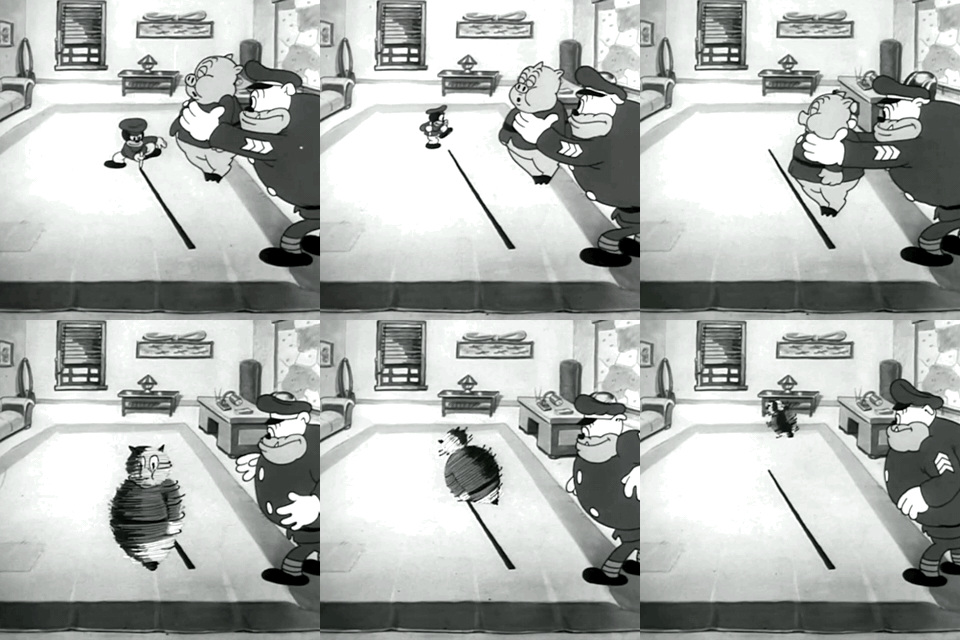
Tex’s love of typography gags is prominently displayed as we get white text on a black background: DIZZINESS TEST. The words whirl around in a circle as we transition to the next scene, the sergeant winding Porky up like a top with some duct tape. With a whip of the tape (or ribbon, up to interpretation), Porky whirls around the room Tasmanian Devil style. The sarge stops him and picks him up, just in time for Beans to make a cameo by drawing a straight line on the floor. The sarge places Porky back down on the line, and he zips uncontrollably around the room.

Bullets spell out our next test: TARGET PRACTICE. Porky and the sarge are in a different room, both positioned behind a gun on a tripod. The sarge provides a demo by propelling a toy plane into the air and shooting the gun at the plane, hitting it in one go. He grins at his handiwork and offers Porky the gun to do the same. The sarge tosses another toy plane in the air, and Porky attempts to shoot it. Instead, he has great difficulty controlling the gun, shooting everywhere BUT the plane and nearly taking out the sergeant himself. A cloud of smoke fills the scene. Once the smoke clears, Porky’s left standing on a wooden floor, now finding him outside as the entire building is reduced to debris and bricks around him. The gun and the plane survive the wreckage, and Porky gives the gun a frustrated kick. To his befuddlement, the kick prompts the gun to shoot, and it hits the plane perfectly.

READY FOR DUTY. Now, the sergeant tosses rifles into the hands of aspiring soldiers, the force of the throw so strong that they each stumble backwards (fittingly accompanied by a gunshot sound effect.) dutiful Porky prepares to receive his honor... and a duster is thrust into his possession (still hilariously accompanied by the gunshot sound.) as Porky ogles at the duster, the sarge thrusts a paper that merely reads “ORDERS” into his grip and points to a nearby shed. Outside of the shed reads a sign: “ROBOT PLANE — KEEP OUT!” Perfect for Porky to wander into.

Porky obeys captain’s orders, and meanders into the shed. He gives a few whistles to alert his presence, and he’s met with nothing. Suddenly, a monkey whips a cloth off of a covered object, spinning Porky around like a top from the impact. Thusly uncovers said robotic plane as the monkey inquires “Well?” Porky hands him the orders with a loyal solute. “To Professor Blotz — this helper O.K. for your robot plane tests.” 

Professor Blotz doesn't interrogate Porky, instead showing him his new invention. He drags over a radio and microphone, ordering “Get ready!” into the microphone. A signal is sent directly to the robot plane, the propeller whirring to life. “Take off!” Porky runs out of the way as the plane zooms into the air. Professor Blotz shows off his fancy voice activated plane, much to the fascination of Porky. Loops, nosedives, ascensions... there’s nothing the plane can’t do.

Now the professor offers the microphone to porky, coercing him with “Try it!” Porky struggles to get his command out, and the plane comically shudders and jitters in conjunction with Porky’s stuttering. The plane does an uncertain l-l-lo-loop d-de l-lo-loo-lo-loop and hastily g-go-goes u-u-up. The plane inches closer and closer to a nearby hot air balloon, and Porky manages to order it down just in time. Professor Blotz yanks the microphone out of Porky’s grip as the plane parks itself outside, growling “Ooooh, get to work!” and thrusting the feather duster in Porky’s hands.

While Porky starts his cleaning duties, the professor haughtily places his radio in the window of the shed. Out come Little Kitty, a puppy, and the unnamed dog with an overbite from I Haven’t Got a Hat. Kitty giggles as the puppy licks her and asks the dog “Does he do tricks?” 

Of course! The dog orders his pup to sit up. Of course, the microphone picks up on his voice, and porky, who’s dutifully dusting the plane, now finds himself clinging onto the plane which is now sitting on its hind legs.

“Wag your tail!” The plane shakes its rear wings to the befuddlement of porky. Now kitty tries, armed with a balloon. “Get the balloon!” She tosses her balloon and giggles as the puppy chases it. And, of course, Porky is thrown into the seat of the plane as it takes off at frightening speeds and immediately pops the hot air balloon, the gag made even more amusing with the detail of two figures floating with parachutes after the accident.

Porky is now stuck in a shanghaied plane. Kitty orders the pup to chase his tail, and the plane spirals towards the ground in an attempt to chase its own tail. In the midst of the game gone horrible wrong, Porky reduces a clock tower to debris as he rams into each “level”. He finds himself flying through a nearby circus. He pops out of the other side of the tent, acrobats performing their routine as they hang from the bottom of the plane.

Now led towards the ocean, Porky’s plane serves as a speedboat as the acrobats transition into water skiers. The timing of all of these scenes is very well done. Just the right sense of urgency conveyed, yet executed so the gags have time to settle in as well. A swordfish leaps out of the waters and cuts the line connecting the acrobats to the plane, and they’re left behind as Porky is sent underwater, desperately trying not to cut the fish into sushi. Some nice camera angles as porky chases a fish in and out of the foreground.

The plane leaps in and out of the waves like a dolphin, chasing the hapless victim fish. Eventually, Porky resurfaces with an intimidatingly huge whale hot on his tail. Elsewhere, the dog overbite orders his pup to chase a cat (“Sic ‘im!”), and Porky is sent hurtling straight towards an innocent victim flying in his own plane. The two planes tussle, the poor pilot clinging onto a lone propeller as he sinks towards the sea below. Porky tears into a blimp. Once advertising “SMOKE ROPO CIGARS”, the blimp is cleverly reduced to “SOS” thanks to Porky cutting up half of said blimp.

Even the clouds fear Porky, taking form of an anthropomorphic human running away from the destructive blades of the plane’s propeller. The cloud man seeks refuge in his cloud house, slamming the door on Porky. Porky is then launched into a nosedive, shredding a farmer’s stack of hay into a shower of already made straw hats. A group of planes zip out of frame so as to avoid porky and zip right back up into their leisurely positions, the timing spot on and making a seemingly pointless gag much funnier.

A whole crowd of children have congregated around the pup causing so much trouble. All of the kids shout various conflicting commands, all picked up by the receiver. Porky’s plane is all but in control, at one point doing back hand springs and zigzagging all throughout the screen. The little puppy has tired itself out, and his owner coos “You’ve had enough”, summoning him home.

Good news for Porky as the microphone picks up the “come on home” command. The plane skids to an uneasy halt, animation light, delicate, and floaty as the wings scrape the grass. The plane skids right through the shed, and Porky is launched out as it crashes into the window. And, with amazing speeds, Porky propels himself to the registration office. A sign on the outside advertises the army as Porky declares “I wanna learn to march!” 

Finally, our happy little soldier gets the ending he’s always wanted. An eager Porky marches in the infantry, intermittently flashing hilariously ecstatic grins at the audience. Perhaps even funnier is that he isn’t even in time with everyone else’s march, doing a much more hurried speed walk (speed waddle?) slightly out of time. A happy end as we iris out.

While this isn’t my favorite Tex Porky short, it’s undoubtedly entertaining. Speed is a big factor to Tex’s cartoons, and it certainly plays a big role in this one, conveying the urgency and out of control nature of Porky’s shanghaied plane. The opening almost feels a little TOO fast, with Porky getting registered right away and doing all his tests one after the other. It’s a minor complaint, and it isn’t even that noticeable. Also amazing how, for lack of a better word, relevant this cartoon is today, where voice control becomes more and more popular. A highly amusing short that’s worth a watch, just because.

Link!

128. Westward Whoa (1936)

Disclaimer: Unfortunately, this is one of those cartoons that requires a disclaimer. This review you’re about to see entails racist stereotypes, concepts, and imagery. I do not at all support or condone these ideas in any way, shape, or form—they’re gross and wrong. It would, however, be just as gross of me to skip over them. This review is for the intent of educating and informing, and I don’t at all intend to harm or offend anyone. I ask and thank you for your cooperation and understanding.

Release date: April 25th, 1936

Series: Looney Tunes

Director: Jack King

Starring: Berneice Hansell (Kitty), Tommy Bond (Beans, Ham), Joe Dougherty (Porky)

Hard to believe it’s time already, but this is the last major appearance of Beans and Kitty. Both make cameo appearances in Plane Dippy, Ham or Ex pop in for Porky's Pet, and the bespectacled unnamed dog with an overbite who occasionally makes appearances reappears in Shanghaied Shipmates, but now the cartoons begin to shift focus towards Porky. Beans' last hurray isn’t the most savory of cartoons—out west, Ham and Ex cry wolf, pretending to be Native Americans and crying for help, but, of course, actual Natives show up and no one believes their pleas for help.

Open to a wagon train traversing the old west. Beans and kitty are included in the band of pioneers, singing “Covered Wagon Days”, vocals contributed by their cattle, some other pioneers, etc. Even Porky’s shown playing a flute solo. Another gag includes a man riding his mule, essentially walking on top of it—he walks on ahead with his beer bottle, leaving the donkey behind. 

I’ve said it before, but I find it so interesting that jack king included songs in his cartoons. Freleng and Avery have mentioned how the Merrie Melodies format was nothing but a burden to their cartoons, having to work around the story to arbitrarily include a song in, yet King seemed to make it a point to include a song when he didn’t have to.

The gang settle in (Kitty excitedly babbles on about how nice the spot they chose would be, with a lovely lake, big rock, trees, etc., etc.) quite comfortably. Fade out back in to some pioneers square dancing to “Oh, Susanna!”, a crowd clapping and cheering them on.

Beans is enjoying himself, dancing along to the music. Ham and Ex run up to him and excitedly declare in unison “We’re gonna play Indians!”, to which Beans playfully warns “Be careful the Indians don’t getcha!” Yes, it's one of those shorts, which would unfortunately persist for decades to come. 

Ham and Ex giggle and hobble away, but almost immediately halt in their tracks. Behind a rock appears to be a Native headdress that’s moving. Ham and Ex exchange worried glances and eventually creep up to the source... only to find that it’s just a turkey pecking at the ground. This, of course, gives (who I presume to be) Ham an idea as he whispers into Ex’s ear.

Their idea? Running around yelling “Indians! Help!” Beans drops his stack of wood he’s carrying and reaches for his rifle, echoing their warning. All of the pioneers are alerted and resort to gunfire. A dog in a pond shoots his rifle, skipping around like a rock in water. Another dog hops into a wood stove and fires from there.

Beans darts over to the rock where the turkey (unbeknownst to him) is pecking at the ground. Beans fires, and does a Jack King hat take when he realizes he shot the fan off of a turkey instead. Ham and Ex find it just absolutely hilarious, doubling over in a fit of laughter. Beans is pissed and approaches them, warning Ex that a Native will someday get them and (he pretends to cut his neck) “Krrrrrrk! Off goes your head!” He retreats, done with his lecture, when he suddenly whips around and snaps “and you too!” at Ham. Finally some nice comedic timing and a clever joke, but a shame it has to be wasted on something so racist and tiresome.

If Ham and Ex were rattled by Beans’ lecture, they do little to express it. In fact, Ex whispers in Ham’s ear, both smiling with mischievous pride. Ex thusly launches into a war call, followed by Ham, and predictably Beans is fooled again. He grabs his gun and starts running around in a flurry once more, his pioneer buddies also shooting aimlessly. Ham and Ex are now, for some reason, in the same spot where Beans was prior (it never showed them running around). Suddenly, Ham taps Ex on the back, who’s in a fit of hysterics. They both dart off screen as a frustrated and befuddled beans approaches, scratching his head.

As if things couldn't get more reprehensible, we get a double whammy by having the Natives caricatured in blackface.

Now, Ham and Ex seek refuge behind a log, laughing and continuing their war cry. But get this—an actual grotesquely caricatured Native pops out from behind a tree! Who would’ve thunk it? Ham and Ex run away, and once more does their routine of crying for help ensue, yet this time they actually mean it. The two pups hide inside the log, the Native diving in after them. The twins make it out of the other end as the Native gets stuck, and they both beat his head and butt with clubs respectively.

The twins cry once more, and, just as the classic story goes, no one believes them. Beans runs his laundry through a wringer while Kitty proposes he go check on the kids—“Never can tell what they’re up to!”. Elsewhere, Porky peels potatoes and shrugs off the cries for helps. He talks to the audience and stutters “It’s just those kids trying to fool you again.” 

Back to Ham and Ex. Ham beats the Native on the butt, and he’s propelled out of his log and hurdles straight towards a tree. As the twins attempt to escape, they encounter more Natives, who attempt to dog pile on them. They narrowly escape, and this time run around in helpless circles near Porky, who’s still (captivating as ever) peeling potatoes, merely smiling and shrugging. They both dive into a trunk at the base for safety. Porky comments “Those kids must think we’re pretty dumb.” He laughs, but his laughter is quickly cut short once an arrow flies right through his beloved potato and splits it in two.

Now Porky attempts to make a break for it, running around aimlessly and tripping over a spare rifle in the foreground (I will admit that the shot is rather nicely staged.) Suddenly, a ton of Natives pour into their base, all doing a war cry. Porky struggles to get his warning out, but he has no trouble shouting “INDIANS!” after an arrow zings him right in the butt.

Directors had lamented about working with Joe Dougherty’s natural stutter, because they couldn’t play around with his dialogue as much. Mel Blanc’s Porky, as you know, would typically change his sentence structure in the midst of a stutter. (For example, in Porky and Egypt, Porky laments “It’s awful war-wa-w-h-ho-h—gosh, I’m roasting!”) That sentence structure was made famous by vaudevillian Roscoe Ates, who overcame a natural childhood stutter. Part of his shtick would be to substitute his own words to make them come out easier. They wanted to take that direction with Porky since the Dougherty days, but couldn’t because of his natural stutter. Tex Avery has lamented about how much film was wasted during recording sessions with Dougherty. So, to substitute, they’d play around with gags like these to get him to hurry up, whether it be whistling at him or, in this case, shooting him with an arrow. It's interesting to see them play around with his stutter as much as they could, despite their limitations.

There’s a really strange cut that contributes to the cartoon’s incoherency—Beans is chased by a Native brandishing a tomahawk while Kitty cowers. Beans is pinned beneath the crank of the wringer, and Kitty tugs at the clothes in the wringer, which causes the handle to repeatedly smack the Native in the chin. It’s very subtle, but you see Beans leap off of the wringer. A jump cut and Beans is perfectly in position near a wood stove, shooting his pistols. The transition is nonexistent, almost no indication to show that he was in peril 4 seconds earlier. 

An arrow pierces beans’ coonskin hat, a Native firing a number of arrows at him. Beans hatches an idea and opens the door to the wood stove. The arrows fly into the stove and shoot right out of the pipe back at the perpetrator like a boomerang, pinning him against a tree. Elsewhere, a Native attempts to slice a dog with his tomahawk. The dog takes off a toupee and hands it to the Native (a reference to the practice of scalping). 

Gags ensue as the fight rages on. A Native curves an arrow to shoot like a curveball, but it hits him in the but as the pioneer ducks. Beans prepares to hit a Native over the head with a club, but instead hits another BEHIND him as he anticipates to go into the swing, eventually hitting them both. Porky’s shooting his rifles, when an arrow pierced his suspenders. Porky struggles to get his pants to stay up, occasionally flashing the audience as he continually hikes them up. Another arrow shoots by and lodges in both his pants and shirt, effectively pinning the pants securely. I will give credit where credit is due, that’s a gag that actually feels somewhat funny.

Meanwhile, Ham and Ex dive into some dresser drawers, popping out at the top of the dresser and hitting a Native over the head with hair brushes. They continue to hit and mock him, like a makeshift game of whack a mole. The Native cuts the dresser in half with his tomahawk, reaching into both halves and grabbing the kids, who cry for help. Beans discovers a bear trap, and circles it like a lasso, throwing it right at the Native . It hits—where else?—right in the butt, and he retreats, the kids watching him go. Unbeknownst to them, Beans is creeping up slowly from behind. He does a war chant to give them a taste of their own medicine, and, of course, the pups are scared out of their wits. We iris out on their little eyes peering out of the trunk they used as a hideout.

To say the least, I hate this cartoon. This is my least favorite Jack King cartoon to date, and least favorite Beans cartoon. It’s a shame, I actually liked Beans and I wish he had a more ceremonious goodbye. As you can obviously see for yourself, the cartoon is downright racist, mean spirited, and ugly. Of course, practically all of the Native cartoons are racist, but this one in particular feels exceptionally mean spirited and grotesque. And aside from all that, it’s an obnoxious, repetitive cartoon. Porky peels potatoes! Beans gets mad! People shoot guns! Ham and Ex yell! As high energy as it is, there’s nothing very exciting about it. 

As for Beans, it’s been... something! I feel he has flavor than Buddy, but still fell victim to the bland, smiley protagonist. Out of all 3 beginner stars, Bosko, Buddy, and Beans, Bosko was the most fleshed out and fun to watch. I certainly took him for granted when watching his cartoons (because I couldn’t shake the notion that “This is a blackface caricature”)—he was very bouncy and a musical character, and he was almost captivating to watch. Buddy and Beans you don’t get that musicality. So, better than Buddy, not as good as Bosko. I’ll still miss him, but Porky’s time to shine is finally here, and things are going to get rolling! 

I don’t at all recommend this cartoon, but if you’re that curious I’ll put a link. Obviously view at your own discretion.


124. Alpine Antics (1936)

Release date: March 9th, 1936

Series: Looney Tunes

Director: Jack King

Starring: Billy Bletcher (Bully), Jack Carr (Race Starter)

Another Beans cartoon by king, featuring his girlfriend Kitty and a Peg Leg Pete facsimile. Beans plans to enter a skiing contest, and his motives for winning are pushed further when a bully brews up trouble.

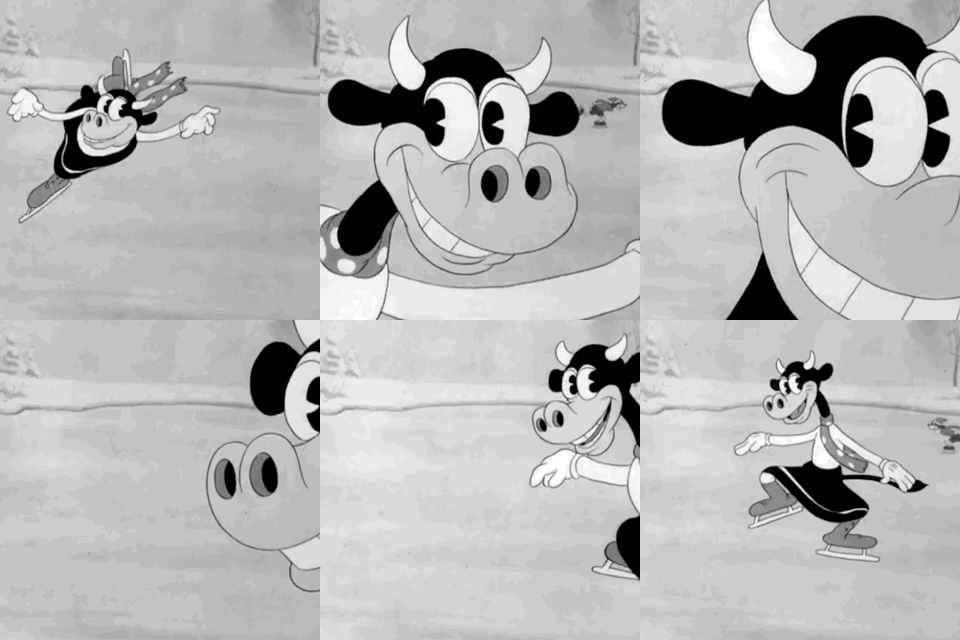
Open to a winter landscape, everyone skiing and skating. Three snowmen sing “She Was an Acrobat’s Daughter” as “She Was an Ice Skater’s Daughter” while a Clarabelle Cow facsimile skates right up against the screen, animation smooth and crisp. The singing snowmen have their own 15 seconds of fame, melting in front of a roaring fire to end the song.

More ice centered gags ensue—a dog boils some water over a fire and pours it into a hole in the ice, hoping for a quick dip. Predictably, the genius pops up frozen in an ice cube. Elsewhere, three horses wearing sweaters that spell out “SOS” skate in a line, a tiny dog skating beneath their legs. The entire scene is reminiscent of the opening scene in Bosko in Dutch. A turtle dances on the ice, when he and his reflection get separated. The gags aren’t laugh out loud hilarious, but the visuals are appealing.

Enter Beans and Kitty. Beans pushes kitty in a sled, occasionally hopping on the back for the ride. He brakes in front of a cabin (the break being a boot attached to a lever) to read a flyer posted on the wall. The flyer boasts a ski race, promoting $100,000,000 in prizes “or a cool $2.00 cash to the winner!” a classic that will appear in many a cartoon.

Beans is ecstatic. He snags a pair of spare skis and declares “Big race today, Kitty! Oh boy, watch me win that race!” a Peg Leg Pete facsimile (more so than usual—this time he’s an actual cat, of course voiced by Billy Bletcher. I don’t know if I explicitly mentioned it but I’ve always implied it—Bletcher also voiced Pete in the original Disney cartoons) hides behind a tree, menacingly chuffing on a cigar so you know he’s hot shit. He approaches Beans and picks him up by the skis. He asserts his kindness by sliding Beans off of the skis and flicking him off his own pair before breaking beans’ skis over his knees. A reasonable fella.

Rightfully so, Beans is pissed, shaking his fist, sticking out his tongue, shadow boxing, tapping his foot, promising he’ll show him. He rips the seat portion of the sled off, and thus has his own makeshift pair of skis. Hope Kitty didn’t want to do any more sledding. Two conveniently placed straps are under the skis, which he ties around his feet and shuffles off towards the big race.

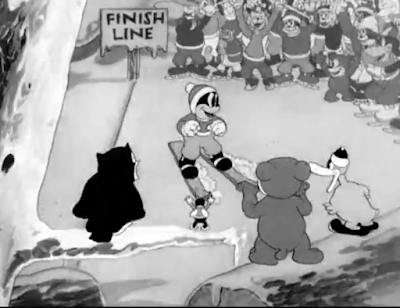
Porky makes a cameo at the starting line, riding a rocking horse into battle. The bully is confidently waiting for the start, yet his pride deflates as soon as he notices Beans adorning new skis. He grimaces at Beans, who innocently laughs in return. A turtle referee checks his clock—time is ticking. The bully also recognizes this, and thusly pulls out a rocket from his pocket. He swipes Beans’ hat over his head so he can’t see, creating the perfect distraction as he ties the rocket to one of Beans’ skis and lights it. And, of course, Beans  is sent rocketing backwards, flying right into a cabin and shooting out of the roof. He lands in the snow in a daze as the bully gives a trademark belly laugh.

The bully’s timing was just right. A fire of the pistol and the race is off. The bully speeds ahead on his skis, Porky rides his horse into battle, a dog takes off with a makeshift sailboat, and another struggles to get his exercise bike through the snow. Though Beans  is already at a disadvantage, his optimism is seldom flattened. He skis right where he is, the bully already in a steady lead.

Visuals galore as we spot the racers. The biker sends snow flying right into Porky’s face, a dog pumps a bellows into a sail, a duck rides a wiener dog donning skis, the essentials. Beans is finally on the course, spreading his legs to avoid a tree trunk and conversely compacting his body as he passes between two trunks. The bully takes time to admire his lead, once more laughing. He shreds down a slope and jumps off, pulling a string to summon a parachute and ensure safely. As he floats lazily in the sky, he makes attempts to ski in the air.

Cue the dirty tricks. The bully spins around a tree to stop himself, tying a rope to one of his ski poles. He jabs the pole into a neighboring tree and effectively creates a tripwire. One by one, his victims fall into place (literally): the cycling dog falls headfirst into the snow, spinning his bike upside down. Porky’s next, he and his rocking horse both shaking their tails in the snow. Next the sail boat dog, and even the three little pigs(?), also shaking their tails like Porky. Next is Beans’ turn, who barrels into the pole with enough force that the pole is loosened and the bully’s contraption ties around him instead.

Beans has now secured the lead... for now. The bully is fueled with extra motivation and vitriol to beat beans, puffing out his chest and breaking his bonds. Beans slides over a hill, his skis getting lodged in the side of a mountain. And, of course, the bully flies right over his head, once more in the winning seat. To make matters worse, the duck and wiener dog duo are fast approaching. They slide UNDER the mountain, and barrel into Beans from under, propelling him into the air. The duck briefly rides the dog like a tire, until a jump cut has them back in regular formation, the cut a bit discombobulated and incoherent.

The duck honks at the bully to get out of the way, who, of course, does everything but that. Therefore, the duck turns the wiener dog sideways and knocks straight into the bully. Their glory is hardly reveled in: they crash into a tree, the dog wrapping around the tree and pinning the duck. Next comes Beans, who uses the bully’s skis lodged into the snow as a ramp.

The chase is now exclusively focused on Beans and the bully. Beans hits a slope that flings him into the air, and once more he lands behind the bully. Nevertheless, they weave in and out of trees, Beans managing to pass the bully. Another slope sends the bully flying forward, landing straight on beans’ shoulders. They pass a cabin, the bully riding on the roof and landing back on beans’ shoulders. They’re broken up once the bully runs into a tree branch, spiraling up the tree and back down. He’s flung forward, about to hit the finish line...

...until he crashes into an ice patch, the ice propelling him underwater. Beans rides over the reversible ice, skidding across the finish line. Finally, a winner! Yet, another ice patch (or perhaps the same one?) bucks Beans forward as the bully pops his head out, clearly upset at his loss. Iris out as Beans pokes his head out from his own ice hole, staring incredulously at the audience.

Not the most coherent Beans cartoon. This is one of the rare Beans cartoons I had seen before, and overall remembered nothing about it. I can see why. There aren’t many gags but more so visuals that are all tired out and lose their punch. Many times the story lapsed in coherence—at the end, the bully is clearly thrown into an ice patch that lies BEFORE the finish line, since Beans skids past it and slides over the line afterwards. Yet, the patch is shown to be inside the line at the end. Of course, with many of these cartoons, suspension of disbelief plays an important role, but here it’s just not believable. Believability can make or break a cartoon (believable does not equal realistic! Stick to what you’re specializing in, no matter how absurd the plot is. A plot can be absurd but still believable). Probably best to skip, but it isn’t a cartoon that’s terrible. The animation is certainly nice in some spots. Just a relatively mediocre cartoon that I probably won’t be watching again anytime soon.

Link!

Sunday, May 16, 2021

116. Gold Diggers of '49 (1935)

Release date: November 2nd, 1935

Series: Looney Tunes

Director: Tex Avery

Starring: Tommy Bond (Beans), Joe Dougherty (Porky), Berneice Hansell (Kitty), Billy Bletcher (Villain), Rudy Sooter's Californians (Cowboys)

Where to begin? This is probably the most important review yet, arguably more important than I Haven’t Got a Hat. You’re seeing that right! This is Tex Avery’s directorial debut. Some history before we start: 

Tex had worked at Walter Lantz before working at Warner Bros., where he suffered an eye injury. He was horseplaying in the office—they had a game where one would shoot a rubber band or a spitball at someone and hit them in the back of the eye, yelling “Bullseye!” with each successful shot. The game evolved to using paper clips, and someone told Tex to look out. He turned around just in time for the paper clip to strike him in his left eye, losing vision in said eye. Many have attributed his poor depth perception to the wackiness and bizarre nature of his cartoons.

Avery applied for Warner Bros., bluffing his way through and telling Leon Schlesinger he was a director. Tex is cited as saying “'Hey, I’m, a director'. Hell! I was no more a director than nothing, but with my loud mouth, I talked him into it.” with Ben Hardaway gone, Freleng and King were the only directors there, and Avery was graciously accepted.

Yet, the staff was growing in size, and Avery’s unit was beyond the limit for a single studio. Thus, Termite Terrace was born—a shoddy five room bungalow affectionately dubbed termite terrace as a result of their termite houseguests. He was assigned animators Bob Clampett, Chuck Jones, Sid Sutherland, and Virgil Ross. Instead of animators swarming around to whatever director needed them, Avery now had a solid unit, a model that would continue on and distinguish the animators/units as we know them today.

Tex is attributed to birthing the studios greatest stars. Daffy Duck, Elmer Fudd, and Bugs Bunny (it could be debated whether he created Bugs or Ben Hardaway created Bugs, especially since Bugs was Hardaway’s nickname and literally named Bugs’ Bunny. However, for simplicity’s sake, Tex is virtually the creator of Bugs. He solidified the voice, the personality, and the design, which differed greatly from the hayseed loon that was Hardaway’s Bugs.) He had a relatively short career at WB, leaving in 1941 to MGM, where his potential as a director really exploded. He spawned the iconic yet austere Droopy, as well as Red Hot Riding Hood, the inspiration for Jessica Rabbit in Who Framed Roger Rabbit. This man is responsible for a LOT, including holding the title as one of my favorite directors (the others being, of course, Bob Clampett and Frank Tashlin. Coincidentally, all of them left sometime in the '40s.) 

I’ll run my mouth more at the end of the review, soap boxing on why this cartoon is so important, but let’s actually SEE the contents of the cartoon so we can interpret it. It’s 1849, the heart of the gold rush. Beans and Porky wish to hit it big by digging for gold, but a nefarious villain snatches their findings, resulting in trouble.

Tex Avery loved to play around with words, whether it be sign gags or narrating captions as we see here. Open to a remote western town, rife with cacti and dry land. “THE TIME” is proudly displayed on the screen as we pan to a covered wagon, a calendar inside clueing us in that it’s July of 1849. “THE PLACE”—we pan to a saloon titled “GOLDVILLE SALOON”. And, of course, “THE GIRL”. The opening pan would be repurposed for Friz Freleng's My Little Buckaroo in 1938.

Little Kitty comes bounding out of the general store, joining a crowd congregating around a bulletin board. The newspaper article posted details Beans’ gold digging ambitions: “YOUNG PROSPECTOR TO HUNT GOLD IN RED GULCH”. A picture of a proud Beans, posing with his pickaxe and his mule. Below it: “BEANS — Local boy to brave hazards of red gulch for gold”.

Absolutely ecstatic, Kitty snatches the paper from the billboard and rushes away. Berneice Hansell's delivery is on point and absolutely hilarious as Kitty gives her breathless monologue: “Oh, that’s my sweetie, and I’ll bet he’ll find the gold, and he loves me and everything!” 

Porky makes his second major appearance, this time as a fully grown adult, father to Kitty. Genetics work in mysterious ways. He fixes himself a giant towering sandwich, including a whole fish, a block of cheese, sausage links, and an entire roasted turkey. Sustenance! He scarfs the sandwich down and gives an ecstatic “WWWWHHOOOOPEEEE!!”, a catchphrase of his that thankfully never returned outside of this short. Still extremely amusing. As I said before, I don’t find Dougherty’s Porky “painful” like how some other people find it, but I definitely think this is his most awkward performance, and it’s not even because of his characterization, but the decision not to speed up his voice. Dougherty had a very deep voice, and in this cartoon his voice isn’t sped up at all. It’s a bit jarring, but this WAS his second real appearance. Tex’s next Porky cartoon, The Blow Out, would have him back as a (much cuter) plucky child.

Kitty rushes in and shoves the paper in Porky’s face, continuing her breathless babbling. “Look what my sweetie’s gonna do! I’m so proud of him! He loves me and everything! He’s gonna find gold and we’re gonna be married! And right this minute, he’s way out in the mountains—“ Kitty’s breathless narration continues as we get a shot of the mountains. A long, exposed tunnel goes right through one of the mountains, where we get a distance shot of Beans hacking away at a mountain. “And right now he might be discovering gold!”

A closeup reveals Beans picking away at the side of the mountain, carving a little hole. Just above it are some slots. Beans plucks a button from his shirt and feeds it into the makeshift machine, pulling a branch as a lever. He spins, and lands the jackpot. A plethora of gold coins rush out of the slot, Beans collecting the loot with his hat. If only it were that easy! 

Rightfully gleeful, beans cries “Gold! Gold!” and leaps on his trusty steed. A giant “GOLD!” zooms into view on the screen as beans gallops along on his mule, rushing into town. He bursts into the saloon and declares “I found gold in the gulch, boys! Gold in the gulch!” 

All of the patrons echo “GOLD?” incredulously, deserting their post at once. Even the bartender leaps over the bar, leaving behind some ice cream and other desserts on the counter. A bit of an awkward shot—there’s a still frame of the food on the counter, and you’d expect someone to come in and take the food with them, but that’s not the case. It just sits there and goes onto the next scene. I wonder if there were any cuts, or if didn’t have time, or what. Nevertheless, it’s slightly jarring but a menial thing to pick at.

One by one, the patrons leap on their horses and follow beans to his site. A man flops to the ground where his horse rides HIM instead—a regular gag in the looney tunes universe, but one that tex avery seemed to enjoy in particular. Can’t blame him.

Beans alerts everyone in town—a dog in the bathtub, the dog taking his bathtub with him as he runs, two stereotypical Chinese men at the laundromat (blatant racism isn't the greatest start to Tex's career), and a barbershop quartet singing “Sweet Adeline” outside of a barbershop, animation by Bob Clampett. Beans alerts them, and the quartet runs off... until they rush right back to finish their song. A great gag as they run right back to find the gold.

Next stop, Kitty’s house. Beans rushes inside and exclaims “I found gold!”, holding Kitty by the hands. Porky pokes his head out from the kitchen, wielding a fork and spoon, where he repeats “Gold?” incredulously. No time is wasted as he jogs right out the door, donning a ten gallon hat and a pick axe. Beans excuses himself, kitty refusing to let go. He runs out the door, and Kitty reflects on her sweetie. Good, snappy timing as Beans unexpectedly zooms right back inside, dipping Kitty and giving her a rather passionate kiss. He leaves once more as Kitty collects herself.

Porky has his jalopy all ready to go, and Beans jumps right in. Porky gives another “WHOOPEE!” as they barrel on. More blatant racism as they pass the Chinese men traveling via rickshaw. Porky and Beans zoom right past them, and a cloud of exhaust cover the men. Predictably, they’re now in blackface, talking in a stereotypical accent in an imitation of Amos 'n Andy. Obviously, it goes without saying why or how this is disgusting and wrong. 

Fade out and back in to the site where beans struck it rich. Porky gives another “WHOOPEE!” and strikes his axe into the ground, as do the Siamese twins and Beans. Porky sticks his hand in his hole, where he pulls out a shiny coin and yells “Gold!” so far, his dialogue has been three “WHOOPEE!”s and two variations of “gold”. What a complex character! He stores his find in his back pocket for safekeeping. A highly amusing gag as he sticks his hand down again, this time his hand extending through another hole near his pocket. He fishes his hand into his back pocket (unknowingly) and grabs his find, reaching his hand out of the hole and admiring his “new” loot.

The process repeats until Beans’ voice stops Porky in his tracks. He’s found something. Porky tosses a rope down into the cavernous hole that Beans is in, and with a few good tugs, Beans  pops out of the hole, perched on top of a heavy treasure chest.

Everyone crowds around as Porky and Beans lift the chest. Inside is a tiny little book, covered in a thick layer of cobwebs that reads “HOW TO FIND GOLD”. Beans opens the book, and the answer is right there in the print: “DIG FOR IT”. Tex’s strong sense of humor brings the cartoon much needed liveliness and fun. Tex was definitely a gag man more than an artist, and he has said so. Not that his cartoons are badly drawn at all, but it’s clear he has a priority in humor, which is a great priority to have. Porky and Beans exchange gobsmacked looks.

Enter the villain, creeping along furtively with his horse. He peers through his binoculars, surveying the site. Pan past Porky and Beans scratching their heads over their instructions, past a bag of gold, past a pickaxe... the villain goes back to the bag of gold, exclaiming “Ah! Gold!” He fires his gun, a wonderfully strange hybrid between a gun, a fishing rod, and a grappling hook. As he fires, a lasso extends down to the gulch, tying conveniently around the bag of loot. The villain reels in his catch—some great added detail as he struggles, as if fighting a big one, and even scooping it up in a net.

Porky and Beans spot the bandit. Porky stutters “If you get that bag for me, you can have my daughter.” Beans is delighted and eagerly shakes his hand—it’s a deal. He jumps into Porky’s car and rides off, winding up the twists and turns of the mountain as the bandit makes off with his gold. Visions of grandeur fill the bandits head as he imagines a long, fanciful, costly limo, a driver touting him around as he chuffs on a fat cigar, donning expensive clothes.

His fantasy is interrupted by gunfire. Beans wields duel pistols, firing back and forth at the bandit. Bullets reduce the bandit’s hats to shreds, the hat a shadow of its former self as it plops back on the villain’s big head. Great contrast. Beans continued his fire, shooting a giant hole in the bandit’s pants. A makeshift buttflap falls open, revealing a giant tin pan covering the bandit’s ass for protection. Bullets ricochet off the pan, much to the delight of the bandit.

Frustrated, Beans opts for a rifle instead. A gunfight ensues, and Tex Avery’s need for speed begins to break out. It’ll climax soon, but Tex’s strong point in his cartoons is definitely speed and timing. He can drag out gags or make them ensue in a blink, so much so that those scenes leave you breathless and exhilarated. Some great examples that we’ll see are in this, The Village Smithy, and Porky the Wrestler. The bandit slings his guns back at beans, his arms whirling around at impossible speeds, so much so that he turns into a literal blur, rising and falling back on his horse.

Beans ducks, retaliating. The force of his fire is so strong that his car is propelled back multiple feet with each shot. However, trouble boils when his car stalls out. Empty. Beans pours a jug of moonshine directly into the engine (instead of the gas tank), and the car explodes to life—parallel to the same scene in You Don’t Know What You’re Doin’! but on steroids. The car turns into a giant blur, stretching out to vaguely resemble a race car. With amazing force, the car barrels into the villain, who is thrown into the air with ease. This is where Tex’s speed is magnified and used to a great amount of potential, a potential we haven’t seen yet in a cartoon. It’s exhilarating and breathless, and above all, believable. You feel like you’re right there with them, a must see scene.

The car defies gravity as it speeds along the walls of the caverns, a lovely angle of the car headed straight towards the camera (that would be recycled in one of Tex’s cartoons at MGM, Dumb-Hounded). Beans now barrels whence he came, knocking into the villain once more. Instead of being propelled into the air, the bandit is dragged into the car, reduced to nothing but a mere blur. Around another curve they speed, the loose bag of gold that was thrown into the air with the bandit now landing in the car.

A forlorn Porky paces anxiously, awaiting the return of his beloved gold. He, too, is wiped into the chase, again reduced to a mere blur as he falls into the car. The car zips into town, right past Kitty, who sweeps outside her house. She’s spun around like a top as the shanghaied racecar whirls past.

Finally, the car screeches to a halt. The villain is slumped over inside the car, whereas Porky and Beans are unharmed. Kitty reunites with Porky, who lifts her up lovingly. He places her down in front of Beans. “Well, here’s my daughter!” Beans graciously accepts Kitty’s hand as he thrusts the bag into Porky’s hands, replying “and here’s your gold!” 

A lovely twist as Porky stutters “Gold be derned! That’s my lunch!” Sure enough, he stuffs his hands inside the bag and lifts out a giant towering sandwich, identical to the one he scarfed down at the beginning of the cartoon. He gobbles it up with ease, giving a contented smile as we iris out.

Whether you love this cartoon or hate it, it’s historical significance can’t be denied. This and I Haven’t Got a Hat are probably the most important cartoons we’ve seen thus far, and the two, in my opinion, rely on each other for success. Had Friz not created Porky, who knows what would have happened in this cartoon. Same goes the opposite way. Had Tex not come aboard and used Porky in a suitable role, Porky may have continued to exist in cameos, but how far would Looney Tunes have gotten before inevitably getting canned? 

I personally love this cartoon, and is probably my favorite one so far. Tex Avery was such a pivotal element to the success of Looney Tunes. Albeit this isn’t his most polished work (and the reprehensible racism with the Chinese twins and the blackface gag can’t be overlooked or dismissed), this cartoon is fun, exhilarating, and happy. Tex’s sense of humor is on point, and his timing/speed is impeccable. It leaves you wanting more, almost as if you aren’t satisfied. The whole cartoon revolving around Porky reuniting with his giant sandwich is another plus. Beans is endearing, though bland in personality. Kitty is equally endearing, her breathless excitement indescribably amusing and contagious. Porky is also amusing, but hardly endearing—but, again, second cartoon, still trying to figure things out. Without comparing his appearance here to other cartoons (which is very difficult to do), he fits just fine as the bumbling comic relief character.

This is a major turning point in the world of Looney Tunes. Thanks to Tex, cartoons are going to get snappier, funnier, wittier. I may be biased since he’s one of my favorite directors, but it’s hard to argue with, especially since this is the man who made Daffy, Elmer, Bugs. If anything else, I definitely recommend this for historical significance. Aside from that, it’s fun, happy, energizing, and a great relief to the drab cartoons we’ve been seeing thus far (though Friz deserves much more credit than he gets for his Merrie Melodies). Obviously, express discretion at the racist gag of the Chinese twins/blackface—they aren’t too exhausted, but definitely prominent enough to constitute a warning. This is a cartoon worth watching for its contribution to animation alone.

Link!

115. Hollywood Capers (1935)

Release date: October 19th, 1935

Series: Looney Tunes

Director: Jack King

Starring: Tommy Bond (Beans), Berneice Hansell (Kitty), Billy Bletcher (Guard, Frankenstein’s Monster)

Originally titled Beans in Hollywood, Hollywood Capers centers around beans’ infatuation with the movie industry, dropping in on a recording sessions. However, things quickly run amuck once he accidentally powers on a ferocious Frankenstein robot.

Activity is high as ever at Warmer Bros. studios (a pun frequented in many a cartoon). Actors bustle to and fro, including a humorous caricature of W.C. Fields, sauntering along with a rolling cane, cigar propped in his mouth and showing off some gaudy checkered pants. The guard and Fields (pinned as “Mr. Seal”) exchange “good morning”s. Suddenly, Fields places his hat atop the guard’s head and pops his cigar in the guard’s mouth. He positions his cane like a cue stick, shooting off any ash. Very amusing and creative. He regains his cigar and hat, matching into the studio as the guard scratches his head.

Next comes our favorite Hollywood star, Beans. He putters along in his car, the engine shorting out and making for a bumpy ride, animation fun and flexible. Screeching to a halt at the gate, Beans allows the guard to interrogate him, the guard growling “Who do you think YOU are?” Beans jumps up and puffs out his chest proudly. “Beans is the name, one of the Boston beans!” A nice touch as he tilts his hat forward and holds out his overall straps smugly.

The guard is having none of it. He grabs the car and pushes it backwards, and Beans is sent riding up into a tree, the car exploding. Rubbery, smooth animation as beans dangles on the safety of a tire, bouncing up and down, his butt honking the car horn.

Other celebrities have better luck than beans. A Charlie Chaplin caricature enters with ease, his car wheels moving along like actual feet. Oliver Hardy also saunters into the studio, greeted by the guard. Hardy briefly acknowledges the guard’s “Good morning, Mr. Hardy!” as he strolls inside the studio. Once far enough in, a familiar hand unbuttons the jacket’s buttons, and beans steps out of the disguise as his Hardy getup, nothing more than a bundle of balloons and clothes, rise into the sky. This could also be paralleled with Porky’s attempts to disguise himself as Hardy in order to enter the WB lot as well in Friz Freleng’s You Ought to Be in Pictures, Freleng’s approach much more amusing and rewarding. Still a nice gag here, though.

Giddy at the fact that he’s in, beans wanders the lot and enters one of the studios, a sign posted on the door indicating that they’re filming.

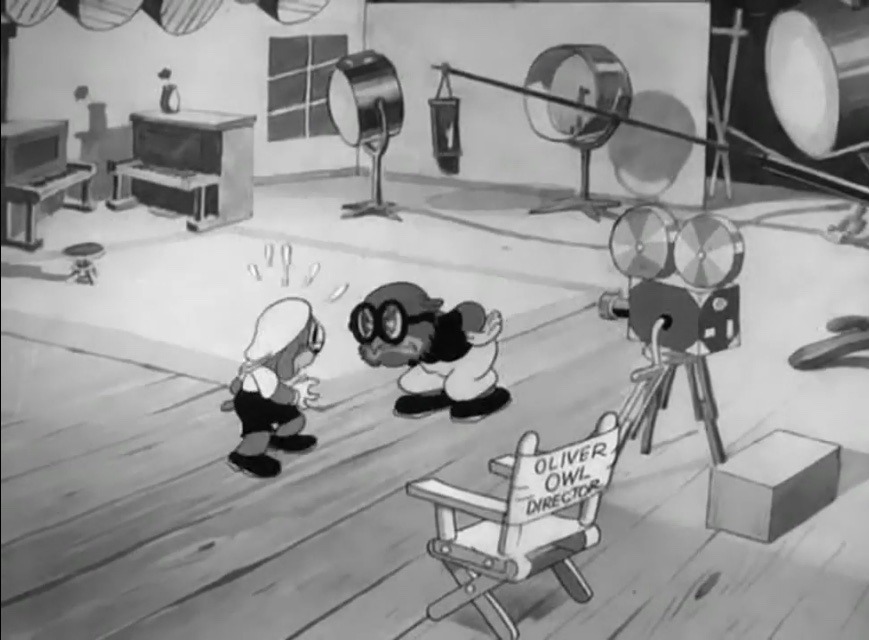
I was wondering if Oliver Owl would ever make an appearance again! Here, he’s an adult, a crotchety, anxious director pacing around, accompanied by a dog assistant who matches his pace. The dog bumps into Oliver, who isn’t pleased. He orders the dog to go back to his post at the camera.

Oliver loops himself down in his director’s chair and barks “Quiet!” A tanned Porky makes a cameo as he shushes the bystanders in the studio. A shot of a man asleep on the rafters, blowing out a candle that also aligns with a chorus of hushes. Beans’ shadow also shushes him, as does an anthropomorphized microphone.

The cameras are now rolling. Lovely animation as the camera man runs over to film the scene, his camera running like stilts. Little Kitty is the star of the film, singing “Sweet Flossie Farmer” as a turtle  accompanies her on piano. A barbershop trio lend their voices, as does the piano playing turtle. Beans observes in awe as he stands on the rafters.

A brief interlude as a man plays “Chopsticks” on a cash register, reused from those were wonderful days. It’s been awhile since we’ve seen any recycled animation, or at least to my knowledge. The piano playing turtle tickles the ivory as he lies on his shell playing dueling pianos. Animation is also reused from Buddy’s Beer Garden as a bartender fills up various mugs with some beer to the beat of the music.

Back to Beans, who’s still ogling in awe at the scene below—the stuttering dog from Into Your Dance attempting to woo an indignant kitty. Disaster strikes when a nearby workman passes by, carrying a long piece of board. As he turns the corner, the board smacks Beans and sends him flying. He attempts to grab onto a rope for support, yet the rope is tied to nothing. Despite his best efforts, Beans is sent tumbling down, right into the arms of the dog.

Rightfully so, everyone is shocked, especially Oliver and his anthropomorphic director’s chair (King’s Disney roots seeping in once more). He marches over to Beans, who dutifully introduces himself, once more repeating his “Beans is the name, one of the Boston beans!” greeting. It didn’t work before, and it doesn’t work now. Oliver grabs Beans and throws him out (another future parallel to You Ought to Be in Pictures).

Beans rockets through the studio, landing right onto the set of Frankenstein. Granted, a robotic adaptation, but still. He discovers a bench obscured by a white sheet. Pulling back the sheet, Beans is met with the grotesque face of Frankenstein’s monster. In the midst of his shock, beans stumbles backwards and trips over a power switch, which brings the robotic monster to life. Beans runs for his little life as Frankenstein’s monster limbers up, stretching before barreling right through a wall leading to the prop department.

The dog camera man is rolling, just in time to catch the metal menace marching towards his camera. The sound effects are a bit misplaced as the monster literally swallows the camera (a Jack King trademark), the sound of crunching already playing as his mouth is still gaping open. The sound effects are a little off in this one. Sometimes it isn’t noticeable, sometimes it is—nothing against Bernard Brown, there’s only so much you can do. Treg Brown’s ingenuity and creativity in his sounds is sorely missed. Nevertheless, the monster devours the camera whole, wincing as he chomps on a bolt. He spits out a plethora of camera parts, including a film strip—accompanied by a jarringly funny machine gun sound effect.

Kitty spots the monster, a fun take as her bonnet spins above her in shock. She darts away as the monster stumbles across a mirror, sticking out his tongue and mocking himself. It’s a useless and arbitrary gag for sure, but also funny for that reason alone. Like a baby or an animal discovering its reflection for the first time. He gets closer to the mirror, mocking himself once more. His reflection leans back and punches his actual self hard, a gag that would be reused in Porky’s Double Trouble to the same degree.

The monster is sent flying right into a tub of water, where he squeezes his head to pour out the water from his ears and scalp (his hair rising like a toupée as a geyser of water spurts out from his head). The animation is fun and amusing, always entertaining to see particularly hard substances turned to rubber. Though this IS the rubber hose era of animation, so that’s a given.

Beans spots a metal rod propped up to a spotlight, which he can use to his advantage. He sneaks up behind the robot, who’s still drying himself off. His plan is sent into action as Beans wraps the rod around the monster, constricting him into place. Of course, a simple puff of the chest and the binds are broken free by the monster. A fun indicator of personality as beans flashes a guilty, sly smile, bashfully dragging his feet.

Cue a triumphant chase sequence as Beans runs from the monster, who snags him by the overalls. A slightly incoherent cut as Beans is seen flying through the air, crashing into many doors that pile up beneath him like dominos, one by one. The animation is very smooth and tantalizing as the doors collapse to the ground, beans skidding across the floor like butter.

He slides straight into a giant fan (or in this case, labeled as a wind machine). An idea hatches as he disregards any instructions to turn off the fan. He turns the switch, and a harsh breeze blows against the approaching monster. Beans slides the fan closer to the monster, and eventually the monster is chopped to pieces as he walks right through it. His remains splay out on the form, forming a makeshift engine of a car. Robotic arms smack the monster repeatedly in the face as we iris out.

Not bad at all—I found A Cartoonist’s Nightmare to be more entertaining and smooth sailing, but this was more enjoyable than any Buddy cartoon by king. The biggest downfall to this cartoon was slight lapses in coherence, often gags falling short of their intentions and jarring animation cuts. The sound effects also felt occasionally out of place. Nevertheless, high energy and decent. A neat way to reprise the cast of I Haven’t Got a Hat. Ham and Ex, the two curious pups, were missing from this cartoon, but they’d make prominent sidekicks for beans in his cartoons as troublemaking tricksters. This cartoon felt very similar to You Ought to Be in Pictures (one of my favorite cartoons). Protagonist has trouble entering a studio, and once he manages to get in, trouble is never ending. Ultimately, a bit soupy at times, but a decent, entertaining short that makes for an amusing watch.

Our next review is our most important yet—Tex Avery makes his debut with Gold Diggers of ‘49, which could be debated as to why Looney Tunes is the phenomenon that it is today.


Monday, May 10, 2021

98. I Haven't Got a Hat (1935)

Release date: March 2nd, 1935

Series: Merrie Melodies

Director: Friz Freleng

Starring: Joe Dougherty (Porky), Berneice Hansell (Kitty, Ham, Ex), Elvia Allman (Miss Cud), Purv Pullen (Dogs)

The fated day at last, the day the world was shook to its core... kind of. I Haven't Got a Hat marks the introduction of our favorite Porky Pig, along with a few others: Beans, Ham and Ex, Little Kitty, and Oliver Owl. Buddy’s lack of success was obvious. He couldn’t adequately fill the gap that Bosko had left. Thus, this cartoon serves as a “free for all”, introducing a number of new characters to see who would work out the best. Beans was looking to be the star of the new franchise, but his stuttering sidekick was much more endearing to audiences. To put it this way, Beans starred in 9 cartoons. Porky starred in 153. Buddy would continue to have a few cartoons afterwards, bidding his last “That’s all, folks” with Buddy the Gee-man. 1936 would see a rise in Porky cartoons, thanks to Jack King, Tex Avery, and Frank Tashlin. But for now, we’ll focus on this cartoon. Various school children put on a musical and recital, but trouble arises when Beans’ jealousy causes the show to run amuck.

Right off the bat, we’re introduced to our selection of characters. Miss Cud, “school teacher”—a Clarabelle Cow facsimile who rings her school bell cheekily. Beans, a mischievous cat introduced by eating jam by the fistfuls. An offscreen voice yells “HEY!”, to which Beans responds by sticking out his tongue after wiping the offending jam off his face. Very amusing to note how different in personality he is here, a rambunctious, mischievous kid. In the rest of his filmography, he's essentially Buddy in a cat suit. This whole introduction scene is great—forcing some personality out of these characters. Porky and Oliver Owl are next, Porky giving a happy salute and Oliver Owl pretentiously tipping his hat. Ham and Ex, two troublemaking twins, spot the camera and eagerly whisper to each other. They’d be featured in a few Beans cartoons, usually causing trouble that Beans has to remedy.

An underscore of “I Haven’t Got a Hat” plays jauntily as we’re introduced to the scenario: a flyer posted on the side of the schoolhouse reading “MUSICAL and RECITAL — sponsored by the children of this school for the benefit of teachers and parents — ALL CHILDREN ARE ELIGIBLE!” Sure enough, happy parents stream inside with their kids. A mother cat and her child, a mother dog and her two pups, a mother pig and her three little pigs, and a mother hen with her long line of chicks that zigzag inside, a straggler catching up.

Once all the parents and children are settled, Miss Cud rings her cowbell to introduce the show, stating “we will now open our exercises with a recitation by our little friend, Porky Pig.” Porky misses the cue, too engrossed with the book “Custer’s Last Stand”. Beans glares at Porky, tapping on his book and signaling for him to go up.

Porky meanders his way to the front of the schoolhouse and recites “The Midnight Ride of Paul Revere”. As always, his stuttering gets in the way of his presentation.

Here’s the thing about Joe Dougherty—I’ve really come to appreciate him. There certainly is that “poor guy” feeling when you listen to him characterize Porky because of his actual uncontrollable stutter, but I don’t think it’s THAT painful to listen to. Maybe because I’ve seen all of the Dougherty Porkys. Honestly, I think his most “painful” performance is here and in Gold Diggers of ‘49, which were his first two cartoons. It’s not even the stuttering, but then figuring out how to perfect his character. His voice is especially high, aluminum sounding in this one, and in gold diggers it isn’t sped up at all, and sounds rather jarring to hear Joe Dougherty’s natural voice, which is VERY deep. Joe Dougherty would use his regular speaking voice for Porky’s father, in cartoons such as Porky the Rain Maker and Milk and Money. I think the stuttering is the most “out of control” here—I really don’t find his performances that bad at all. I think it really fits him, especially when he was so chubby. It’s really odd to hear Mel do Porky in his chubby design in Porky’s Double Trouble.

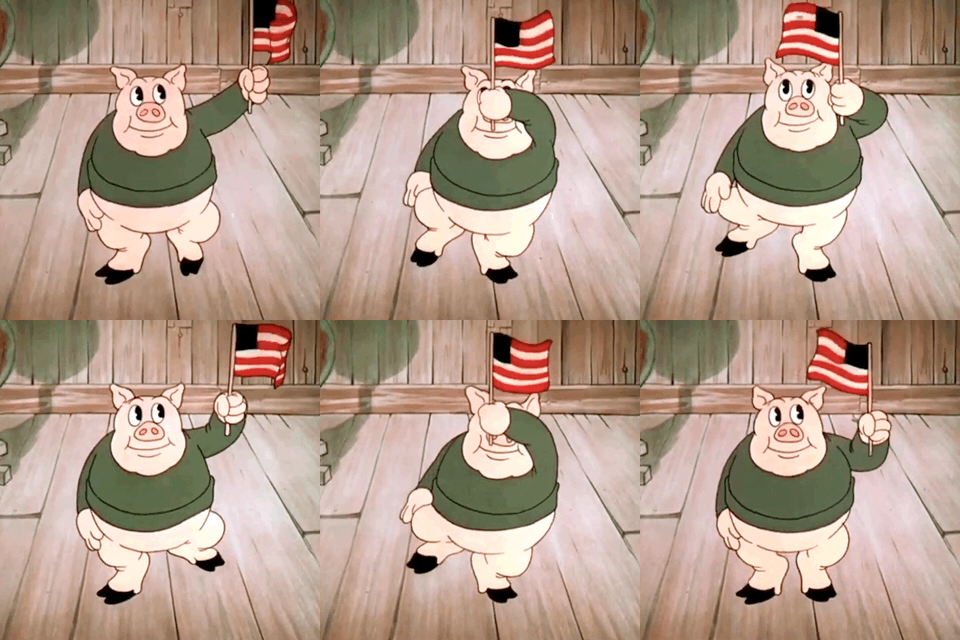
(My) blabbering aside, Porky recites the poem, exerting so much effort that he begins to sweat—wonderful animation done by Bob McKimson. Once he finishes the first stanza, he imitates a horse, complete with slapping his butt like a whip. He gives another stanza, whipping out an American flag and marching to “The Girl I Left Behind Me”. He recites some more, (even confusing poems and reciting a snippet of “The Charge of the Light Brigade”), declaring “Cannon to the right of them!” I love the little inkling of personality as he deliberately points to the left (which actually WOULD be his right), recognizing his mistake and pointing the other direction. A turtle drums on its stomach with some mallets.

“Cannon to the left of them!” another wrong direction: this scene is especially amusing because of his determined expression, so confident in his delivery. What a ham. A dog tilts a basket of lightbulbs, breaking them one by one to imitate the sound of gunshots.

Porky struggles to finish his poem, and the entire classmates whistle at him to get it over with—a reoccurring gag in the Dougherty era. The whistle plays out like a dog whistle, an army of dogs playfully licking and hopping on Porky, who walks backwards out of the scene as the children applaud. Quite an introduction! 

Miss Cud introduces “Little Kitty”, who’d serve as Beans’ love interest in the Beans cartoons. She’s obviously reluctant to go on, panicking and struggling against her parent’s arms. The parent gives her a final push as she stumbles on stage. She pauses before reciting “Mary had a little... a little... uh...” She seeks Miss Cud for help, who mouths “lamb!” and provides a picture. Kitty beams and continues “Lamb! It’s fleece was white as... white as...” 

Once more, Miss Cud displays thinly veiled frustration as she tosses cornflakes above her head to imitate snow. Berneice Hansell's delivery is great as Kitty says “cornflakes!” with such utter confidence. She corrects herself bashfully, and what continues is a very nervous, possibly the most annoying yet entertaining recitation of Mary Had a Little Lamb. It’s amusing to watch her pace around and grimace, wringing her dress. Her voice gets pitched up higher and higher, speeding up so her open is borderline incomprehensible. It’s certainly annoying and technology rather primitive, but amusing because of that. The best part is when she runs out of the school building and heads for home, her voice fading away as she’s still frantically reciting it.

Next is Ham and Ex, who sing the criminally catchy “I Haven’t Got a Hat”. Berneice Hansell's squeaky voice singing the lyrics matched with Billy Bletcher’s deep bass voice of “Bom bom bom bom” makes the perfect contrast, especially as ex sings the bass line and squats with each “bom”.

Elsewhere, Bob Clampett animates a scene of Beans and Oliver, who are both bored by the performance—Beans especially. Oliver snacks on some candy canes, to which beans eagerly extends his arms towards. Oliver tricks him into giving him a piece, stuffing it in his mouth and sticking his tongue out at the last minute. Man, what a jerk! I’d be pissed too! Especially amusing to watch Beans silently mutter obscenities are Oliver as the song continues on.

Once the song ends, Miss Cud introduces Oliver. If the introduction where he haughtily tips his hat or when he denies beans food isn’t enough of an indicator for his snobby personality, Miss Cud introduces him as “Master Oliver Owl” as a very confident musician. A great scene as Oliver grins at Beans, but remembers his rivalry. He stalks off with his nose (beak?) in the air, his peppermint ripe for the picking. Beans reaches over for it eagerly... until Oliver runs back into the scene and snatches it away, scowling.

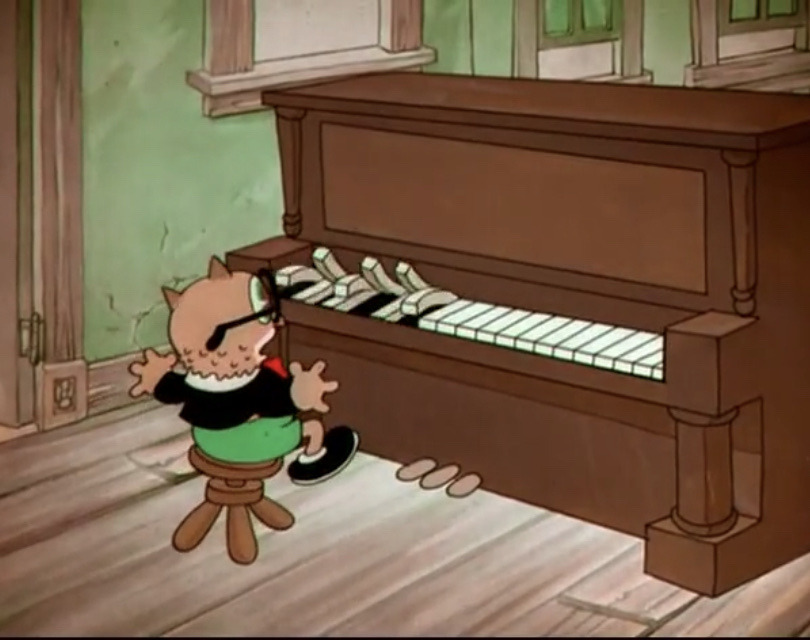
Oliver plays a standard “school kid playing piano for the class” tune. Beans isn’t impressed... until an idea hatches. He sneaks out of the classroom, where he spots a sleeping cat on a ladder right outside the window. Perfect! He opens the lid of the piano and drops the cat in, his sabotage unfolding as he spots a dog and drops it inside, too. What a little bastard! I wish they kept him that way.

At once, the keys start playing for themselves, a thunderous rendition of “Poet and Peasant Overture”. Oliver ogles in astonishment as the keys (great animation) wiggle on their own, the piano jumping up and down as the dog and cat duke it out inside. Friz’s musical timing is excellent, and Oliver’s reactions are priceless as he doesn’t even know what to do with himself. Everyone claps thunderously as he stares at the audience in astonishment.

Not one to question his unseen methods, Oliver recognizes he is receiving glory and eats it up. Unfortunately, he stops in his tracks once the piano continues to play. The dog and the cat leap out of the piano and chase each other around, Oliver’s head spinning as he attempts to keep track of the chase. He grins nervously and sweats, his performance exposed.

All the kids boo and hiss, except for Beans, who’s laughing outside the window. Oliver spots him and squirts green ink on him in retaliation. Beans falls off the ladder and lands on a bench, which throws both Beans AND a can of red paint into the window. The paint can lands right on Oliver’s head, Beans toppling next to him. They exchange bewildered looks, and their rivalry is transformed into camaraderie as they shake hands. Iris out.

Obviously, I’m pretty biased since Porky is one of my favorite characters in animation. However, I truly think this is a really good cartoon, and probably one of the best we’ve seen. The attempt to really get some personality out of these characters is absolutely there. Facial acting, body language, acting in GENERAL, it’s all there. The characters are all endearing, even Oliver. Some beautiful animation, especially the Porky scenes by Bob McKimson and the piano scene with the dog and cat. Nothing feels too drawn out—of course, Porky’s recitation is VERY long, but that’s also the point. It’ll be interesting to see how Joe Dougherty improves—maybe I just feel bad for the guy, but I think he needs some more credit. Anyway, VERY good cartoon. The song is dreadfully catchy! If anything, it’s certainly worth watching for its historical significance. Even then, it’s just an entertaining, light-hearted, fun cartoon.

Link!

390. Case of the Missing Hare (1942)

Release Date: December 12th, 1942 Series: Merrie Melodies Director: Chuck Jones Story: Tedd Pierce Animation: Ken Harris Musical Direction:...